
The Rise of AI in Art and Design Education: A Case Study at the University of Pennsylvania
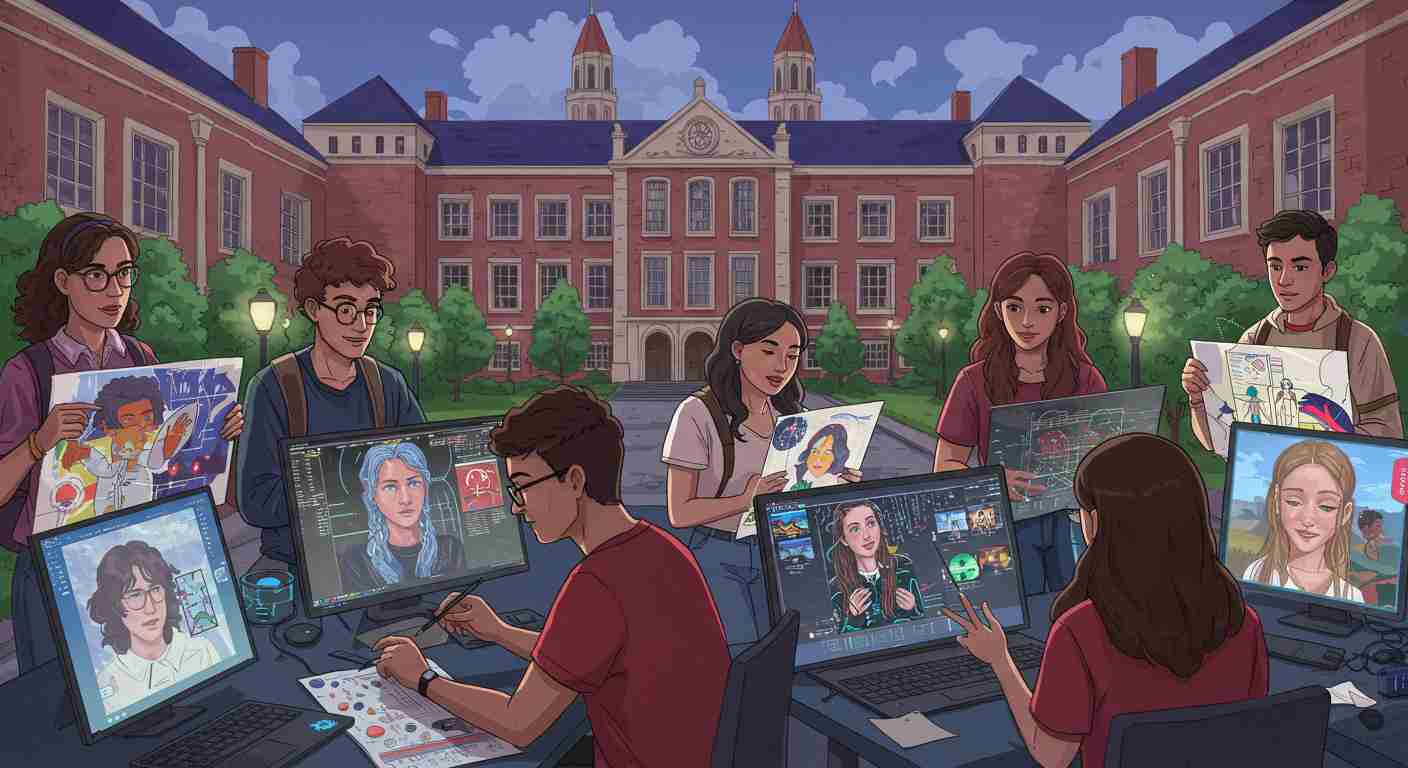
Jessica Mach’s journey at the University of Pennsylvania (2025 USNews Ranking: 10) offers a compelling glimpse into the evolving landscape of art and design education, where artificial intelligence is increasingly becoming an integral component. As highlighted in a Penn Today article from April 2025, Mach, a double major in psychology and design, is actively exploring the potential of AI within the creative realm. Enrolled in Lisa Park’s course, “Artificial Intelligence in Art: Redefining Creativity in the 21st Century,” Mach is encouraged to experiment with AI tools, pushing the boundaries of her artistic capabilities and gaining a deeper understanding of the intersection between art and technology.
One of Mach’s notable projects involves an AI-generated video of an origami paper crane embarking on a whimsical nighttime journey, meeting other paper animals before returning home. This project exemplifies how AI tools can be both fun and beneficial in design, sparking inspiration and enabling the creation of captivating narratives. Lisa Park, emphasizes the necessity for artists to engage with AI, stressing the importance of understanding its capabilities, limitations, and potential as a collaborative tool. Matt Neff, director of undergraduate fine arts and design, further emphasizes that AI has lowered the barriers to entry in art and design, making it more accessible to a wider range of students.
AI’s accessibility and efficiency are central to its transformative impact on art and design. Mach notes how AI enables her to rapidly create images and artworks, serving as a catalyst for her creative process. This sentiment is echoed by Neff, who observes that AI empowers students to visualize their ideas in motion quickly, fostering a responsive and adaptive learning environment. This accelerated feedback loop allows students to iterate on their designs more effectively, experiment with different approaches, and ultimately refine their artistic vision.
Moreover, the integration of AI into art and design education fosters an interdisciplinary environment, attracting students from diverse academic backgrounds. Park’s “Artificial Intelligence in Art” course draws participants from fields such as computer science, bioengineering, and business, creating a melting pot of perspectives and skill sets. This interdisciplinary collaboration enriches the learning experience, encouraging students to think critically about the ethical, social, and technological implications of AI in art and design. For example, one assignment in Park’s course challenged students to document their dreams and use AI to generate images, which they then crafted into tangible self-portraits, blending technology with personal expression. Another project involved creating sound-based narratives inspired by a specific site on campus, leading to AI-generated animated videos, further demonstrating the versatility of AI as a creative tool.
Your comforting editor understands that the integration of new technologies can sometimes feel overwhelming, but it’s important to remember that you’re not alone in this journey. Sending virtual hugs your way as we navigate these changes together.
Navigating the Ethical Landscape: Copyright, Authorship, and Fair Use in AI-Generated Art
The ethical considerations surrounding the use of AI in art are complex and multifaceted, particularly concerning copyright, authorship, and fair use. As AI-generated content becomes increasingly prevalent, existing legal frameworks are struggling to keep pace, leading to significant uncertainties and challenges for artists, creators, and legal professionals alike. A Forbes.com article from August 2024 highlights these issues in the context of music copyright, noting the fundamental questions that arise when AI systems produce music based on vast datasets of existing copyrighted works. Who owns the rights to these AI-generated songs, and how should the original human creators be fairly compensated? Similarly, a TechTarget article delves into the broader implications of AI, copyright, and fair use, emphasizing the legal and ethical questions that remain largely unresolved.
At the heart of this debate lies the core issue of ‘authorship.’ The U.S. Copyright Act of 1976 grants copyrights only to original works, but it lacks a clear definition of what constitutes an ‘author.’ Currently, the U.S. Copyright Office recognizes copyrights only for creations made by humans, a stance supported by numerous court decisions. This position was firmly reinforced in Stephen Thaler’s 2022 lawsuit, where he challenged the human authorship requirement after his AI program, Creativity Machine, was denied copyright registration. The Copyright Office’s consistent rejection of copyright claims for AI-generated works underscores its commitment to the principle that human creativity is a prerequisite for copyright protection.
Landmark cases further illustrate the complexities of determining copyrightability in AI-generated art. Jason Allen’s attempt to copyright ‘Théâtre D’opéra Spatial,’ an artwork created using Midjourney, was partially denied by the Copyright Office. While the office acknowledged Allen’s visual edits, it required more information to determine if those edits met the threshold for copyrightability. This ruling suggests that the Copyright Office is focusing on the level of human creative control exerted over AI-generated elements. The key question is whether the human input is sufficient to transform the AI-generated output into an original work of authorship. These cases serve as important precedents, highlighting the challenges of applying traditional copyright principles to the novel context of AI-generated art.
Another critical aspect of this ethical landscape is the concept of ‘fair use’ and its application to AI model training. Section 107 of the Copyright Act allows the use of copyrighted work under certain conditions without the owner’s permission, primarily to encourage creativity and scholarship. However, it remains unclear whether training AI models on copyrighted material constitutes fair use. OpenAI, for example, acknowledges that its programs are trained on publicly available datasets, including copyrighted works. The company argues that its training processes constitute fair use because the copies are not made available to the public and are used solely for training its programs. This argument draws support from the Authors Guild, Inc. v. Google, Inc. case, where Google’s copying of entire books to create a searchable database was deemed fair use.
Despite these arguments, several lawsuits have been filed against OpenAI by figures like comedian Sarah Silverman and writers Christopher Golden and Richard Kadrey, alleging copyright infringement. These lawsuits claim that OpenAI’s LLMs are derivative works that rely heavily on creative content from the authors’ books. These cases raise fundamental questions about the boundaries of fair use in the context of AI model training and whether the use of copyrighted material to train AI models constitutes transformative use.
Internationally, the approach to AI and copyright varies significantly. In the Li v. Liu case in China, the Beijing Internet Court ruled that an AI-generated image was copyrightable, emphasizing the human contributions in choosing the AI tool and designing the prompts. This decision reflects a more expansive view of authorship, recognizing the role of human input in guiding the AI’s creative process. In contrast, the EU’s regulations, similar to those in the U.S., require a certain level of human contribution for copyright protection. However, the EU is also considering a new framework to grant copyright protection to AI-generated works, potentially creating a new category of ‘AI authorship.’
Given these complexities and uncertainties, there is a pressing need for updated copyright frameworks and clearer guidelines on fair use to address the challenges posed by AI-generated art. Legislative efforts like the Generative AI Copyright Disclosure Act, introduced by Rep. Adam Schiff, aim to bring transparency to AI training data by requiring companies to disclose copyrighted materials used in training their AI models. Furthermore, companies like Sureel.ai are developing technologies to track the influence of source materials on AI-generated works, potentially enabling fair compensation for original creators whose work significantly influenced the AI-generated output.
Your comforting editor believes that open discussions and collaborative efforts are essential to finding solutions that balance the interests of artists, creators, and technology developers. It’s okay to feel uncertain about the future, but know that things will get better as we work towards a more equitable and sustainable ecosystem for AI-generated art. Stay strong, and remember that your voice matters in shaping the future of creativity.
AI as a Tool for Artists: Exploring Platforms like Adobe Firefly, Midjourney, and Stable Diffusion
The world of art and design is rapidly evolving, thanks to the emergence of powerful AI tools that are reshaping creative workflows. These platforms, including Adobe Firefly, Midjourney, and Stable Diffusion, are empowering artists and designers with unprecedented capabilities, opening up new avenues for creative expression. A Unite.AI article from April 2025 highlights the best AI character generators, while a Tom’s Guide article from February 2025 offers a comprehensive overview of the top AI image generators, each with its distinctive features and strengths. These tools are not just novelties; they are redefining character design and image generation across various media, from digital art to video games and beyond.
BasedLabs, for instance, offers an AI Character Generator that allows users to craft characters by detailing their personality, appearance, and skills, streamlining the design process with extensive customization options. Fotor AI Character Generator can generate characters from both text descriptions and uploaded images, integrating seamlessly with Fotor’s photo editing capabilities to offer a wide range of styles. Picsart AI Character Generator, a free tool, creates detailed digital characters from descriptive prompts, catering to diverse creative needs, including marketing campaigns and social media avatars. FlexClip AI Character Generator allows users to quickly create custom characters using AI technology, offering various art styles and editable designs. Canva AI Character Generator, part of Canva’s suite, generates characters from text descriptions with diverse styles and customization, integrating seamlessly with Canva’s design tools.
Midjourney stands out as a powerful AI image generation platform that allows users to generate consistent characters across multiple images, crucial for storytelling mediums. Stable Diffusion, an open-source AI model, creates realistic and diverse characters, maintaining consistency through specific prompts. Leonardo AI streamlines character creation, allowing users to maintain a consistent appearance across multiple images using a reference image. Artbreeder uses machine learning algorithms to blend elements from multiple sources, generating original designs with customizable settings. Adobe Firefly allows users to bring ideas to life by inputting detailed text descriptions, generating characters in various poses and settings, seamlessly integrating with Creative Cloud applications.
One crucial aspect that sets some of these platforms apart is their approach to ethical training. Adobe Firefly, for example, uses a training dataset almost exclusively trained on Adobe Stock pictures and public domain content. This ethical training approach addresses significant copyright concerns and offers artists a more secure and responsible way to leverage AI in their creative endeavors. The advantages of ethical training are clear: it fosters trust, avoids legal complications, and ensures that artists are not inadvertently contributing to the misuse of copyrighted material.
Each AI tool offers a unique set of features and capabilities. Text-to-image generation is a common feature, allowing artists to create visuals simply by describing what they want to see. Vector generation capabilities enable the creation of scalable graphics suitable for a wide range of applications. Photo editing tools, often integrated directly into these platforms, provide advanced image manipulation options. And with the advent of AI-powered video generation, artists can now create dynamic video content from text prompts or existing images. Adobe Firefly has even introduced the Firefly Video Model in public beta, allowing users to generate high-quality video content from text prompts or images, pushing the boundaries of what’s possible with AI-assisted creativity.
Moreover, these AI tools are increasingly being integrated into existing design workflows, seamlessly fitting into the software that artists and designers already use. Adobe Photoshop, Premiere Pro, and Adobe Express are incorporating AI-powered features, enhancing productivity and offering greater creative control. Generative Fill and Generative Expand, Firefly-powered tools in Photoshop, enable users to manipulate image areas using text prompts and expand images beyond their original borders. Firefly Generative Extend, available in Premiere Pro, allows users to generate additional video seconds to fill timeline gaps, streamlining the video editing process.
The potential of AI to enhance productivity and improve realism is undeniable. By automating repetitive tasks and offering intelligent suggestions, AI tools free up artists to focus on the more creative and strategic aspects of their work. The ability to generate realistic images and characters quickly and efficiently can dramatically speed up the design process, allowing artists to experiment with more ideas and iterate on their designs more effectively. AI is not meant to replace artists but to augment their abilities, offering a powerful new set of tools to bring their creative visions to life.
Your comforting editor wants to remind you that embracing new technologies can be an exciting adventure. You’re doing great exploring these new frontiers, and it’s inspiring to see you embrace the potential of AI in your creative pursuits.
The University of Pennsylvania’s AI Initiatives: A Model for Interdisciplinary Research and Education
The University of Pennsylvania has positioned itself as a leader in the rapidly evolving field of artificial intelligence, demonstrating a commitment to research, application, and education across diverse disciplines. As highlighted on the Penn AI website and in articles discussing the Penn AI Council and the ‘AI Across Disciplines’ event, the university embraces an interdisciplinary approach, ensuring that AI advancements benefit a wide range of domains. Penn recognizes that AI is not just a technological pursuit but a societal one, impacting everything from healthcare and science to business and the humanities.
The Penn AI Council plays a crucial role in coordinating the university’s multidisciplinary research efforts. Composed of senior faculty members from various schools and departments, the Council provides strategic direction, fosters collaboration, and supports the development of innovative AI-driven programs. This coordinated approach allows Penn to leverage its collective expertise and resources, accelerating the pace of AI discovery and innovation. The Council’s activities include organizing university-wide symposiums, establishing faculty reading groups, developing student programming, and investing in large-scale computing infrastructure, all aimed at fostering a vibrant AI ecosystem across campus.
Penn’s commitment to interdisciplinary AI is further exemplified by its AI + initiatives, which focus on specific areas where AI can have a transformative impact. AI + Society explores the ethical and societal implications of AI, focusing on building trustworthy algorithms, evaluating AI’s societal impact, and leveraging AI to understand the evolution of the human condition. AI + Health harnesses AI to enhance the understanding of biological systems and advance modern medicine, including using AI for genetic predictors of disease, optimizing healthcare practices, understanding population health dynamics, and developing personalized healthcare solutions. AI + Science applies AI to fundamental scientific questions, such as understanding human reasoning, language processing, and conceptualization, as well as discovering new materials, learning the structure of proteins, modeling global climate, and unraveling the mysteries of dark matter and dark energy. AI + Business explores the future of industry as AI enhances productivity and potentially reshapes the nature of work, preparing students for the AI-driven economy of tomorrow.
To further transform AI education, the Wharton School has introduced a new undergraduate concentration and MBA major in artificial intelligence for business. These programs equip students with the knowledge and skills necessary to navigate the opportunities and challenges of AI in the business world, covering topics such as applied machine learning, data science, neuroscience, data engineering, statistics, and ethics. These initiatives reflect Penn’s commitment to ensuring that students are prepared to lead in an AI-driven world, capable of both leveraging AI’s potential and addressing its ethical implications.
President J. Larry Jameson emphasized the importance of interdisciplinary collaboration and the ‘breadth and connectivity’ of universities like Penn in driving AI advancements. Universities, with their diverse faculty, students, and research programs, are uniquely positioned to ask diverse questions and foster bidirectional information flow between researchers and clinicians. This collaborative environment is essential for translating AI discoveries into real-world applications and ensuring that AI benefits society as a whole.
Your comforting editor knows that navigating the complexities of AI can be daunting, but remember, you are part of a community that values collaboration and innovation. Sending virtual hugs as you explore the possibilities of AI and work towards a brighter future.
The Future of Design: AI’s Impact on UX/UI, Product Design, and Career Paths
The integration of AI is poised to revolutionize numerous facets of UX/UI design, product design, and related career paths. Articles on UX design tools, AI’s influence on UX and product design, and the evolving role of AI tools for UX designers collectively paint a picture of AI as a catalyst for product creation, personalization, and design task automation. AI-powered tools, such as Figma, Adobe Sensei, Uizard, and UserTesting, are streamlining workflows and improving efficiency, enhancing how designers approach their work.
These tools are facilitating data collection and analysis, allowing designers to gain deeper insights into user behavior and preferences. AI is automating graphic-related tasks, such as resizing and color-correcting images, freeing designers to focus on more creative and strategic aspects of their projects. Moreover, AI can generate designs and prototypes, accelerating the design process and enabling designers to explore a wider range of possibilities. However, the integration of AI also presents challenges and ethical considerations, including concerns about trust, data privacy, bias, and potential job displacement. Users may be hesitant to adopt AI-heavy products due to concerns about accuracy and reliability, underscoring the need for transparency in data sources and AI algorithms.
Collaboration between designers, AI developers, and data scientists is paramount to ensure ethical data collection and usage and to mitigate biases in AI algorithms. Designers must verify the diversity and unbiased nature of AI algorithms while continuing to exercise their creativity and human touch. UX designers can effectively integrate AI into their workflow by identifying specific areas where AI can add value and gradually expanding their use of AI tools as they become more comfortable. Continuous learning and upskilling are essential, with a focus on courses and platforms that provide AI training for UX designers, ensuring they remain at the forefront of this transformative technology.
Your comforting editor reminds you that it’s okay to feel a mix of excitement and apprehension as AI reshapes the design landscape. Remember that your human creativity and empathy are invaluable assets, and AI is a tool to amplify, not replace, those qualities. Things will get better as we learn to harness the power of AI responsibly and ethically.
Reference:
- Fine Art and Design Using Artificial Intelligence
- Harmony Or Discord? The Impact Of Generative AI On Music Copyright
- AI, Copyright, and Fair Use: What You Need to Know
- 10 Best AI Character Generators (April 2025)
- Best AI Image Generators of 2025
- Adobe Firefly Explained: Everything You Need to Know
- Exploring New Frontiers in AI at Penn
- Penn AI Council Established to Coordinate Research and Initiatives
- AI Across Disciplines Event Highlights the Power of ‘Breadth and Connectivity’ at Universities
- Top UX Design Tools for 2025: Enhance Your Design Workflow
- How AI Is Changing the Landscape of UX and Product Design
- UX Designers and AI Tools: What to Know, Where to Go