
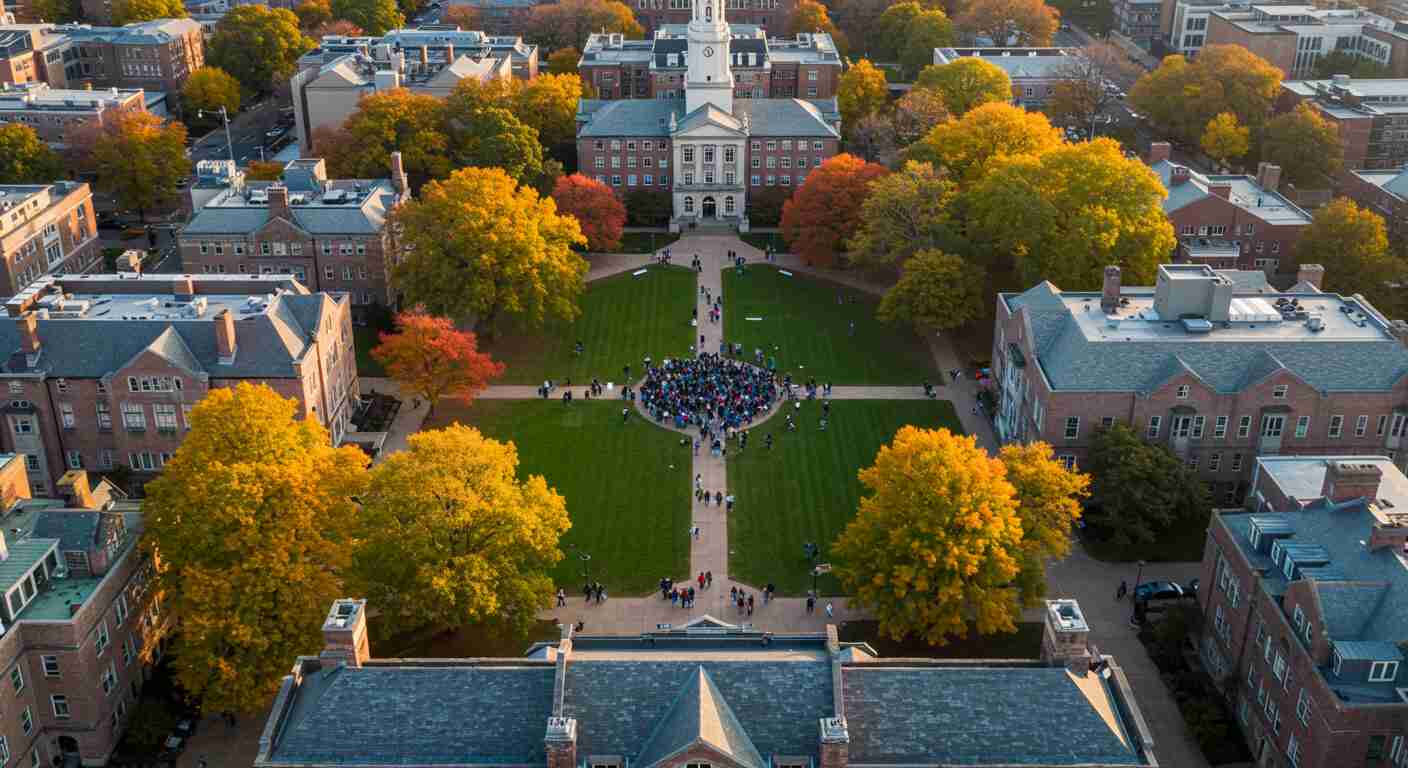
Brown University is best known among applicants for its Open Curriculum: there are no general education or distribution requirements, and students build their own course of study around a concentration. Every fall the idea is introduced to new students in the first days on campus; at New Student Orientation in 2025, when Brown welcomed more than 3,200 new undergraduate, graduate and medical students, Dean of the College Ethan Pollock and Brown Arts Institute director Sydney Skybetter gave a talk on the Open Curriculum before the university’s 262nd Opening Convocation on September 2 (Brown University, September 2, 2025). This guide explains how the Open Curriculum works and what it means for applicants, including international students, as of November 2026.
What “open” means
Brown describes the Open Curriculum as offering “the flexibility to complete coursework in a variety of fields of study, without general core requirements.” Instead of a list of required subjects, students are encouraged to spread their courses across fields while choosing a focus (Brown University, The College: Explore the Open Curriculum). To graduate, a student must:
- complete at least 30 courses;
- fulfill the requirements of at least one concentration (Brown’s word for a major; there are nearly 80);
- demonstrate writing competence; and
- be enrolled for the equivalent of eight full-time semesters.
The writing requirement is the closest thing to a universal course requirement. Students must work on their writing at least twice, once in the first half of their studies and once in the second, typically through writing-designated (WRIT) courses or approved English, literary arts or comparative literature courses; part of it must be completed at Brown in the first two years (Brown University, Degree Requirements).
Grading and course selection
- Satisfactory/No Credit. Students can take most courses for a letter grade or S/NC, except courses an instructor designates as mandatory S/NC. Brown uses a grading system “without grade point averages or class rankings,” and students may request narrative evaluations from instructors (Brown, The College).
- Shopping period. Brown offers nearly 2,000 courses in 45 departments. Students preregister, then can change their schedules during the first two weeks of each term, when materials for most courses are available in Canvas. Brown calls the initial schedule “a plan, not a contract” (Brown, Course Selection).
- First-year seminars. First-year students are strongly encouraged to take a First-Year Seminar, a small course that introduces a field, or a Race, Power, and Privilege course.
- Beyond Brown’s catalog. Students can also take courses at the Rhode Island School of Design, study abroad, and propose independent studies or design an independent concentration (Brown, The College). For how independent concentrations work and similar options at other universities, see our guide to self-designed majors.
Advising matters more, not less
Without requirements to steer course choices, Brown leans on advising. The College calls its Advising Partnership “a necessary complement to the Brown curriculum” (Brown, The College). New students are paired with advisors and have access to academic deans, and they declare a concentration later in their studies after exploring. Students who do well with the Open Curriculum tend to use the first two years deliberately: trying unfamiliar fields, taking at least one small seminar each term, and checking early which introductory courses a likely concentration requires.
Some concentrations, especially in engineering, the sciences and economics, have long prerequisite chains, so “open” does not mean every path can be started late. Students considering those fields should take the introductory sequence in the first year.
Is the Open Curriculum right for you?
- Good fit: students with several interests who want to combine them, students who want to take risks outside their concentration (S/NC helps), and students who are comfortable planning their own education with advisors.
- Harder fit: students who want a structured, prescribed sequence, or who will rely on a GPA for later applications. Because Brown does not compute a GPA, graduate schools and employers read the transcript and recommendations instead.
- In your application: the “Why Brown” part of the application is where to show that you understand the Open Curriculum and have ideas about how you would use it.
For international applicants
- Need-blind admission. Starting with first-year applicants entering in fall 2025, Brown is need-blind for international undergraduates and meets full demonstrated need for those admitted, provided they apply for financial aid when they apply for admission. Transfer and Resumed Undergraduate Education applicants remain need-aware (Brown Undergraduate Financial Aid).
- Testing. Brown has required SAT or ACT scores again since the 2024–25 admission cycle (Brown Admission Counselor Newsletter).
- Cost. Brown estimates the 2026–27 cost of attendance for a first-year undergraduate at $99,994, including tuition of $74,568 (Brown Office of Financial Aid).
- Rankings. Brown is No. 16 among national universities in the 2027 U.S. News Best Colleges rankings and No. 66 in the QS World University Rankings 2027 (Forward Pathway school page).
- STEM OPT. If you plan to work in the U.S. after graduation, check whether your intended concentration is classified under a STEM-designated CIP code, since that decides eligibility for the 24-month STEM OPT extension.
References
- Brown University: First week of fall 2025 (September 2, 2025)
- Brown University, The College: Explore the Open Curriculum
- Brown University, The College: Course Selection
- Brown University, The College: Degree Requirements
- Brown Undergraduate Financial Aid: Need-blind admission
- Brown Office of Financial Aid: Cost of attendance
- Forward Pathway: Brown University