
Every U.S. university runs a set of student support offices: tutoring and writing centers, counseling services, and a disability office that arranges exam and classroom accommodations. They are usually included in tuition and fees, but students have to find and use them themselves, and many international students only discover them after a hard semester. This guide explains, as of November 2026, what each kind of support does, how the accommodation process works, and what international students on F-1 visas should know, using George Washington University and Purdue University as examples.
Academic Support: Tutoring, Writing Centers and Libraries
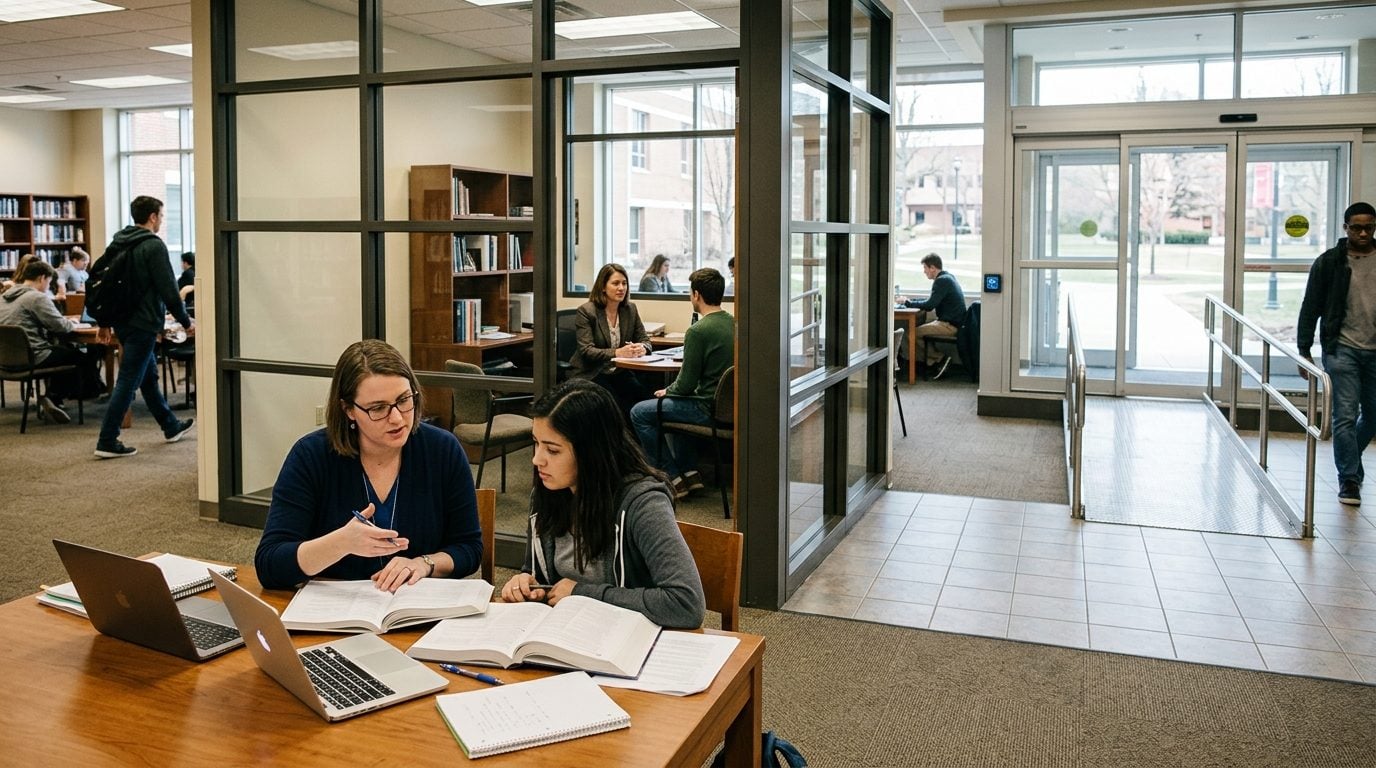
Most universities offer free academic help outside class. The typical services are:
- Tutoring and course reviews for large introductory courses, often run by trained student tutors.
- A writing center where you can bring an essay, lab report or application at any stage, from outline to final draft.
- Library research help, study spaces and longer opening hours at the end of the term.
- An academic advising or student success office that handles academic policies, probation and special programs.
George Washington University’s finals-week guide for spring 2025 is a good example of how these fit together. It pointed undergraduates to the Academic Commons for tutoring, course reviews and help finding study spaces; to short time-management videos made by GW students; to the Office for Student Success; to the Writing Center, part of the University Writing Program, which offers free one-on-one sessions with peer consultants at every stage of the writing process; and to library services, including extended hours at Gelman and Eckles libraries (GW Today, April 29, 2025).
For international students, the writing center is often the most useful of these. Consultants do not edit your paper for you, but they can show you how U.S. instructors expect an argument to be organized and how to cite sources, which helps avoid the academic integrity problems that catch many new students. Book early in the term: appointments fill up before midterms and finals.
Counseling and Mental Health
University counseling centers offer short-term counseling, group sessions, crisis support and referrals, usually at no extra charge for enrolled students. At GW, for example, the spring 2025 finals guide listed same-day in-person visits at the Student Health Center from noon to 4 p.m. on weekdays, virtual sessions booked by phone in the same hours, a counselor line available 24 hours a day, and free round-the-clock telehealth through TimelyCare by app or web (GW Today). Many schools add lighter stress-relief events at the end of term; GW’s included free group fitness classes and a petting zoo in G Street Park.
In a crisis anywhere in the United States, you can call or text 988 to reach the 988 Suicide & Crisis Lifeline (988 Lifeline). For how campus counseling works, confidentiality, and what international students should know about cost and insurance, see our guide to mental health support for college students.
Disability Services and Accommodations
What the law requires
Colleges that receive federal funding are covered by Section 504 of the Rehabilitation Act. Its regulation requires them to modify academic requirements where needed so that they do not discriminate against qualified students with disabilities, for example by allowing more time to finish a degree, substituting a required course, or adapting how a course is taught. Exams must measure what a student has learned rather than an impaired sensory, manual or speaking skill, and schools must provide auxiliary aids such as interpreters, readers in libraries, recorded texts or adapted equipment. Requirements that the school can show are essential to the program, or to a related licensing requirement, do not have to be changed, and schools do not have to provide personal attendants, individually prescribed devices or other services of a personal nature (34 CFR 104.44).
The biggest difference from high school is that the college does not come looking for you. There is no individualized education program; you have to contact the disability office yourself, provide documentation, and request accommodations, normally every term.
How the process works
The steps are broadly similar at most schools:
- Register with the disability office. At GW, new students apply for academic or housing accommodations through Disability Support Services’ online application, and can first join a short virtual drop-in meeting (Mondays and Wednesdays, 1–3 p.m. Eastern) to work out next steps (GW Disability Support Services).
- Provide documentation and meet a specialist. At Purdue, students meet an access consultant at the Disability Resource Center, who determines their reasonable accommodations (Purdue Student Success, January 2025).
- Send accommodation letters to instructors each term. GW students request letters through the DSS portal; Purdue students send course accommodation letters to their instructors.
- Schedule accommodated exams in advance. Instructors either arrange accommodations themselves or use the university testing center. GW runs test proctoring from its Testing Center in Rome Hall; GW DSS also covers assistive technology, alternative formats, classroom and housing access, interpreting and captioning, and guidance on service and emotional support animals.
Demand for these services has grown quickly. Purdue Testing Services handled 2,627 accommodated exams on the West Lafayette campus during fall 2024 finals week, and the Disability Resource Center in Indianapolis another 116. Over the whole fall 2024 semester the office handled more than 10,000 accommodated exams, and finals volume was 16% higher than a year earlier. Its director said the office used to handle about 600 exams in a finals week and now handles about that many in an ordinary week (Purdue Student Success). Because testing centers are busy at the end of term, register early and book exam slots as soon as your instructor allows.
What International Students Should Know
- Disability services are not only for U.S. citizens. Section 504 defines a qualified postsecondary student by the school’s academic and technical standards, not by citizenship (34 CFR 104.3). Ask the disability office early what documentation it accepts and whether reports from your home country must be translated or updated.
- A medical reduced course load protects your F-1 status. F-1 students must normally study full time. If an illness or medical condition makes that impossible, the international office can authorize a medical reduced course load, which federal rules cap at 12 months in total at each program level (8 CFR 214.2(f)(6)(iii)). Get approval before dropping classes. At the University of Washington, for example, the letter must come from a licensed medical doctor, psychiatrist, doctor of osteopathy, licensed psychologist or clinical psychologist, you do not have to disclose your diagnosis, approval is given one term at a time, and you receive a new I-20 (UW International Student Services). At some schools the disability office handles this request together with the international office.
- Language support is usually separate. English-language help, such as ESL writing courses or conversation programs, is generally run by the writing center or an English language institute, not the disability office.
A Short Checklist for Your First Semester
- Save the counseling center’s after-hours number and 988 in your phone.
- Find your school’s writing center and tutoring schedule in the first two weeks.
- If you have a diagnosed condition, register with the disability office before classes start; accommodations generally apply from the time they are approved, not to exams already taken.
- Send accommodation letters to every instructor at the start of each term and book accommodated exams early.
- Talk to your international student adviser before dropping below full time for any reason.
For school-by-school data on admissions, cost and international enrollment, see our profiles of George Washington University and Purdue University.
References
- GW Today: Spring 2025 Final Exam Period Resources (April 29, 2025)
- George Washington University: Disability Support Services
- Purdue University: Purdue Testing Services facilitates record number of accommodated exams during finals week (January 2025)
- 34 CFR 104.44: Academic adjustments (Section 504 regulation)
- 34 CFR 104.3: Definitions (Section 504 regulation)
- 8 CFR 214.2(f): F-1 students, including reduced course load
- University of Washington International Student Services: Medical Reduced Course Load
- 988 Suicide & Crisis Lifeline
- Forward Pathway: Mental Health Support for College Students