
Hospital volunteering is one of the few ways a high school student can see healthcare from the inside before college. Teen volunteer programs at U.S. hospitals place students at information desks, in patient transport and in clinical departments, usually over the summer. This guide explains what these programs involve, what hospitals require, how to apply for the summer 2027 cycle, and how the experience fits into a later pre-health path. It uses UConn Health’s 2025 summer program as a worked example.
Example: UConn Health’s summer student volunteers
In summer 2025, the Office of Patient Experience at UConn Health, the academic medical center of the University of Connecticut in Farmington, Connecticut, ran an eight-week Summer Student Volunteer Program for students aged 14 to 17. It received more than 130 applications and placed 65 students (UConn Today, August 27, 2025). Volunteers worked at the Guest Services Desk, in the Office of Patient Experience and in the Neurology and Neurosurgery departments. Their tasks included:
- wayfinding and escorting patients to appointments;
- delivering flowers and stocking supplies;
- helping clinical staff meet basic patient needs and assisting with appointments and visits;
- administrative work such as filing and scanning.
One volunteer, an Avon High School senior, split her time between patient experience and Neurology, where she observed a physician’s encounter with a patient who had had a transient ischemic attack (a “mini stroke”). Another, a 10th grader, did administrative support in Neurosurgery, handling records under HIPAA retention rules. UConn said information on the next year’s program would be posted in March (UConn Today).
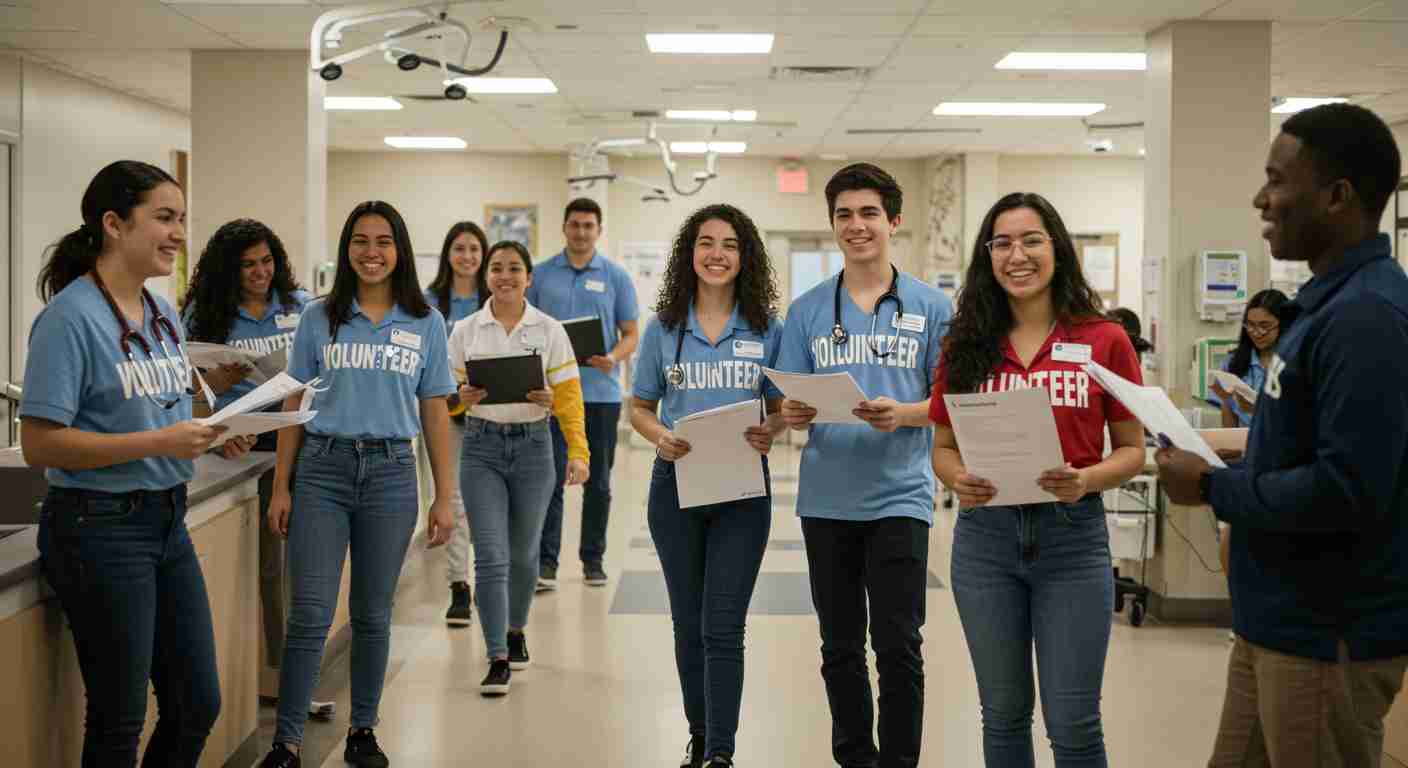
The example shows what to expect: teen volunteers do non-clinical work, but in a clinical setting, and some placements let them observe how departments run.
What teen hospital volunteers actually do
Most roles fall into a few groups:
- Wayfinding and escort. Large medical centers are hard to navigate. At NYU Langone Health, Dr. JohnRoss Rizzo, director of disability inclusion, has said 80 to 90 percent of patients need some directional help when entering a large health system and 40 to 50 percent get lost, which is “directly correlated with missed or late appointments.” NYU Langone’s “I’ll Walk with You” program had accompanied more than 3,000 patients by February 2025; its volunteers include college students and retirees (NYU Langone Health, February 14, 2025).
- Patient transport and discharge. Helping staff move patients by wheelchair for discharges and transfers.
- Unit and clinic support. Stocking supplies, delivering mail, flowers or newspapers, and clerical work in a department.
- Front desk and guest services. Greeting visitors and answering questions.
Teen volunteers do not provide medical care. Hands-on patient care, and more structured shadowing of physicians, generally come later, in college.
Typical requirements
Every hospital sets its own rules, but the two University of California programs below are representative of large academic medical centers:
| UCLA Health Volunteen (Westwood) | UC Davis Health VolunTEEN | |
|---|---|---|
| Minimum age | 16 by June 1 | 16 by June 15 (2026 program) |
| Time commitment | At least 50 hours by August 31 | 8-week program (June 15 to August 7, 2026), at least 6 weeks, one or two 4-hour shifts a week |
| Health records | Proof of varicella, MMR and TB screening; recent COVID vaccine or a signed declination | Two MMR and two varicella doses (or positive titers), Tdap, and TB screening (two skin tests or one QuantiFERON blood test) |
| Process | Mandatory Zoom information session, online application, one mandatory in-person orientation | Online application, first come, first served by completion date |
| Example roles | Patient transport, wayfinding, floater (mail and newspapers) | Patient transportation, radiology, ENT/internal medicine, neuroscience and epilepsy monitoring, discharge |
| Timing | Summer 2027 information to be posted January 1, 2027 | 2026 applications had to be complete by May 4, 2026 |
Sources: UCLA Health Volunteer Services; UC Davis Health VolunTEEN Summer Program.
Some hospitals take younger students; UConn Health’s 2025 program accepted 14-year-olds. Others require 16 or 17 for patient-facing units. Expect to provide a photo ID, immunization records and sometimes a parent’s consent, and to attend an orientation you cannot miss.
How to apply for summer 2027
- Make a shortlist in December and January. Look at the volunteer services pages of nearby hospitals, academic medical centers and children’s hospitals. Summer programs often post details in winter and fill in spring.
- Get your health records early. TB tests have timing rules (UC Davis wants results within the last three months), and catching up on vaccines can take weeks.
- Apply as soon as the window opens. Programs with limited spots may fill on a first-come basis, as UC Davis’s does.
- Plan for the commitment. Count the minimum hours, shift lengths and transport. Hospitals take reliability seriously; missing orientation or shifts can end your placement.
- Keep a log. Record dates, hours, department and a supervisor’s name. You will need these for college applications and, later, for any pre-health application.
How it fits into a pre-health path
Hospital volunteering in high school does not count toward medical school requirements, but it is a useful early test of whether you like the environment. When you reach medical school applications, schools look for evidence of the AAMC’s premed competencies, which include service orientation and empathy and compassion (AAMC, Premed Competencies). Those are demonstrated through sustained clinical and service experience in college, so treat high school volunteering as a start, not a box to tick.
On college applications, a hospital role belongs in the activities section with hours per week and weeks per year. What you learned, for example from observing a neurology clinic or helping lost patients, is more informative than the total hours.
For international students
- International students already at a U.S. high school can apply to most teen programs on the same terms, but check whether the hospital asks for documents you may not have, such as a U.S. immunization record; bring translated records from home if needed.
- Students applying from abroad can look for comparable volunteer roles at hospitals, clinics or eldercare homes in their own country and describe them the same way on the Common App.
- If you are aiming for a U.S. medical degree, know early that U.S. medical schools admit few international applicants; see our guide From Virginia Tech to Vanderbilt Medicine: What International Applicants Should Know.
References
- UConn Today: High School Students Gain Hands-On Experience Through UConn Health’s Summer Volunteer Program (August 27, 2025)
- NYU Langone Health: “I’ll Walk with You” program (February 14, 2025)
- UCLA Health: High School Students (Volunteen Summer Program)
- UC Davis Health: VolunTEEN Summer Program
- AAMC: The Premed Competencies (2023 update)