
Many U.S. engineering schools let students design and build real products long before graduation. A well-known example is the Learning Factory at Penn State, which describes itself as “the maker space for Penn State’s College of Engineering.” It runs the college’s industry-sponsored capstone design projects and gives students access to fabrication equipment for class, club and personal projects (Penn State Learning Factory). This guide explains how it works and what prospective engineering students, including international students, can take from it when comparing universities.
What the Learning Factory Offers
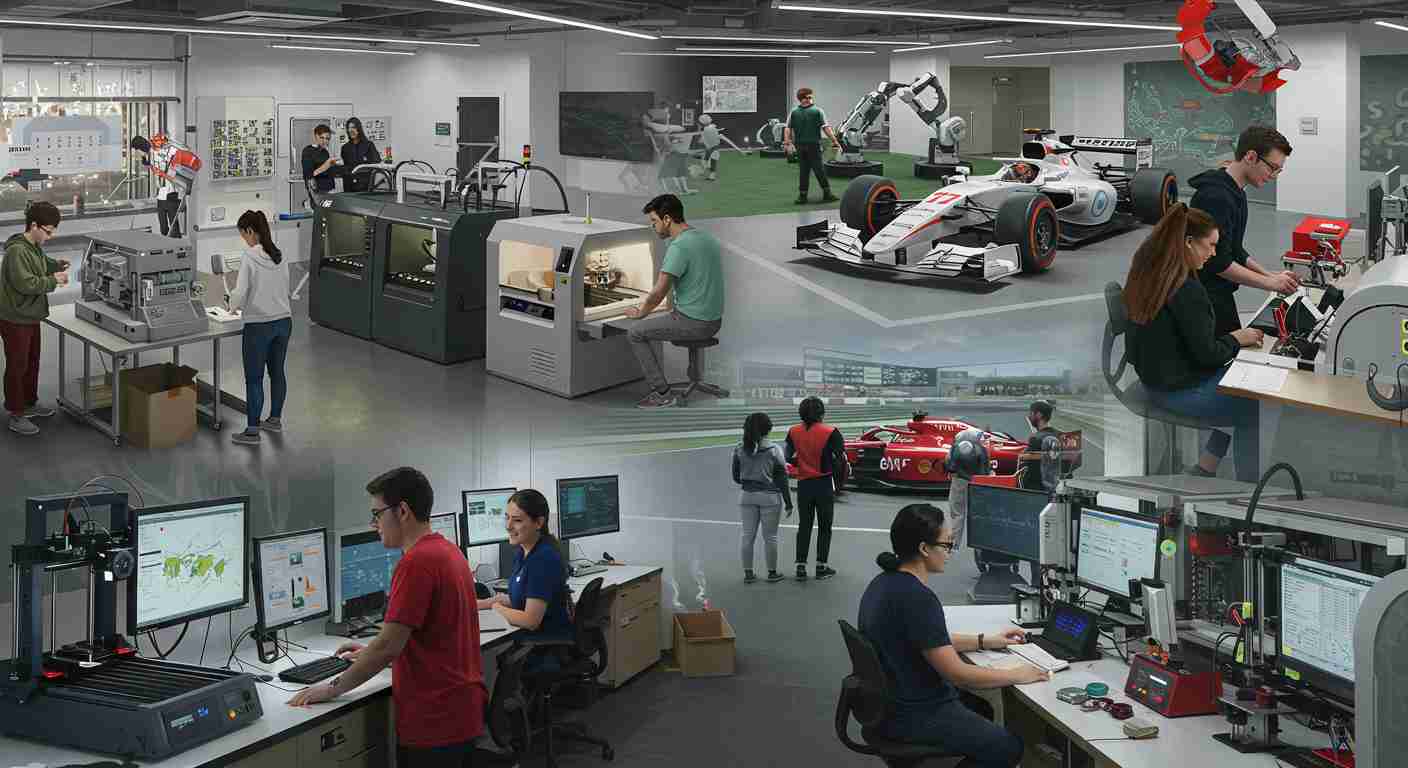
The Learning Factory is based on the fourth floor of the Engineering Design and Innovation Building at University Park. It is open to the Penn State community, not only engineering majors, and every piece of equipment requires Basic Safety Training before use; more advanced machines require additional training levels (Learning Factory Equipment). Its equipment list includes:
- 3D printing: Prusa and Bambu Lab printers, a Formlabs Form 4 resin printer, Markforged Metal X and X7 printers and a Stratasys J55.
- Cutting and machining: Epilog laser cutters and a fiber metal engraver, CNC lathes and mills, and an OMAX abrasive waterjet.
- Shops: a metal shop (band saw, presses, tube bender, hardness tester), a wood shop with a CNC router, and textile equipment such as an embroidery machine and a sublimation printer.
- Electronics: power supplies, oscilloscopes and soldering stations for electrical engineering and Internet of Things projects.
Each fall the Learning Factory holds an “Open House Closed Shop” event, a club-fair-style evening where student organizations that work in the space show their projects to the rest of campus. In 2025 it was held on October 16 (Penn State News, October 8, 2025).
Industry-Sponsored Capstone Projects
The Learning Factory’s best-known role is the senior capstone, in which teams of engineering students solve real design problems for outside clients. How it works, according to the sponsor information page (Sponsor a Project):
- Each project is done by a team of typically four to six students over one 15-week semester, roughly 400 person-hours of work.
- A sponsor makes a $4,000 donation to the College of Engineering; up to $1,250 goes to the team for supplies and travel. The sponsor’s liaison attends a kickoff in the second week and the design showcase in the last week.
- Prototypes become the sponsor’s property, subject to Penn State policy. Some projects involve extra intellectual-property or confidentiality terms.
Since its inception the Learning Factory has facilitated more than 2,000 projects for more than 575 sponsors, involving more than 10,000 engineering students at University Park, and its end-of-semester showcase has run for 28 years (Learning Factory Showcase, Fall 2025). First-year students in the EDSGN 100 cornerstone design course also present at the showcase.
The fall 2025 showcase took place on December 11, 2025, at the Bryce Jordan Center, with an online showcase running through December 19. Sponsors of winning projects included the Aluminum Association, the Naval Surface Warfare Center Dahlgren Division, Northrop Grumman, Seco Tools and Walmart; projects ranged from a tolerance calculator for aluminum extrusions and an end-of-arm tool for handling naval projectiles to a device that helps people zip a winter coat (Penn State Engineering News, January 29, 2026).
Why Hands-On Projects Matter When You Choose a School
Senior design looks very different from one university to another. When you compare engineering programs, ask:
- Who sponsors the capstone? Real companies and government labs give you a client, a budget and a deliverable you can discuss in interviews. Look for a published list of sponsors or past showcase projects.
- Is there a first-year design course? Programs like Penn State’s cornerstone course get students building in their first semester rather than waiting until senior year.
- Who can use the makerspace, and when? Check hours, training requirements, whether students from other majors can use it, and whether material costs are covered.
- Which clubs use it? Competition teams and student engineering societies are often where students get the most fabrication experience.
Notes for International Students
- Coursework, not employment. A capstone done as part of a required course is part of your degree program. Working off campus for a sponsor outside the course is different and would require work authorization such as Curricular Practical Training; ask your international student office before you accept any paid or off-campus role.
- Export-controlled or defense projects. Some sponsors, especially defense contractors, may limit which students can work on a project. If a project interests you, ask early whether there are citizenship restrictions.
- Costs and enrollment. According to IPEDS, Penn State University Park’s 2025–26 tuition and fees were $20,644 for Pennsylvania residents and $41,790 for nonresidents, with room and board of about $14,474; tuition can differ by major and class standing, so check Penn State’s official tuition tables. IPEDS counted about 7,539 international students at University Park in fall 2025, including 3,989 undergraduates.
- Ranking. Penn State is ranked No. 55 among national universities in the 2027 U.S. News rankings. More data is on the Forward Pathway Penn State page.
References
- Penn State Learning Factory
- Learning Factory: Equipment
- Learning Factory: Sponsor a Project
- Learning Factory Showcase, Fall 2025 archive
- Penn State News: Learning Factory to host Open House Closed Shop Event (October 8, 2025)
- Penn State Engineering News: Learning Factory announces fall 2025 showcase winners (January 29, 2026)
- Forward Pathway: The Pennsylvania State University