
Four public universities announced new master’s programs in November 2026: an online accounting degree at the University of Maryland, an entrepreneurship degree at UNC Charlotte, a sustainability planning degree at UT Dallas and a library and information studies degree at the University of Arkansas. For international applicants, the two questions that matter most are whether the program’s classification code is on the Department of Homeland Security’s STEM list, which decides eligibility for a 24-month STEM OPT extension, and whether the program is fully online, which rules out F-1 status. Of the four, only UT Dallas’s program is listed as STEM by its college, and that listing is still marked “Coming Soon.”
The code matters more than the program name. U.S. Department of Education data show that the number of international students earning master’s degrees under the accounting code, which is not on the STEM list, fell from 4,000 in 2016 to 509 in 2025. Over the same years, international master’s graduates in all fields rose about 54%.
Key takeaways
- STEM OPT eligibility depends on the six-digit CIP code on a student’s Form I-20, not on the program title. Accounting (52.0301), entrepreneurship (52.0701) and general business administration (52.0201) are not on the DHS STEM list; business analytics (30.7102), sustainability studies (30.3301) and information science (11.0401) are.
- UNC Charlotte’s new M.S. in Entrepreneurship is filed under CIP 52.0701, so international graduates would get 12 months of OPT with no STEM extension.
- Maryland’s Smith School labels its in-person M.S. in Accounting a “STEM-Designated Program.” The new online version carries no such label, and a fully online program cannot support F-1 status.
- International master’s graduates under the accounting code fell from 4,000 in 2016 to 509 in 2025, and their share of all accounting master’s graduates dropped from 20.2% to 4.4%.
- A proposed ICE rule would charge schools $70,000 for a student’s first OPT recommendation and $30,000 for each later one, including STEM OPT extensions. As of Nov. 17, 2026, it has not been finalized.
What the four new master’s programs are
University of Maryland-College Park: Online Master of Science in Accounting. The Robert H. Smith School of Business said on Nov. 11, 2026, that the program starts in fall 2027. It is a 30-credit, three-semester (16-month) online program aimed at early- to mid-career working professionals and recent graduates. It has two tracks: a CPA Foundations Track for students from non-accounting backgrounds and an Advanced Accounting and Analytics Track for students who already have an accounting foundation (Smith School announcement). On the school’s business master’s overview page, the in-person M.S. in Accounting is labeled “STEM-Designated Program.” The online version is not.
University of North Carolina at Charlotte: M.S. in Entrepreneurship. On Nov. 10, 2026, the university announced the RA Session II School of Entrepreneurship and Innovation in the Belk College of Business. Its first offerings include a one-year Master of Science in Entrepreneurship that pairs classes with mentoring and incubator space (UNC Charlotte announcement). The announcement does not mention credits or STEM status. The university’s request to establish the program, filed with the UNC System, gives the code as 52.0701 (Entrepreneurship/Entrepreneurial Studies). It lists delivery as 100% at the Dubois Center in uptown Charlotte and fall 2026 as the first enrollment term.
The University of Texas at Dallas: M.S. in Sustainability Planning and Policy. The 30-credit degree from the School of Economic, Political and Policy Sciences (EPPS) includes courses in geographic information systems, remote sensing, urban planning and environmental economics. The fall application deadline is May 1, and the school does not yet offer a fast-track route from the bachelor’s degree (2026 graduate catalog; The UTD Mercury, Nov. 10, 2026). The program page says the master’s was coming in fall 2026, so students who start in fall 2027 would be the second cohort. The same page notes that online courses are available. EPPS’s STEM degrees page lists the program as STEM but marks it “Coming Soon.”
University of Arkansas: Master of Library and Information Studies. The University of Arkansas Libraries will run this 36-credit program, which is designed to take about two years. Students choose a thesis or a capstone project. Applicants with a bachelor’s degree in any discipline may apply. They need a 3.0 GPA overall or for their last 60 hours of coursework, and the GRE is not required. Applications are due March 1, 2027 (University of Arkansas announcement). The announcement does not state the delivery format or the program’s CIP code.
How to tell if a master’s program qualifies for STEM OPT
The Department of Homeland Security’s STEM Designated Degree Program List (last updated July 22, 2024) uses the Education Department’s Classification of Instructional Programs (CIP) codes. Four broad families qualify in full: engineering, biological sciences, mathematics and statistics, and physical sciences. Everything else qualifies only by specific six-digit code. In the business family (52), only four codes are on the list: management science (52.1301), business statistics (52.1302), actuarial science (52.1304) and other management science and quantitative methods (52.1399). Accounting, entrepreneurship and business administration are not. Sustainability studies (30.3301) and information science (11.0401) are on the list. No code in the library science family (25) is.
Under federal regulations at 8 CFR 214.2(f)(10)(ii)(C), a school official can recommend a STEM OPT extension only if the student’s degree is in a field on the list in effect at the time, and the employer must use E-Verify. UT Dallas’s international student office puts it plainly: the CIP code on page 1 of the I-20 “must appear on the list of designated majors.” Two programs with the same name, such as two accounting master’s degrees, can therefore have different OPT outcomes depending on the code each school reports.
Can international students enroll in an online master’s program?
Not on an F-1 visa. Under 8 CFR 214.2(f)(6)(i)(G), an F-1 student can count no more than one online class, or 3 credits, per term toward a full course of study. A program delivered entirely online, with no on-campus attendance, cannot meet the full-time requirement, so it cannot support F-1 status or lead to OPT. Maryland’s online accounting degree is aimed at working professionals and recent graduates. International students who want to study in the United States and then work there should look at the in-person version.
| School and program | Credits / length | Format | CIP code | On the DHS STEM list? | Prior master’s graduates in this field at the school (2025) |
|---|---|---|---|---|---|
| University of Maryland-College Park, Online M.S. in Accounting | 30 credits, 16 months | Online | Not published | Not labeled STEM (in-person version is) | 0 under the accounting code (in-person program now reports under another code) |
| UNC Charlotte, M.S. in Entrepreneurship | One year | In person | 52.0701 | No | None |
| UT Dallas, M.S. in Sustainability Planning and Policy | 30 credits | Not stated | Not published | Listed as STEM by the school (“Coming Soon”) | None |
| University of Arkansas, Master of Library and Information Studies | 36 credits, about two years | Not stated | Not published | Library science codes no; information science yes | None |
Last column: Forward Pathway analysis of 2025 U.S. Department of Education data. UNC Charlotte had no master’s graduates under 52.0701, UT Dallas had none under 30.3301 and Arkansas had none in the library science family (25). Maryland awarded none under the accounting code, but its in-person accounting master’s continues under a different code (see below). Apart from Maryland, these fields are new at the master’s level at each school, with no past graduates’ outcomes to check.
Why international accounting graduates shifted to STEM codes
Accounting shows most clearly how much the code matters. In federal data, international students earning master’s degrees under the accounting code (52.0301) peaked at 4,000 in 2016 and fell every year after that, to 509 in 2025. Their share of all accounting master’s graduates fell from 20.2% to 4.4%. Over the same period, international master’s graduates across all fields grew from 137,080 to 211,116, an increase of about 54%.
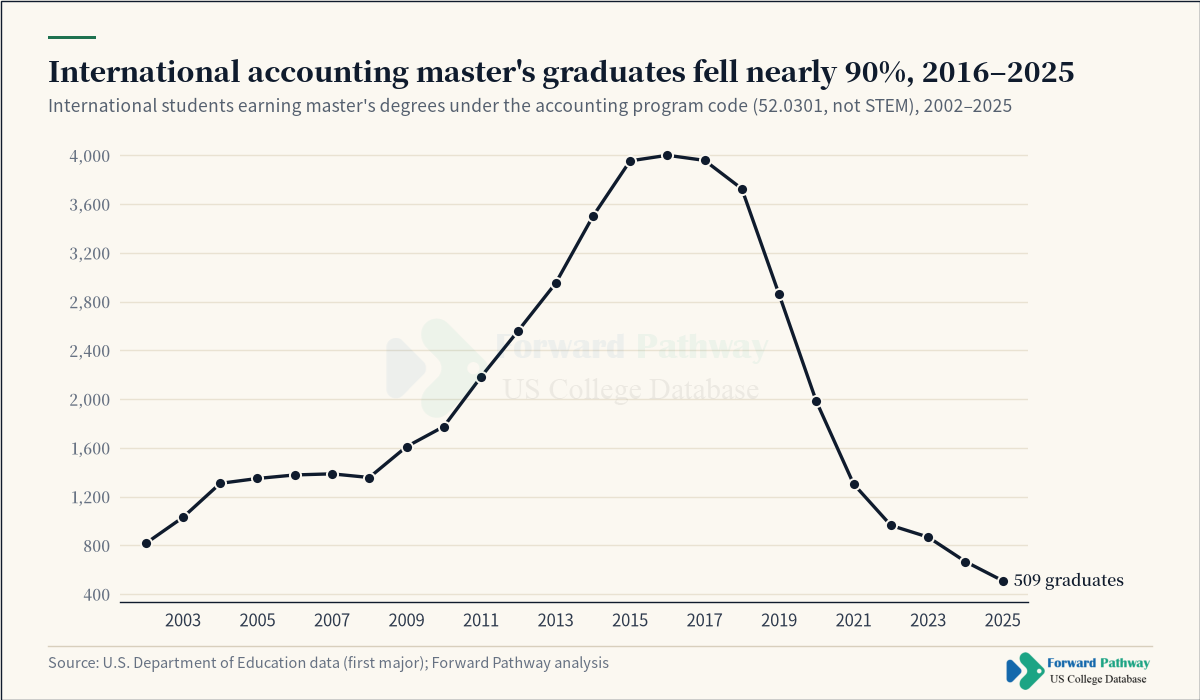
That does not mean international students stopped studying accounting. In recent years many schools have moved their accounting master’s programs to codes that are on the STEM list. Maryland is an example. Federal data show it awarded 67 master’s degrees under the accounting code in 2023, 27 of them to international students. The number fell to 1 in 2024 and to 0 in 2025. Meanwhile, the Smith School now labels its in-person accounting master’s as STEM-designated. The program continued under a different code, and international students moved with it. Public data do not show which code Maryland now uses. Applicants should go by the code on the I-20.
There are two limits to this data. Total accounting master’s graduates also fell, from 19,826 in 2016 to 11,486 in 2025, so recoding does not explain the whole decline. And the federal data do not break out students by country of citizenship.
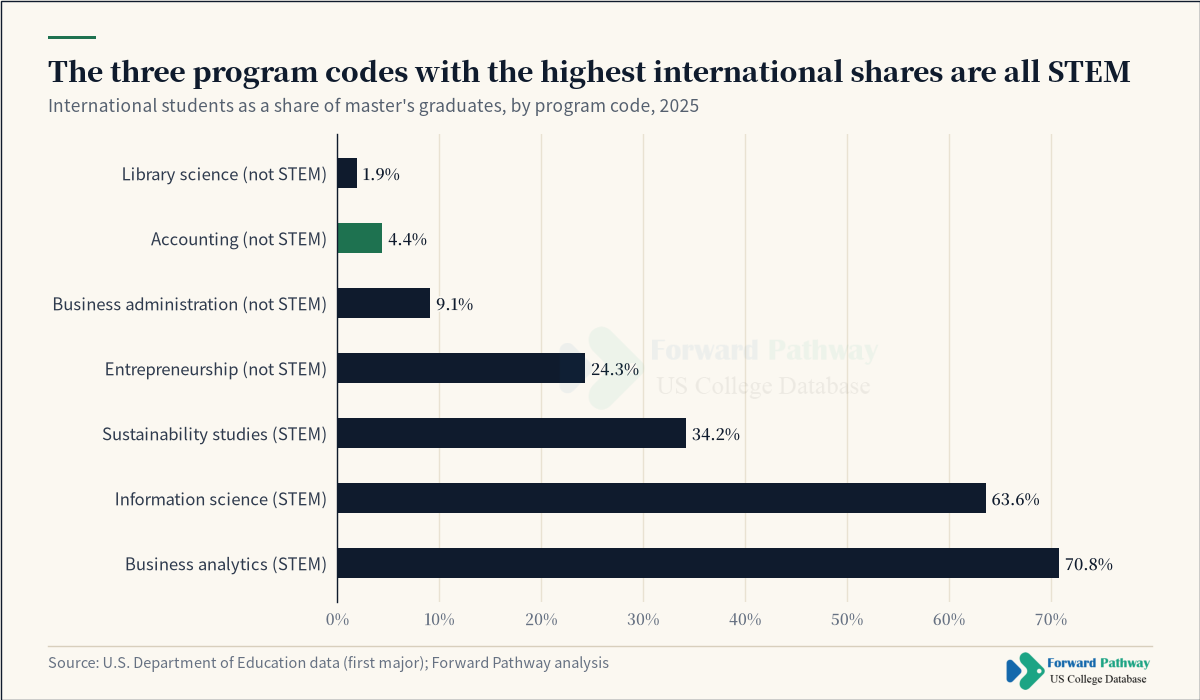
Comparing the fields behind the four new programs shows the same pattern. In 2025, international students made up 1.9% of master’s graduates in library science and 4.4% in accounting, both non-STEM. Their shares in STEM-listed sustainability studies, information science and business analytics were 34.2%, 63.6% and 70.8%. Entrepreneurship is the exception: it is not on the list, yet international students were 24.3% of its master’s graduates. The field is small, with just 917 master’s graduates nationwide under that code in 2025.
How the proposed OPT fee affects STEM programs
The main reason to choose a STEM-coded program is the longer work period after graduation: 12 months of OPT, plus a 24-month extension for STEM fields. On Oct. 8, 2026, U.S. Immigration and Customs Enforcement published a proposed rule titled “Optional Practical Training Fees” in the Federal Register. Schools would pay $70,000 for a student’s initial OPT and $30,000 for any subsequent OPT. The rule’s explanation treats a STEM OPT extension as subsequent OPT, so the $30,000 fee would apply. Schools pay the fee but may cover it themselves or pass it on to students or employers. The public comment period closed on Nov. 9, 2026. If finalized, the rule would take effect 60 days after the final rule is published.
As of Nov. 17, 2026, the rule remains a proposal, and it is unclear whether the final version will keep these amounts. Students who start a master’s program in fall 2027 would not apply for post-completion OPT before 2028. For now, applicants should still verify STEM status, build the possibility of higher OPT costs into their budgets and backup plans, and ask schools how they would handle the fee if the rule takes effect.
Questions to ask before applying to a new master’s program
New programs have real advantages. Arkansas’s library and information studies degree, for example, accepts any undergraduate major and does not require the GRE. But new programs have no admissions or employment history to compare, so applicants have to ask directly about selectivity, funding and career support.
- Which CIP code will appear on the I-20? Email the admissions office or international student office, get the six-digit code and check it against the DHS STEM list yourself. “Coming Soon” or “STEM designation pending” does not count. What counts is the code on your I-20 when you enroll.
- Is it in person or online? A school cannot issue an I-20 for a fully online program. If a program has both versions, confirm which one you are applying to and whether both carry the STEM designation.
- Does the school have a similar established program? Maryland’s in-person accounting master’s is already STEM-designated. UT Dallas’s EPPS also offers STEM master’s degrees in economics and geospatial information sciences. When a new program overlaps heavily with an older one, compare selectivity, scholarships and job placement before deciding.
- What will career support look like? Without past graduates to point to, ask about internships, project partners, which employers work with the program and whether the career center serves international students. For library programs, also ask about accreditation; Arkansas’s announcement does not mention American Library Association accreditation.
- Is a non-STEM program still worth it? UNC Charlotte’s entrepreneurship degree offers international graduates only 12 months of OPT. It fits students who plan to start a business in their home country or who value the incubator and network most. Students who plan to work in the United States for several years should give priority to STEM-coded programs.
Students applying for fall 2027 should email programs now to confirm the CIP code and keep the written replies on file. International students finishing a non-STEM bachelor’s degree in the United States can gain the 24-month extension by choosing a STEM-coded master’s. Working professionals who want an online degree are not affected by F-1 or OPT rules and can choose on curriculum and credential needs.
Frequently asked questions
Is the University of Maryland’s online M.S. in Accounting STEM-designated?
The Smith School labels its in-person M.S. in Accounting a “STEM-Designated Program” but shows no STEM label for the online version, which starts in fall 2027. Because F-1 students can count at most one online class or 3 credits per term toward full-time study, a fully online program cannot support F-1 status or OPT.
Does UNC Charlotte’s M.S. in Entrepreneurship qualify for STEM OPT?
No. UNC Charlotte’s request to establish the program lists CIP code 52.0701 (Entrepreneurship/Entrepreneurial Studies), which is not on the DHS STEM Designated Degree Program List. International graduates would get 12 months of OPT without the 24-month STEM extension.
Is UT Dallas’s M.S. in Sustainability Planning and Policy a STEM program?
The EPPS STEM degrees page lists it as STEM but marks it “Coming Soon.” Sustainability studies (30.3301) is on the DHS STEM list. What matters is the CIP code on page 1 of the I-20 at enrollment, so applicants should get written confirmation of the code from the school before committing.
How do I check whether a master’s program is STEM for OPT purposes?
Find the six-digit CIP code that will appear on your Form I-20 and look it up on the DHS STEM Designated Degree Program List, last updated July 22, 2024. In the business family, only 52.1301, 52.1302, 52.1304 and 52.1399 are on the list. The program name alone does not settle it.
Will the proposed OPT fee apply to students starting in fall 2027?
It is uncertain. The Oct. 8, 2026, proposed rule would charge schools $70,000 for initial OPT and $30,000 for each subsequent OPT, including STEM extensions, and schools could pass the cost to students or employers. As of Nov. 17, 2026, it has not been finalized; a final rule would take effect 60 days after publication. Fall 2027 entrants would not apply for post-completion OPT before 2028.
Sources
- Smith School Launches Online MS in Accounting Program (University of Maryland Smith School of Business)
- Business Master’s Degree Programs (University of Maryland Smith School of Business)
- UNC Charlotte establishes RA Session II School of Entrepreneurship and Innovation (UNC Charlotte)
- New Academic Degree Program Request to Establish: M.S. in Entrepreneurship (UNC Charlotte)
- EPPS introduces sustainability master’s degree (The UTD Mercury)
- 2026 Graduate Catalog: Sustainability Planning and Policy (UT Dallas)
- STEM Degrees (UT Dallas School of Economic, Political and Policy Sciences)
- Sustainability Planning and Policy (UT Dallas School of Economic, Political and Policy Sciences)
- STEM OPT Extension (UT Dallas international student office)
- U of A Libraries Launch New Master’s Degree Program (University of Arkansas)
- DHS STEM Designated Degree Program List, last updated July 22, 2024 (U.S. Immigration and Customs Enforcement)
- 8 CFR 214.2 (Legal Information Institute, Cornell Law School)
- Optional Practical Training Fees, proposed rule, Federal Register, Oct. 8, 2026
- U.S. Department of Education degree completions data, 2002–2025; Forward Pathway analysis