
Transfer students arrive with college experience but without the friendships, campus knowledge and advising history that their classmates built in their first year. Many also lose credits along the way. This guide explains, as of November 2026, the main challenges transfer students face, what support to look for, how to prepare a transfer application, and how international students on F-1 visas move their status to a new school. Boston University and its student-run Transition to BU club serve as the example.
Transfer Students at Boston University
Boston University enrolled 915 transfer students in the 2024–25 academic year (BU Today, April 15, 2025). For fall 2025, BU received 6,761 transfer applications and enrolled 840 transfer students, whose average college GPA was 3.7 (BU Admissions: Transfer Applicants).
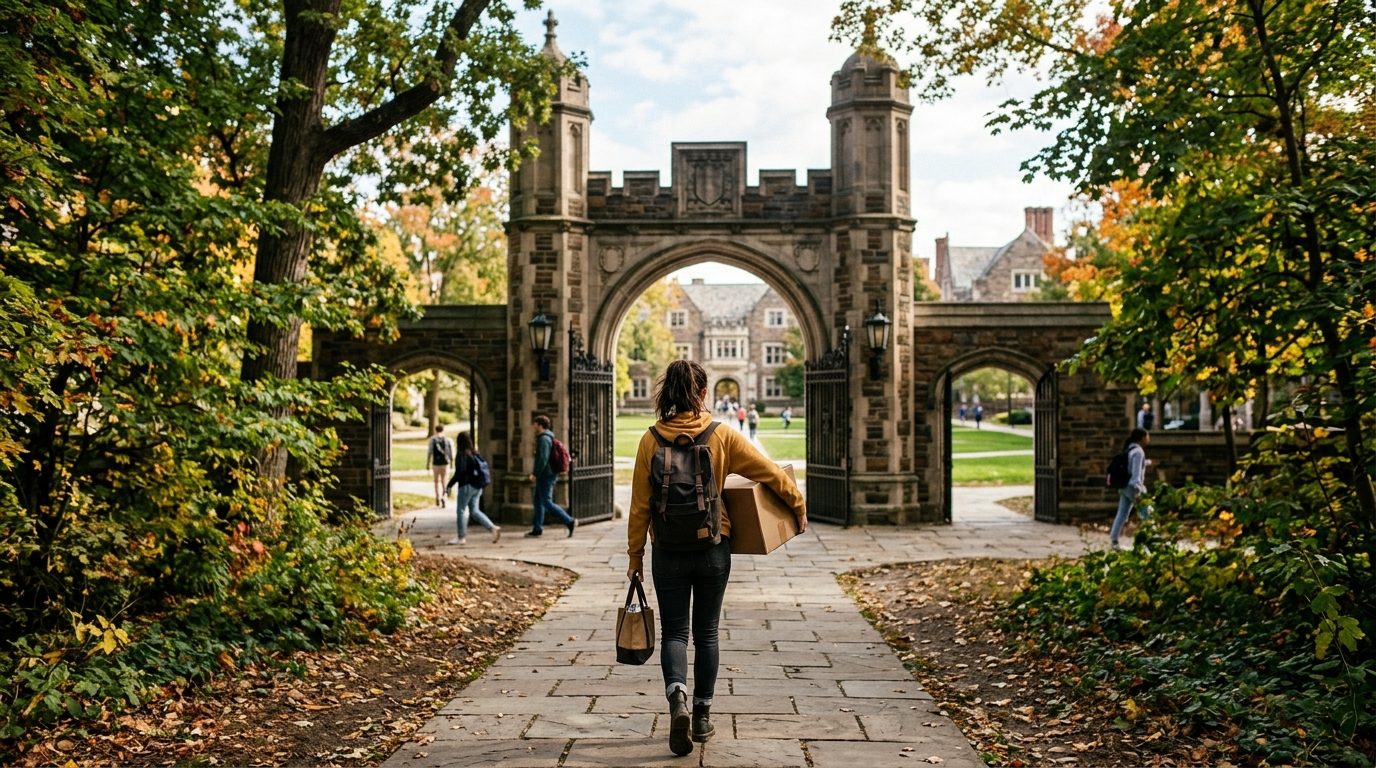
To help them settle in, former transfer students run a club called Transition to BU (TTBU). According to BU Today:
- TTBU pairs incoming transfers with current students for semester-long mentorships. The executive board asks new students about their major, cultural background, hometown and previous school to make better matches.
- Mentor applications are first come, first served, so that each mentor has only one or two mentees. The board trains mentors on the university’s academic and mental health services so they can point mentees to the right office.
- The club holds group events such as arts and crafts nights and an escape room outing, and encourages pairs to meet on their own.
Students quoted in the article described what the club gave them. Sara Howie (CAS’25), who transferred from Holyoke Community College, called her mentor a “built-in friend” and said connecting with someone who had been in the same situation mattered at a large school where it is easy to feel lost. TTBU president Noelle Tegan (CAS’25), who transferred from the University of South Carolina, said her mentor helped with housing, class registration, study abroad and an internship. Phoebe Bitzer (CAS’26), who came from Emerson College, said transferring can be overwhelming at first. BU also has an assistant director of transfer success (BU Today).
Common Challenges for Transfer Students
- Losing credits. A U.S. Government Accountability Office study found that students who transferred between 2004 and 2009 lost an estimated 43% of their credits on average. Students moving between public schools, the most common path, lost about 37%, while students moving from for-profit colleges to public schools lost about 94% (GAO-17-574, 2017). Lost credits can add semesters and tuition.
- Academic adjustment. Course pace, grading and expectations differ between schools, and transfer students usually go straight into upper-level courses in their major without a first-year transition.
- Social isolation. Classmates have often formed friend groups and joined clubs in their first year, and transfers who arrive as juniors have less time to catch up.
- Navigating a new system. Registration, advising, housing and degree requirements all work differently, and transfer orientation is usually shorter than first-year orientation.
Before You Apply: Protect Your Credits
- Check the target school’s transfer credit rules and any course-equivalency database it publishes, and choose current courses that will count toward your intended major.
- Keep your syllabi. Schools evaluate credit course by course. BU, for example, asks transfer applicants to upload course syllabi as PDFs (BU Admissions).
- Know the application requirements. At BU, applicants must have completed at least one full-time semester (12 or more credits) at another college, must declare a major (undeclared applications are not accepted), and submit the Common Application, official transcripts from every college attended, a Transfer Report from each school, the high school transcript and a 600-word essay on why they are transferring. SAT/ACT scores are not required. Questrom School of Business requires college-level or AP/IB-level calculus, and the College of Fine Arts requires an audition or portfolio. Admitted transfers cannot defer (BU Admissions).
- Prepare credential documents if you studied outside the U.S. Many schools require an evaluation or verification of foreign coursework. BU asks applicants from Chinese universities to have CSSD send a verification report in English and official transcripts in English and Chinese directly to BU (BU Admissions).
- Ask about transfer scholarships and aid early; many schools have separate merit awards for transfers, and aid for international students is often limited.
For International Students: Transferring Your F-1 Record
If you are already studying in the U.S. on an F-1 visa, you do not apply for a new visa to change schools; your SEVIS record is transferred. According to SEVP’s guidance (ICE SEVP: F-1 Transfers):
- After you are admitted, tell the international office at your current school. Its designated school official (DSO) works with you to choose a transfer release date, when responsibility for your SEVIS record passes to the new school.
- The new school cannot issue its Form I-20 before the release date. Once the record is released, it issues a transfer I-20.
- You must start classes at the new school within five months of the last day you attended classes at the old school, or at the next available session if that comes sooner.
- Students whose records were terminated need reinstatement or a new initial I-20 instead of an ordinary transfer.
Plan any international travel during the transfer with your international office, since the I-20 you travel on depends on the timing. Also note that DHS published a final rule on July 17, 2026, to replace “duration of status” with fixed admission periods for F and J students; a federal court temporarily blocked it on September 14, 2026, so the duration-of-status system still applies while the litigation continues (Carnegie Mellon Office of International Education). Confirm the latest rules with your international office before transferring.
After You Arrive: Where to Find Support
- Transfer orientation and transfer staff. Attend the transfer-specific sessions and find out who handles transfer success; at BU that is an assistant director of transfer success.
- Peer mentoring. Join a transfer mentoring program or student club such as TTBU if your school has one. It is the fastest way to learn how the campus actually works.
- Academic advising. Meet your adviser in the first weeks to check your degree audit and confirm how your transferred credits count toward major requirements.
- Counseling and wellness services. Feeling overwhelmed in the first semester is common; campus counseling is there for it.
- Clubs and housing. Joining one or two organizations, or a transfer living community where available, helps you build a social circle quickly.
Boston University at a Glance
- Ranking: No. 34 among national universities in the 2027 U.S. News ranking, according to Forward Pathway’s US Colleges Ranking.
- Enrollment: according to the latest IPEDS data, BU enrolled 37,737 students in fall 2025, including 9,910 international students (3,931 of them undergraduates).
- Cost: BU lists 2026–27 undergraduate tuition of $73,024 and an estimated total cost of attendance of $98,419 for students living on campus (BU Admissions: Tuition and Fees).
See our Boston University profile for more admissions and cost data.
References
- BU Today: Transfer Students Find Community with Transition to BU Club (April 15, 2025)
- Boston University Admissions: Transfer Applicants
- Boston University Admissions: Tuition and Fees
- U.S. GAO: Students Need More Information to Help Reduce Challenges in Transferring College Credits (GAO-17-574)
- ICE SEVP: F-1 Transfers
- Forward Pathway: Boston University profile
- Forward Pathway: US Colleges Ranking