
The Investigative Reporting Program (IRP) at the University of California, Berkeley Graduate School of Journalism is both a nonprofit newsroom and a teaching program. Graduate students in Berkeley’s Master of Journalism (MJ) program report and publish their own investigations under their own bylines, with editing and mentoring from professional investigative reporters, often in partnership with national news outlets. This guide explains how the program works, what its students have produced, and what international applicants should know about applying to the Berkeley MJ.
A “radical experiment” in training investigative reporters
The IRP was founded by investigative journalist Lowell Bergman and has run for nearly two decades. Since 2019 it has been led by David Barstow, a four-time Pulitzer Prize winner who left The New York Times to hold the Reva and David Logan Distinguished Chair in Investigative Journalism (Berkeley News, July 15, 2019; Berkeley Journalism, Investigative Reporting).
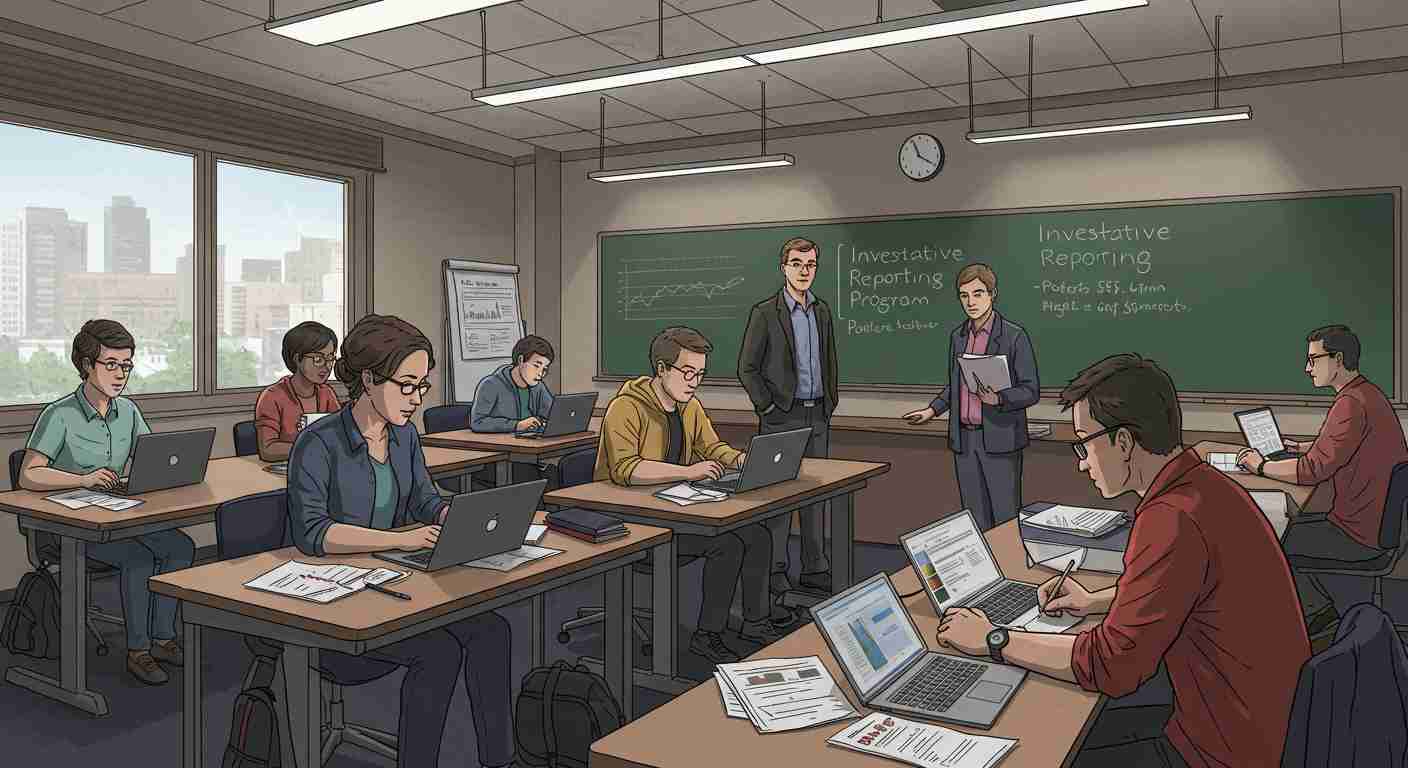
In an April 2025 interview published by the school, Barstow described the IRP as a “radical experiment.” He said the traditional system that produced investigative reporters in the U.S. was “horribly broken,” because young reporters usually had to spend years covering a beat before they got the chance to do investigative work. The IRP tests a different idea: that students who are given bylines for their own investigations, together with intensive editing and mentoring, can develop quickly into strong investigative reporters. About 50 graduate students work on some 15 to 20 investigative projects at any one time (Berkeley Journalism, Q&A with David Barstow, April 23, 2025).
Barstow also argued that diverse newsrooms find stories others miss: “When the only people doing investigative reporting look exactly like me, we miss huge stories.” He said that almost all of the program’s funding comes from gifts and grants it must raise itself, and that sustaining it was his biggest concern (same source).
How the program works
- Coursework: MJ students can take investigative classes such as “Developing Your Blockbuster Investigative Story,” and the IRP newsroom hires student reporters alongside its professional staff of reporters, editors, a records requests manager and a data journalist.
- Publishing partners: IRP work has been published with The New York Times, CalMatters, The Marshall Project, KQED, the Los Angeles Times, Inside Climate News, ProPublica and PBS FRONTLINE, among others.
- Fellowships and projects: The IRP runs the California Local News Fellowship and other reporting fellowships, the invitation-only Logan Symposium (held since 2007), and the Police Records Access Project, which has made about 1.5 million pages of previously secret police records public.
(Source: Berkeley Journalism, Investigative Reporting.)
What students and alumni have produced
According to the school, IRP stories have won three Polk Awards in four years (2021, 2023 and 2024), as well as a duPont-Columbia Award and the Selden Ring Award for Investigative Reporting in 2025 (Q&A with David Barstow; Investigative Reporting page). Examples include:
- “Right to Remain Secret”: Katey Rusch and Casey Smith, both MJ 2020 graduates, investigated “clean-record” agreements that allowed California police officers accused of misconduct to leave a department without their records following them. Published in the San Francisco Chronicle, the series won the Polk Award, the Selden Ring Award, the Goldsmith Prize and an IRE award, and was a Pulitzer Prize finalist.
- “American Insurrection”: Students Kathryn Hurd, Gisela Pérez de Acha, David Thigpen and Ellie Lightfoot shared a 2022 Polk Award for this documentary, a collaboration with PBS FRONTLINE and ProPublica.
- National bylines: Kate Raphael (MJ 2024) had an investigative story on the front page of The New York Times in August 2024, and Daniel Lempres (MJ 2021) was part of a New York Times team that examined the pandemic’s effect on child abuse investigations in 2020.
Latest update: two California laws
In October 2025, the school reported that two investigations developed at the IRP led to laws signed by California Governor Gavin Newsom. AB 1388, by Assembly Member Isaac Bryan, makes clean-record agreements illegal in California starting January 1, 2026, following the “Right to Remain Secret” reporting. AB 572, sponsored by Assembly Member Ash Kalra, restricts police from withholding death notifications from families while questioning them about the victim; departments must update their policies by January 2027. It followed “We Regret to Inform You,” which Brian Howey (MJ 2021) began reporting in 2020 as a student in Barstow’s class and published in 2023 with Reveal/Mother Jones and the Los Angeles Times (Berkeley Journalism, October 24, 2025; University of California, October 30, 2025).
Applying to the Berkeley MJ
Students take part in the IRP through Berkeley’s two-year Master of Journalism. MJ students start with local news, features and in-depth reporting and then concentrate in areas such as narrative writing, audio, photography, video, data journalism and investigative reporting (Berkeley Journalism, MJ program). For fall 2027 entry (Berkeley Journalism, Admissions):
- Deadlines: priority (Round 1) deadline December 1, 2026, and final deadline January 14, 2027, both at 8:59 p.m. Pacific Time. Applying by December 1 is required to be considered for named fellowships such as the Dean’s Fellowship.
- Materials: a statement of purpose and a personal history statement (up to 500 words each), two letters of recommendation, two to three work samples including at least one nonfiction writing sample, a one-page résumé, a 2–3 minute personal video, and transcripts. The GRE is not required.
- Application fee: $135 for domestic and $155 for international applicants.
- English proficiency: applicants whose undergraduate degree is from a non-English-speaking country need a TOEFL iBT of 90 (tests taken June 1, 2025 to January 20, 2026) or 5.0 with at least 4.5 in Speaking and Writing (new format, from January 21, 2026), or an IELTS of 7.0. Scores must be from June 1, 2025 or later, and the school recommends higher scores.
- Funding: departmental awards range from $5,000 to fully funded fellowships. International students cannot receive U.S. federal aid but are eligible for departmental funding (Berkeley Journalism, Costs & Funding). Tuition follows the UC Berkeley Registrar’s fee schedule for the School of Journalism; the school advises multiplying the per-semester fees by four for the full program.
International graduates on F-1 visas can usually apply for 12 months of Optional Practical Training (OPT) after completing the degree. Journalism is not typically a STEM-designated field, so applicants should not plan on the 24-month STEM OPT extension. Note also that some reporting fellowships and newsroom jobs have their own eligibility rules for non-U.S. citizens.
About UC Berkeley
UC Berkeley is ranked No. 20 among national universities in the U.S. News 2027 Best Colleges ranking and No. 7 in the U.S. News 2027 Best Global Universities ranking. See our UC Berkeley school page for admissions, cost and enrollment data.
References
- Berkeley Journalism: David Barstow talks about the “radical” Berkeley experiment to accelerate the production of investigative reporters (April 23, 2025)
- Berkeley Journalism: Investigative Reporting Program
- Berkeley Journalism: Award-winning stories by IRP alums spur passage of two California laws on policing (October 24, 2025)
- University of California News (October 30, 2025)
- Berkeley News: David Barstow to lead Berkeley’s investigative journalism program (July 15, 2019)
- Berkeley Journalism: Master of Journalism
- Berkeley Journalism: Admissions
- Berkeley Journalism: Costs & Funding
- Forward Pathway: University of California, Berkeley