
Campus safety is one of the first questions international students and their families ask about when choosing a U.S. university. Most American campuses are open to the public, sit inside or next to cities, and have no gates, so safety depends on a mix of campus police, lighting and cameras, emergency alert systems, safety apps and, above all, students knowing how to use them. This guide explains how U.S. universities keep campuses safe, how to check a school’s safety record before you apply, and what to set up in your first week on campus. Examples from the University of Florida, the University of Houston, the University of Georgia and Virginia Commonwealth University show what these measures look like in practice.
What U.S. law requires: the Clery Act
Colleges and universities that receive federal funding must follow the Jeanne Clery Act, which gives students a standard way to see crime and safety information (Clery Center):
- Annual Security Report (ASR): published every October 1, with crime statistics for the three preceding calendar years and the school’s policies on reporting crimes, building security and sexual violence prevention.
- Crime statistics in five categories (criminal offenses, hate crimes, hazing, offenses under the Violence Against Women Act, and arrests and disciplinary referrals), covering campus buildings, student housing, adjacent public property and some noncampus property.
- Timely warnings: when a reported crime may be a serious or ongoing threat, the school must warn students and staff.
- Emergency notifications: for an immediate, significant danger such as severe weather or a disease outbreak, sent to the whole campus or just the affected area.
- Daily crime log: campus police or public safety must keep a log of reported crimes in their jurisdiction, open to the public during business hours.
The U.S. Department of Education also publishes institutions’ Clery statistics on its Campus Safety and Security website.
How to read a school’s safety report
- Search the school’s website for “Annual Security Report” or “Clery report”; it is usually posted by the campus police department.
- Compare the same categories over three years rather than single numbers. A large university with many residence halls will report more incidents than a small college, simply because more people live there.
- A higher count of reported sexual assaults can reflect better reporting systems, not necessarily a less safe campus. Read the policy sections too: they tell you where to report and what support is available.
- Look at the area around campus. Clery statistics cover campus and nearby public property, but many students live off campus, so city crime maps and the neighborhood where you plan to rent matter as well.
Physical security: lighting, cameras and call stations
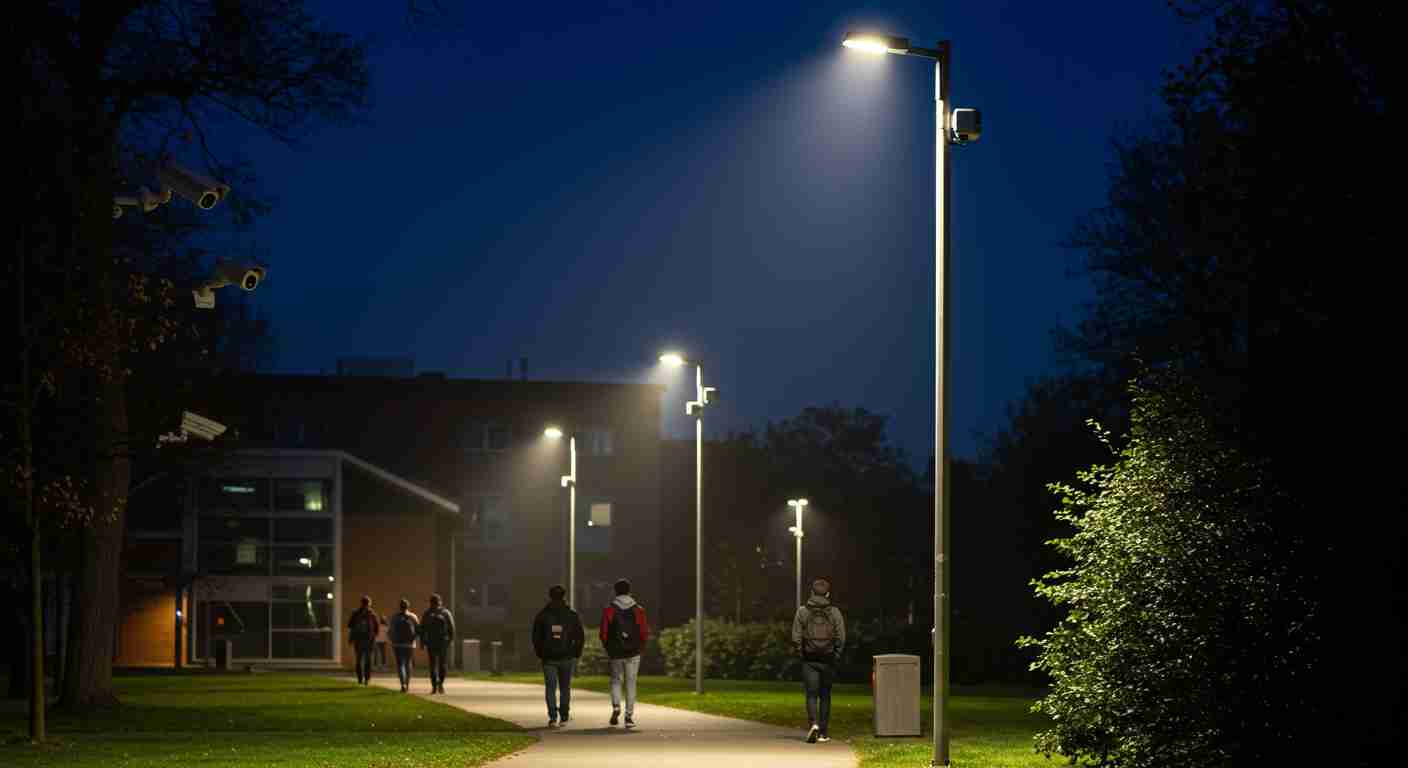
Better lighting and camera coverage are the most common investments universities make, and they are concentrated in parking lots, walkways and residence halls, where students move around at night.
- University of Florida: in January 2023 UF reported that 2,434 exterior lights along sidewalks, roads and parking lots had been upgraded to LED, nearly 60% of its pole-mounted lights. It had about 1,700 surveillance cameras, planned about 200 more and set a long-term goal of up to 3,000 campuswide; new lights were added in areas the university police identified as needing them (UF News, January 17, 2023).
- University of Houston: its Campus Lighting and Security Enhancement Project has an $18 million budget for its first two phases and includes more than 400 new lighting assets, 195 surveillance cameras and 42 emergency call stations and security kiosks. In February 2025 the UH System board accelerated phase two, covering student housing lots and other parking lots, with work scheduled for November and December 2025 (UH News, February 21, 2025).
- University of Georgia: in August 2024 UGA announced $7.3 million in new safety spending that year, bringing its total to more than $23 million over nine years. Measures included 15 new call boxes with cameras, the first of 20 automated license plate readers, LED conversions near busy residence halls, perimeter fencing, 11 campus safety ambassadors, a permanent 20% increase in the UGA Police budget, and evening access to the main and science libraries limited to UGA students, faculty and staff (UGA Today, August 9, 2024).
- Virginia Commonwealth University: VCU has more than 1,800 cameras across its campuses, and footage helped in 541 police investigations in the 2023-24 academic year. Cameras in its parking decks grew from just over 100 in 2020 to 651 in 2023. The system is passive: feeds are not watched around the clock, and video is usually kept for about seven days (VCU News, September 5, 2024).
The VCU example is a useful reminder: cameras mostly help solve crimes after they happen. They do not replace your own precautions, such as walking on lit, busy routes and not leaving laptops unattended in libraries.
Safety apps and alert systems
Almost every U.S. university now has an official safety app and an emergency alert system. Typical features include:
- Mobile blue light / panic button: calls campus police and sends your location at the same time.
- Friend walk: lets a friend follow your location on their phone while you walk home.
- Check-in timers: UF’s GatorSafe app has a “Work/Study Alone” feature for people who study or work alone, for example late in a lab. It asks the user to check in periodically, and if the user does not respond within five minutes, it calls the emergency contact they listed (UF News; UFPD, GatorSafe).
- Anonymous tips to report suspicious behavior, and a safety toolbox (flashlight, alarm).
- Safe rides: many schools run night escort or discounted ride programs. UGA’s Ride Smart, for example, offers 50% off Lyft rides from 6 p.m. to 6 a.m. (UGA Today).
Emergency alerts (often branded as “Alert,” “Rave” or with the school’s name) are sent by text, email and app notification. Register your U.S. phone number as soon as you get one; alerts sent to a foreign number may not arrive.
A first-week safety checklist for international students
- Save the numbers: 911 for emergencies anywhere in the U.S., plus your campus police non-emergency number.
- Download the official safety app from your school’s police or public safety website, set your emergency contacts, and try the friend-walk and check-in features once so you know how they work.
- Sign up for emergency alerts with your U.S. phone number, and keep your U.S. address up to date with your school (F-1 students must report a change of address within 10 days).
- Learn your routes: find the lit, patrolled paths and emergency call stations between your residence, library and labs, and the hours of night shuttles or escorts.
- Know the emergency procedures your school publishes for severe weather, fire and active threats (often “run, hide, fight” guidance), especially in your residence hall and the buildings where you take classes.
- Know where to get help after an incident: campus police, the Title IX office for sexual harassment and assault, counseling services, and your international student office, which can help with academic and immigration questions if something affects your studies.
- Protect your property and identity: bike and laptop theft are among the most common campus crimes. Register your bike, lock it, and be wary of phone calls or emails claiming to be from immigration authorities or the police demanding money; verify by calling your international student office before doing anything.
Choosing a school: how much should safety weigh?
Safety should be one factor among many. When comparing universities, read each school’s Annual Security Report, look at where most students live, ask current students about the area at night, and check what the school offers late at night (shuttles, escorts, library hours). A city campus is not automatically less safe than a suburban one, and the measures above, combined with sensible habits, make a large difference wherever you study. For academic and cost comparisons, see our U.S. college rankings and each school’s profile page.
References
- Clery Center: The Clery Act
- U.S. Department of Education: Campus Safety and Security
- UF News: UF enhancements make for a brighter, safer campus (January 17, 2023)
- University of Florida Police Department: GatorSafe App
- University of Houston: UH System board approves funds to expedite campus lighting project (February 21, 2025)
- UGA Today: University continues to strengthen campus security with new initiatives (August 9, 2024)
- VCU News: How VCU’s more than 1,800 security cameras contribute to campus safety (September 5, 2024)
- Forward Pathway: University of Houston
- Forward Pathway: University of Georgia
- Forward Pathway: Virginia Commonwealth University