
Most people picture pharmacists behind a retail counter or in a hospital, but Pharm.D. graduates also work for drug and device companies in roles such as regulatory affairs, medical affairs, medical communications, health economics and research and development. Getting there usually takes deliberate preparation during pharmacy school. This guide explains the main steps, using the industry career program that the University of Connecticut School of Pharmacy described in 2025 as an example, and covers what international students need to know about industry fellowships.
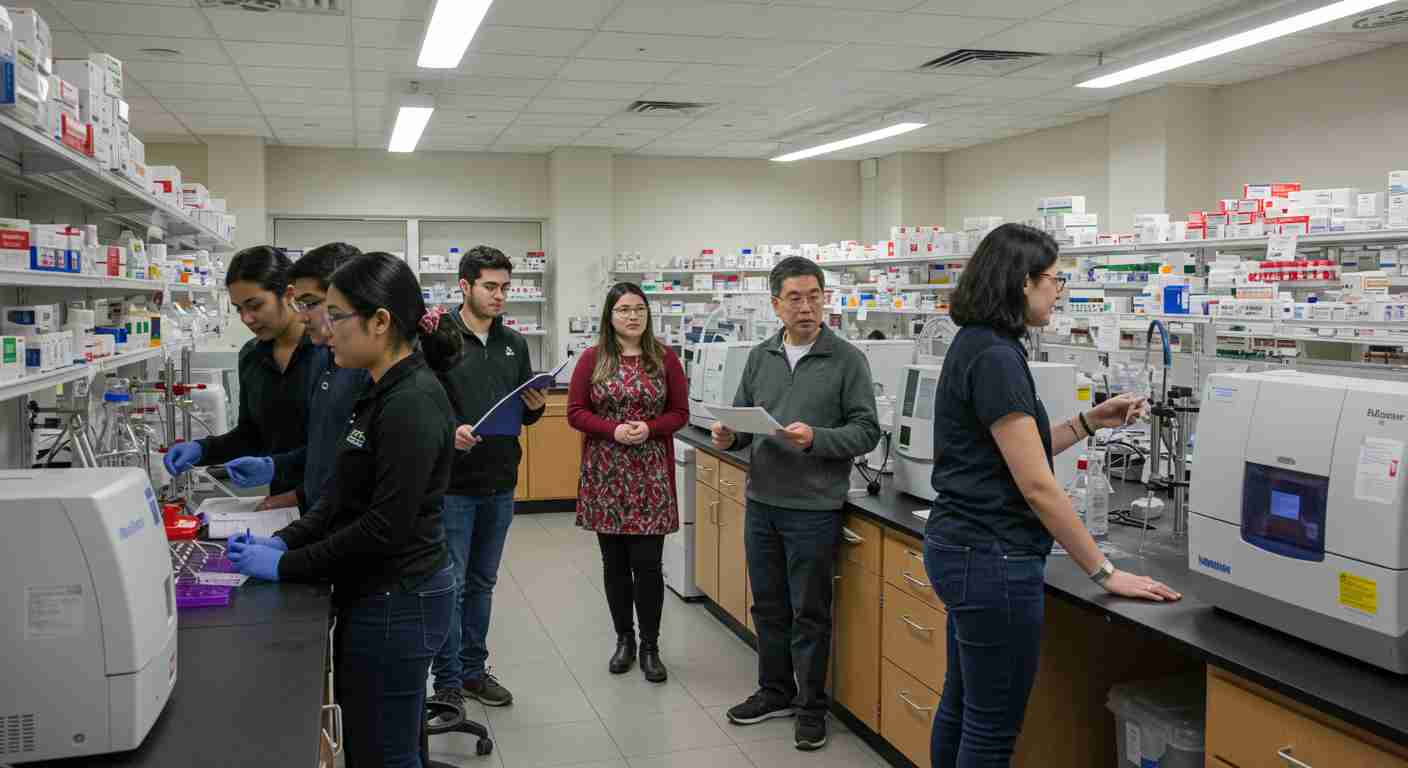
Example: how UConn pharmacy students prepare for industry
In June 2025, UConn’s School of Pharmacy described several steps it had taken to raise awareness of pharmaceutical industry careers (UConn Today, June 4, 2025):
- A student competition: in 2024–25, a UConn team of 35 students placed sixth out of 70 pharmacy schools in the Industry Pharmacists Organization (IPhO) competition, in which teams role-play a drug company and submit a plan to launch a new drug on the U.S. market. Student leader Lahar Miriyapalli said the competition helps students “build real-world skills.”
- A new elective: “Pharmaceutical Industry Fundamentals for Pharmacists,” created by Carl Possidente, Pharm.D., who had recently retired from Pfizer, and C. Michael White, Pharm.D., chair of pharmacy practice. Industry pharmacists from around the country served as panelists on roles in medical communications, pharmacoeconomics, pharmacometrics, regulatory affairs, medical affairs, and research and development, and on how to position yourself through internships, advanced practice experiences, fellowships, research and leadership roles.
- Mentoring: at a half-day event on April 15, 2025, students met industry pharmacists from companies including Pfizer, Eli Lilly, Sanofi, Becton Dickinson and Adaptive Biotechnologies in rotating small groups for mentoring and CV and cover letter reviews.
- Results: seven recent graduates were starting industry fellowships in summer 2025, and 21 students had secured one- or two-month industry rotations at eight companies as part of their Advanced Pharmacy Practice Experiences (APPEs). Graduating student Rohan Kantesaria noted that “industry fellowships are highly competitive, with a rigorous application process that spans several months.”
The usual path from Pharm.D. to industry
- Learn what the roles are early. Electives, student organizations such as IPhO chapters, and conversations with alumni help students choose between areas like regulatory affairs, medical information or health economics before applying for rotations.
- Get industry exposure during school. Summer internships and industry APPE rotations, which at UConn last one or two months, give students experience to discuss in fellowship interviews.
- Apply for a post-Pharm.D. industry fellowship. Fellowships are the most common entry route for new graduates. In the Rutgers Pharmaceutical Industry Fellowship program, one of the largest, fellows spend one or two years working at a partner company while completing a Rutgers component (a project or publication with a faculty member, lectures or precepting students) and monthly professional development days; more than 300 fellows were in the program in 2026. Pharm.D. applicants must graduate from an ACPE-accredited school by the July 1 start date, and applicants could register for the next cycle starting Aug. 19, 2026 (Rutgers Pharmaceutical Industry Fellowship FAQs).
An undergraduate route: pharmaceutical sciences degrees
Students who want to work in drug development without becoming pharmacists can study pharmaceutical sciences at the bachelor’s level. The University of Kentucky College of Pharmacy, for example, launched a 120-credit Bachelor of Science in Pharmaceutical Sciences with its first cohort in fall 2025, aimed at careers in drug development, regulatory affairs and clinical research (UKNow).
What international students should know
- Fellowship eligibility depends on work authorization. Rutgers accepts international students who earn a Pharm.D. from a U.S. ACPE-accredited school, but only for a fellowship that fits the length of their U.S. work authorization: a candidate with one year of authorization should apply for a one-year fellowship. Rutgers “DOES NOT sponsor any applicants for the Fellowship,” offer recipients must prove they can work in the U.S. for the full term, and rotations at the FDA require U.S. citizenship (Rutgers FAQs).
- OPT is the usual bridge. F-1 students can use up to 12 months of Optional Practical Training, and some degrees qualify for an additional 24-month STEM extension; pre-completion OPT reduces the time available after graduation (Rutgers FAQs). Check with your school’s international office whether your Pharm.D. qualifies for the STEM extension, since that decides whether a two-year fellowship is realistic.
- Use the school’s industry network. As the UConn example shows, mentoring events, alumni and rotations at companies are how most students reach fellowship interviews, so ask pharmacy schools how many students get industry APPEs and fellowships each year.
The schools at a glance
In the 2026 U.S. News pharmacy school ranking, the University of Kentucky is No. 11 and the University of Connecticut is No. 27 (Forward Pathway rankings). UConn is No. 73 in the 2027 U.S. News Best National Universities ranking (Forward Pathway).