
The Evolving Landscape of Agricultural Careers: Beyond Traditional Academia
The traditional trajectory for graduate students in agricultural sciences, long characterized by a seemingly inevitable path into academia, is undergoing a significant transformation. What was once a fairly predictable journey from Ph.D. to professorship now features an increasingly diverse landscape of career opportunities, extending far beyond the hallowed halls of universities and into the bustling realm of industry. This diversification isn’t merely a minor shift; it’s a fundamental redefinition of what a career in agricultural sciences can and should look like. In this evolving professional ecosystem, initiatives designed to expose students to these burgeoning possibilities are not just beneficial, but arguably essential.
Virginia Tech’s Translational Plant Sciences Center’s Career Exploration Initiative stands as a prime example of this foresight, acting as a crucial bridge between theoretical knowledge and real-world application. For 15 years, this program has been subtly, yet effectively, guiding future agricultural professionals towards a broader understanding of their potential roles. It’s like telling someone they can be more than just a shepherd for academic papers; they can also be a cattle rancher for agricultural tech or, you know, a venture capitalist for plant-based proteins. You do the math.
This shift isn’t happening in a vacuum. It’s a direct response to broader trends within the agricultural sector, which has seen explosive growth and an accelerating demand for specialized skills. The rise of agritech, biotechnology, sustainable agriculture, and precision farming has created a whole new lexicon of job titles and responsibilities that didn’t exist a decade or two ago. We’re talking about roles that blend genetics with data science, environmental policy with economic modeling, and cutting-edge research with commercialization strategies. It’s almost as if plants decided they needed their own tech bros, and here we are.
Consider the strategic importance of burgeoning hubs like St. Louis, Missouri. What was once primarily known for its arch and perhaps its questionable taste in baseball mascots is now a recognized epicenter for innovation in food, farming, and sustainability. This convergence isn’t accidental; it’s a deliberate cultivation of an ecosystem where industry, research, and technology not only coexist but thrive synergistically. For graduate students, such hubs offer a glimpse into the future of their field, a future where their specialized knowledge isn’t just a research interest but a marketable skill in a rapidly expanding industry. I’m just saying, it’s a good place to be if you like green things and money.
Ultimately, this evolving landscape underscores a fundamental truth for aspiring agricultural scientists: industry exposure and robust alumni networks are no longer optional extras but indispensable components for career success. Knowing how to grow a healthy plant is one thing; knowing who to talk to about scaling that healthy plant into a global commodity is quite another. And sometimes, it’s the latter that gets you the corner office, or at least a desk with a window that doesn’t overlook a lab bench.
Experiential Learning: Industry Tours as Catalysts for Career Redirection and Insight
The profound impact of industry tours on the trajectory of a graduate student’s career path is not merely anecdotal; it’s a systematic reorientation, a gentle nudge from the academic ivory tower towards the somewhat less dusty, and often more financially rewarding, pastures of industry. The Virginia Tech program, in its infinite wisdom, has mastered this subtle art of career redirection. Imagine sending a dedicated scholar of plant pathology to a place like Bayer Crop Science or the Donald Danforth Plant Science Center. It’s less of a field trip and more of a revelation, akin to discovering that the secret ingredient in your grandma’s pie isn’t just love, but also a proprietary blend of genetically enhanced flour.
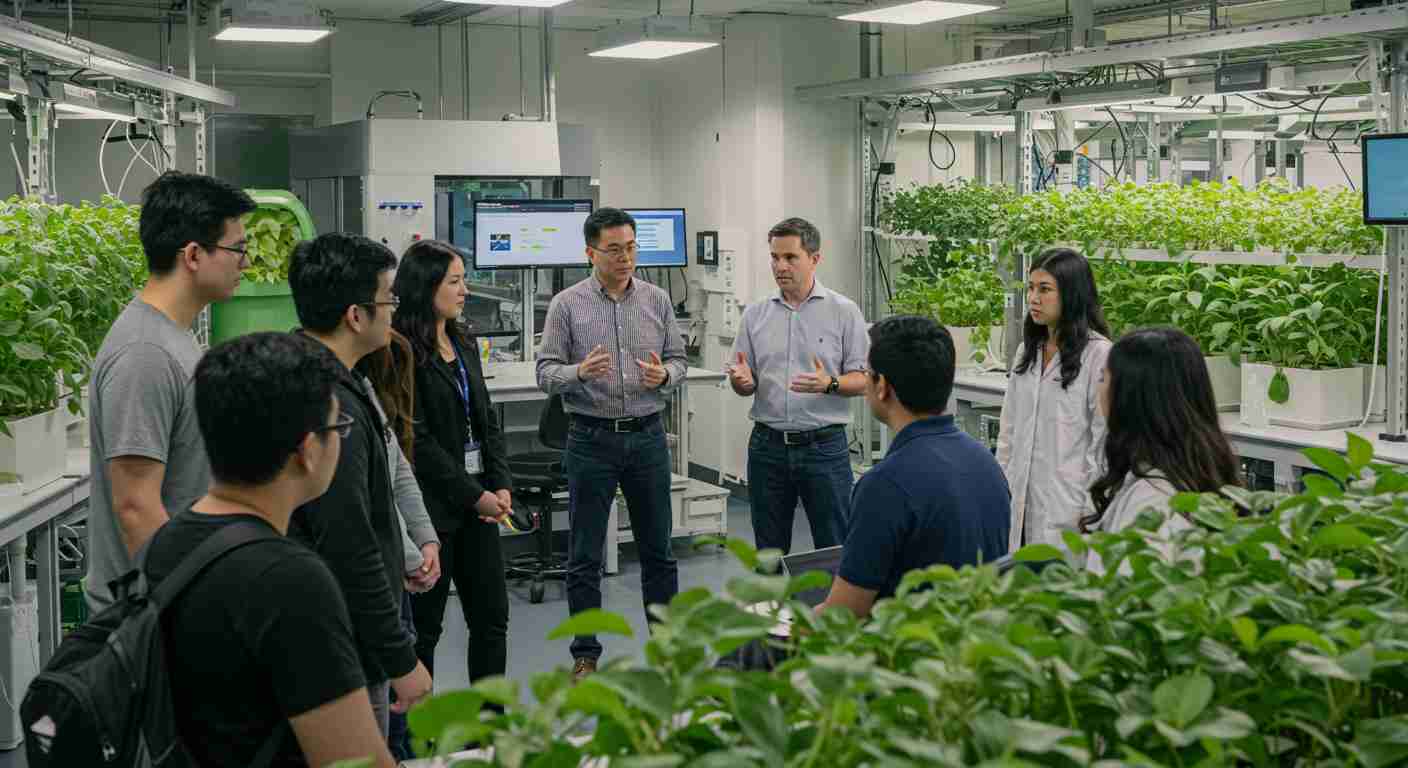
Firsthand exposure to these agricultural titans broadens perspectives faster than a genetically modified beanstalk. Students, who might have previously envisioned their entire professional life encased within the sterile confines of a university lab, suddenly see an entire spectrum of possibilities. Nina Wilson, a 2017 Ph.D. graduate from Virginia Tech, serves as a testament to this transformative power. Her initial goal, like many of her peers, was to become a professor. However, after participating in the industry tours, she found herself pivoting, eventually joining Verb Biotics, a startup the group had toured. It’s like planning to spend your life meticulously counting grains of sand, only to realize there’s a whole beach party happening, and someone needs a DJ.
Purdue Polytechnic, with its equally robust initiatives, offers a similar narrative, demonstrating how diverse site visits illuminate the real-world applications of theoretical knowledge and the increasing demands of Industry 4.0. Their students aren’t just reading about smart manufacturing; they’re walking through facilities like PepsiCo Beverages, watching high-speed blow molding, filling, and packaging in action. It’s one thing to calculate fluid dynamics in a textbook; it’s quite another to see a gazillion bottles being filled per minute and realize your calculations might actually have a practical application beyond impressing your professor. They’re seeing how materials and manufacturing concepts evolve into “smart, interconnected systems,” as Associate Professor Rustin Webster so eloquently puts it. I’m just saying, watching a robot assemble a car part probably beats assembling a thesis footnote.
The value of direct engagement during these tours cannot be overstated. It’s not just about observing; it’s about participating. Students delivering “flash talks” at places like Bayer and Danforth aren’t just showing off their research; they’re demonstrating their ability to communicate complex ideas concisely, a skill often overlooked in academia, where a 40-minute presentation is considered a mere appetizer. Having lunch with Bayer employees or participating in panel discussions at KWS and Danforth aren’t just opportunities for free food (though, let’s be honest, that’s a perk for any graduate student); they are crucial moments for fostering meaningful connections. Adam Sumner, another organizer of Virginia Tech’s excursion, stressed the importance of these interactions, noting that students present their research and interests, laying the groundwork for future industry opportunities. It’s the professional equivalent of speed dating, but instead of finding a life partner, you’re looking for someone who can offer you a job or, at the very least, a LinkedIn connection that actually leads somewhere.
These tours are not just observational; they are actively transformative. They strip away the abstract and replace it with the tangible, showing students the nuances of industry roles. It’s one thing to study plant genetics; it’s another to understand how that research translates into a commercially viable product, how it gets patented, marketed, and eventually, how it ends up in your morning cereal. The sheer scale of operations, the integration of technology, and the interdisciplinary nature of real-world challenges often surprise students. They realize that their niche academic expertise isn’t just a fascinating intellectual pursuit; it’s a piece of a much larger, often global, puzzle. In essence, these tours prepare students for a world where innovation isn’t just published in a journal, but sold, distributed, and sometimes, even eaten. And that, Your low-key editor submits, is a whole different ballgame.
The Strategic Role of Alumni Networks in Graduate Career Development
The strategic function of alumni networks in graduate student career advancement is, frankly, undeniable. It’s the grown-up version of your older sibling introducing you to their cool friends who can, you know, actually get you somewhere. Drawing on the Virginia Tech example, it becomes quite clear that these networks aren’t just about reminiscing over old football games. They are dynamic, living entities that facilitate connections, organize critical components of industry tours, and provide invaluable mentorship. Take Ryan Anderson, for instance. A 2011 Ph.D. graduate, he’s now at Syngenta, serving on an external advisory board, and still finds time to offer resume advice to current students. That’s not just being helpful; that’s knowing where the bodies are buried, career-wise, and offering a map.
The discussion, however, shouldn’t stop at Virginia Tech. Broader perspectives from institutions like Boston University (2025 USNews Ranking: 41) and California State University Long Beach (CSULB) underscore a universal truth: alumni networks are invaluable relationship assets. In an uncertain economic landscape, where jobs are filled less by traditional postings and more by who you know (70-80% through referrals, apparently, so you do the math on that), these networks offer a competitive edge. It’s like having a secret handshake that only those who attended your alma mater understand, and that handshake opens doors to industry insights and job opportunities that mere mortals, with their standard resumes, can only dream of.
The forms of alumni support are as varied as the career paths themselves. You have the formal networking events, meticulously planned down to the last canapé, where students can awkwardly, yet effectively, exchange business cards with professionals who were once exactly where they are. Then there are the mentorship programs, where seasoned alumni guide the greener graduates through the labyrinthine corridors of professional life, offering advice on everything from salary negotiations to how to survive office potlucks. But it’s often the informal advice and job referrals that truly stand out. A quick call, a casual coffee, or a LinkedIn message can morph into a lifeline in a turbulent job market. The shared educational background fosters an immediate, almost primal, trust. It’s the “we survived that professor’s organic chemistry class together, so I trust you with my career” kind of bond.
Consider the narrative from Boston University Questrom School of Business, where Monica Parker-James, the Associate Dean of Career and Alumni Engagement, aptly points out that networking has always been essential, but is “particularly vital in an uncertain job market.” Alumni, she notes, understand the unique strengths of Questrom talent. They’re not just throwing names around; they’re vouching for a shared pedigree. It’s like a quality assurance stamp, but for people. And as Susan Stelter, Chief People Officer at West Monroe, wisely states, alumni make “excellent career advisors due to their varied experiences.” They’ve been there, done that, and probably bought the slightly overpriced university sweatshirt.
Digital platforms have, unsurprisingly, extended the reach and impact of these networks faster than a viral cat video. Platforms like BU Connects and various alumni LinkedIn groups facilitate career conversations that transcend geographical boundaries. It means a Virginia Tech graduate in St. Louis can help organize a tour for current students without having to rely on carrier pigeons or smoke signals. It allows a CSULB alumnus in a different state to offer resume critiques to a new graduate, bridging distances with the click of a button. While face-to-face interactions still hold undeniable power (because, let’s be honest, you can’t truly judge a person’s networking skills until you’ve seen them navigate a cheese board at an event), digital tools ensure that connections, even “weak ties” as Stanford sociologist Mark Granovetter famously identified, can be maintained and leveraged continuously. Srinivas Rayavarapu (Questrom MBA ’24) highlighted the critical role of digital alumni connections for his career as an international student, proving that sometimes, the best way to meet someone is to slide into their professional DMs.
Your low-key editor observes that these networks are not just about finding a job; they’re about building a continuous cycle of support. Alumni give back, not just because it looks good on their professional profile, but because they remember the struggle. They remember needing that resume advice, that insider tip, or that introduction that finally opened the door. It’s a virtuous circle where current students become future alumni, and the cycle of mutual aid continues. It’s an investment, really, in the future of the institution and, let’s be honest, in the quality of your future networking events. After all, if the next generation of alumni isn’t successful, who’s going to organize the next fancy dinner? I’m just saying.
Innovation Hubs and Interdisciplinary Research: Fueling Future Plant Science Careers
This broader ecosystem, designed to support and foster new career opportunities in plant science, often operates like a well-oiled machine, if that machine were powered by intellectual curiosity and an abundance of lab space. St. Louis, for example, has emerged as a prime example of an agricultural innovation hub, proving that you don’t need a coastline to make waves in biotechnology. The 39North AgTech Innovation District, now an independent nonprofit, has been particularly adept at attracting and bolstering agritech startups. Emily Lohse-Busch, Executive Director of 39North, noted a “significant pent-up demand” for companies to move into the St. Louis market, which, one assumes, means they had a long waiting list of brilliant minds eager to turn plants into something more.
Companies like Cquesta, EpiCrop Technologies, and EpiMethyl Analytics have already set up shop within this 600-acre district, demonstrating that the region isn’t just for brewing beer anymore. Sally Mackenzie, Chief Science Officer for EpiCrop Technologies and EpiMethyl Analytics, relocated from Penn State University and highlighted the remarkable speed at which operations could be initiated. She noted the ability to use facilities at the Donald Danforth Plant Science Center while simultaneously establishing their own, which, for a startup, is like being given a race car and a mechanic who also moonlights as a genie. The region, it seems, has a profound “appreciation for innovation, entrepreneurship, and new technology,” along with the infrastructure to support it, making it a good “home base” where building greenhouses is a plausible endeavor, unlike, say, downtown Boston. Apparently, plants prefer elbow room to historic charm.
This supportive environment extends beyond 39North’s immediate offerings. Moolec, a company genetically modifying plants to produce higher and different proteins (which, let’s be honest, sounds like something out of a sci-fi novel, but for breakfast), relocated from Texas to the Cortex Innovation District. Martín Salinas, Moolec’s Chief Technology Officer, lauded 39North for its connective tissue, linking them with Cortex and various Missouri agencies. Their strategic move to St. Louis was driven by its proximity to major soybean cultivation areas, because if you’re going to make meat-like proteins from soybeans, it helps to be near the source. He also mentioned that St. Louis stood out against competitors like Indianapolis and Chicago due to the “rapid and attentive responses” from the region’s innovation districts. Turns out, responsiveness matters, even when discussing the future of plant-based burgers.
This hub also nurtures homegrown startups. Metablify, an Arch Grant recipient, emerged directly from research at the Danforth Plant Science Center. Led by Mike Bielski, the company’s technology improves the analysis of massive liquid chromatography mass spectroscopy (LC-MS) outputs, which, to Your low-key editor, sounds like very intelligent data wrangling. This technology has applications in agriculture (assessing fertilizers) and potentially medicine (identifying biomarkers), proving that plants aren’t just for eating; they’re also for making complex data look simple. Bielski, co-founder of NewLeaf Symbiotics a decade ago, clearly appreciates the “concentrated talent and support” from the Danforth Center, making St. Louis an “exciting place for entrepreneurs.” It seems some people just can’t get enough of being near really smart plants.
Connecting this regional dynamism to academic research reveals how directly it feeds into industry innovation and new career pathways. At Virginia Tech, for instance, Kamal Chhetri is pioneering data-driven solutions to combat emerging foliar diseases in corn. His work, involving low-cost, solar-powered spore trap samplers and high-throughput sequencing, allows for early detection of fungal pathogens. It’s essentially an early warning system for corn, because nobody likes a surprise fungus. His goal is an optimized fungicide application decision-support system, which means farmers can spray precisely when needed, rather than just hoping for the best. This approach is not just about healthier corn; it’s about reducing crop losses and, presumably, making farmers less prone to spontaneous outbursts of profanity.
Meanwhile, also at Virginia Tech, James Westwood and Bastiaan Bargmann are exploring a novel method of plant genetic manipulation using parasitic plants—specifically Cuscuta campestris. Their idea is to use these parasitic weeds to directly alter the genomic properties of a host plant, potentially speeding up the process of introducing desirable traits like drought tolerance or disease resistance. They envision bypassing the time-consuming tissue culture step by having the parasite act as a natural, albeit slightly creepy, genetic delivery system. It’s like having a tiny, unassuming plant do your genetic engineering for you, which sounds both brilliant and vaguely terrifying.
Penn State’s Bayer Crop Science mentoring program further solidifies this convergence. Fifteen graduate students and postdoctoral scholars are participating in the B4U program, connecting them with industry professionals for tailored career coaching and networking. This initiative is designed to bridge the gap between academic research and industry application, providing students with “invaluable opportunity to gain insight into industry research and career pathways beyond academia,” as Surinder Chopra, professor of maize genetics at Penn State, aptly puts it. It’s about showing students that their expertise isn’t just for publishing in a journal; it’s for solving real-world problems and, dare I say, making a real-world income. The program emphasizes the convergence of science, technology, and business in these emerging roles, proving that the future of plant science isn’t just green; it’s also, increasingly, about the green of cold, hard cash. I’m just saying.
Reference:
- Career Exploration Program Cultivates Student Success at Virginia Tech
- Purdue Polytechnic Students Gain Industry Insights Through 12 Site Visits
- The Power Of Alumni Networks In Today’s Changing Economic Landscape
- AgTech Startups See St. Louis as a Plant Science Powerhouse and Are Moving In
- Virginia Tech researcher tackles corn disease with data
- Organic Collaboration Propagates National Science Foundation Grant at Virginia Tech
- Fifteen Penn Staters selected for Bayer Crop Science mentoring program