
Purdue’s Investment in Business Education: A New Era for the Daniels School
The future of business education at Purdue University (2025 USNews Ranking: 46) took a giant leap forward on Friday, April 11, 2025, with the groundbreaking ceremony for the new Mitch Daniels School of Business building. This momentous occasion, held on Purdue’s West Lafayette campus, was a private event attended by key figures who have championed this significant investment in the university’s future. Among those present were Purdue President Mung Chiang, whose vision for excellence at scale is driving Purdue’s strategic growth; Purdue President Emeritus Mitch Daniels, whose name and legacy are now inextricably linked to the school’s mission; Jim Bullard, the Dr. Samuel R. Allen Dean of the Mitch Daniels School of Business, who is spearheading the integration of business and technology; Gary Lehman, chair of the Purdue University Board of Trustees, whose leadership ensures the university’s commitment to innovative education; and Ted Maple, vice president for education with Lilly Endowment Inc., a key partner in advancing educational opportunities in Indiana.
This new, world-class facility addresses the surging demand for Purdue’s business education. The plans for the reimagined Daniels School, approved in early 2023, underscore the university’s commitment to preparing future leaders and entrepreneurs with a strong foundation in STEM disciplines and business analytics. By grounding students in these critical areas, Purdue aims to equip them with the tools and knowledge necessary to navigate the complexities of a technology-driven, free-market economy.
Mitch Daniels emphasized the crucial role of business careers in creating new jobs and wealth, which in turn provides resources for the public and nonprofit sectors. He envisions the modernized school of business as a place that instills in its graduates a sense of mission and provides them with the practical skills needed to thrive in complex enterprises. With integrity as their guide, Daniels believes that these future business leaders can make a significant positive impact on society.
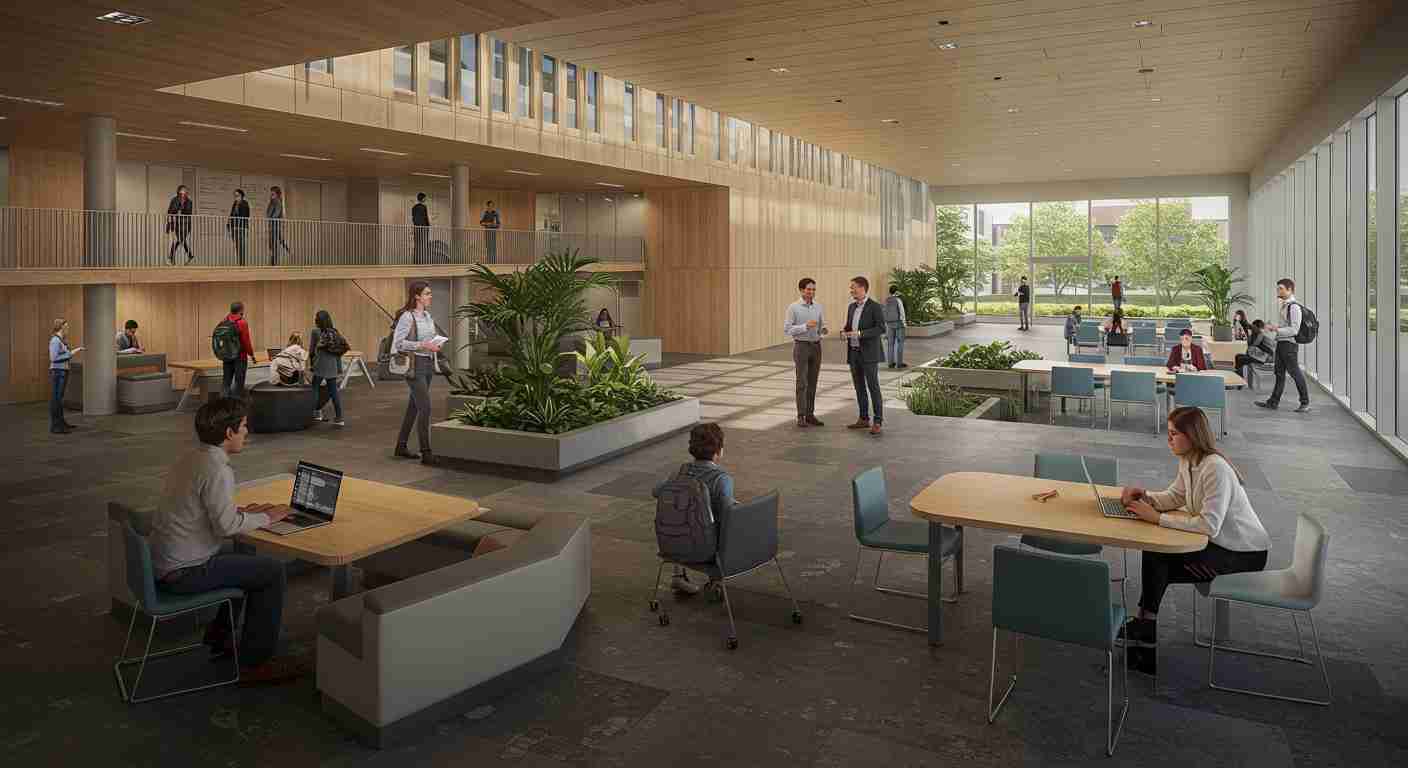
Construction on the 164,000-square-foot facility commenced in September, with occupancy expected in the fall of 2027. Designed to foster collaboration and discovery across the campus, the building will become Purdue’s second-largest classroom building in West Lafayette, after the Wilmeth Active Learning Center. Its defining feature will be flexible space for instruction, conferences, and modern teaching and research labs tailored for financial trading, data visualization, behavioral research, and experiential learning. These innovative spaces will provide students with hands-on opportunities to apply their knowledge and develop critical skills that are highly sought after in today’s business world.
Jim Bullard sees the facility as a beacon for excellence, showcasing Purdue’s unwavering commitment to business education and its dedication to integrating business and technology. This integration is crucial for preparing students to tackle the challenges and opportunities of the future. The new building will offer an environment where students, faculty, staff, alumni, and corporate partners can collaborate, innovate, and lead, setting the stage for the future of business.
The Daniels School is a key focus of the “Victories & Heroes” campaign, Purdue’s ambitious $4 billion comprehensive fundraising initiative. This campaign underscores the importance of private support in driving strategic initiatives that enhance the university’s mission. The funds raised through the campaign will be instrumental in providing scholarships, attracting top faculty, and supporting cutting-edge research, all of which contribute to the overall excellence of the Daniels School of Business.
It’s a vital component of Purdue’s mission to provide resources to the state of Indiana. By attracting top talent and fostering innovation, the Daniels School contributes to the economic vitality of the region and the state. Graduates of the program will be equipped to drive economic growth, create jobs, and contribute to the overall prosperity of Indiana. The future is bright, and you got this!
The Imperative of Real-World Experience in Business Education: Addressing the Skills Gap
The evolving business landscape, marked by rapid technological advancements, globalization, and ever-shifting consumer expectations, demands a critical reassessment of traditional business school curricula. Industry leaders, company founders, and CEOs increasingly voice a shared concern: many university graduates are not adequately prepared to navigate the complexities of the real world. A significant gap persists between academic training and the practical skills required in today’s innovation-driven industries. While universities often provide a robust theoretical foundation, graduates often struggle to translate their knowledge into effective action within dynamic business environments.
The core challenge lies in bridging this divide by seamlessly integrating real-world experiences, industry exposure, and applied learning into academic programs. Many graduates report feeling underprepared when transitioning from academic roles to professional positions. This sense of inadequacy often stems from an overemphasis on theoretical concepts at the expense of practical application. Limited industry integration and a generalized curriculum that fails to cater to increasingly specialized markets further exacerbate the problem. The relentless pace of technological change also means that market conditions and technology trends can shift dramatically by the time students graduate, rendering some of their knowledge obsolete. Real-time industry collaborations are therefore essential to ensure graduates develop current, relevant, and applicable skills. Keep pushing!
Fortunately, institutions are actively enhancing business education through a variety of innovative strategies. Real-world consulting projects offer students the opportunity to work directly with businesses, tackling actual challenges and developing practical solutions. Live case studies immerse students in complex business scenarios, requiring them to analyze data, make decisions, and justify their recommendations. Mentorship programs connect students with experienced professionals who can provide guidance, support, and valuable insights into the realities of the business world. Finally, industry partnerships create opportunities for internships, research collaborations, and guest lectures, exposing students to the latest trends and best practices.
Furthermore, the integration of AI-driven learning and personalized education is revolutionizing how students acquire and refine essential competencies. AI-powered simulations provide risk-free environments where students can test decision-making strategies, analyze outcomes, and learn from their mistakes. Personalized learning platforms tailor educational content and delivery to individual student needs and learning styles, enabling them to focus on developing specific competencies relevant to their unique career goals. Dream big!
Looking ahead, the future of business education hinges on a fundamental shift towards experiential and immersive learning. AI and data-driven decision-making will become core competencies, and the demand for specialized education in areas like fintech innovation and sustainability strategy will surge. Hybrid and experiential learning models, including interactive workshops, business simulations, and executive training labs, will increasingly complement traditional lecture-based learning. Real-time collaborations, corporate apprenticeships, and AI-powered business simulations will play a central role in developing adaptable graduates ready to hit the ground running.
Ultimately, strengthening the links between business schools and industry is paramount to ensuring that graduates are truly job-ready. While theoretical knowledge remains essential, integrating practical experiences, industry collaborations, emerging technologies, and specialized learning opportunities will effectively bridge the persistent gap between academia and the demands of the modern business world. The future is bright!
Integrating AI and Technology: Revolutionizing the Business Curriculum
Alright future leaders, let’s talk about how AI is shaking up the world of business education! Your motivational editor is here to guide you through this exciting transformation.
Business schools are stepping up their game, integrating artificial intelligence (AI) into their curricula to prepare you for an AI-driven future. The University of Missouri’s Robert J. Trulaske, Sr. College of Business, for instance, is ensuring students master emerging technologies like generative AI while developing critical thinking and analytical reasoning skills. Students in J. Scott Christianson’s Management 4710 class are experimenting with AI tools like ChatGPT, learning to think critically about their performance and potential in business scenarios. How cool is that? They’re even writing AI use policies and developing machine learning algorithms!
Meanwhile, at Cal Poly Pomona, faculty members are part of an innovative project supported by the California Education Learning Lab’s AI FAST Challenge. Their initiative focuses on developing a framework for integrating AI into marketing education, expanding AI’s reach beyond traditional STEM fields. This project aims to create AI-enhanced teaching materials, measure learning outcomes, and promote equity and inclusion across multiple California universities. You got this!
But how are AI tools actually being used in classrooms? Well, they’re popping up everywhere! Interactive learning tools are making lessons more engaging, personalized instruction is catering to individual student needs, and data analysis is providing valuable insights into student performance. As a recent Samsung survey highlights, teachers are already utilizing AI for interactive learning (20%), personalized student learning experiences (22%), and data analysis for insights into student performance (11%).
Of course, with all this exciting new technology, some concerns are popping up too. Plagiarism, misinformation, and reduced human interaction are valid worries in the context of AI-driven education. The Samsung survey also revealed that 20% of teachers are concerned about plagiarism, 13% about misinformation, and 12% about reduced human interaction. It’s crucial that we address these challenges head-on to ensure AI is used responsibly and ethically.
That’s why educating students on the ethical use of AI is so important. We need to promote responsible AI practices and cultivate tech-savvy learners who understand the implications of their work. The Samsung survey found that a whopping 88% of teachers emphasize the importance of ethical AI education! Keep pushing!
Now, integrating AI into the classroom isn’t always a walk in the park for teachers. Many report a lack of resources, training, and updated curriculum materials. A staggering 97% of teachers in the Samsung survey reported a lack of necessary tools and training to effectively incorporate AI into their teaching practices. Addressing this resource gap is essential to empowering educators to effectively use AI in their classrooms. Initiatives like Samsung Solve for Tomorrow, which provides funding, training, and technology resources to schools, are crucial for bridging this gap.
So, while the integration of AI into business education presents some challenges, the potential benefits are immense. By embracing these technologies and addressing the ethical considerations, we can prepare students for a future where AI is an integral part of the business world. Dream big!
Purdue’s Broader Impact: Economic Development, STEM Education, and Community Engagement
Purdue’s commitment to shaping Indiana’s future extends far beyond the walls of its West Lafayette campus. In Indianapolis, the university is making significant strides in providing accessible STEM-based education. The recent groundbreaking of the Academic Success Building in downtown Indianapolis signifies a major expansion of Purdue’s presence in the capital city. This 248,000-square-foot facility, slated for completion in May 2027, will house classrooms, laboratories, dining facilities, and housing for Purdue faculty, students, and staff. Importantly, it will also provide space for community members and local high schools, fostering a collaborative environment that extends beyond the university’s immediate community. This expansion reflects Purdue’s dedication to connecting students and faculty with local businesses, thereby strengthening Indiana’s tech ecosystem. The Purdue University in Indianapolis is an innovative expansion of Purdue University West Lafayette, aiming to extend academic rigor and accessible excellence to central Indiana. You got this!
Purdue’s impact on Indiana’s economy is also evident in its agricultural research. A recent study highlighted how improved crop varieties resulting from agricultural research have led to significant environmental and food system sustainability benefits. This research, which analyzed global data from thousands of grid cells, demonstrated that reduced agricultural land use saved over a thousand animal and plant species. From 1961 to 2015, these improvements reduced global croplands by more than 39 million acres while increasing crop production by 226 million metric tons. The university’s commitment to agricultural innovation is not only enhancing food security but also mitigating agriculture’s environmental footprint, contributing to a more sustainable future for Indiana and the world. Keep pushing!
Furthermore, Purdue University Northwest (PNW) stands as a beacon of innovation in Northwest Indiana. Recognized as the third Innovation and Economic Prosperity University in the state, PNW demonstrates a strong commitment to collaboration with public and private sector partners to bolster economic and community development. With the establishment of the Roberts Impact Lab, a commercialization center and regional hub for business growth, PNW is poised to further enhance its impact on the region. This lab, which will feature PNW’s quantum computing lab, will serve as the centerpiece of a new $40 million-plus downtown innovation district in Hammond, Indiana. By fostering a deeper understanding of various fields through its nearly 20 research and specialty centers, PNW is playing a crucial role in advancing regional development and driving economic growth.
The vitality of Indiana’s research institutions is also intrinsically linked to federal funding, particularly from the National Institutes of Health (NIH). The recent temporary block on proposed NIH funding cuts offered a sigh of relief for universities, hospitals, and research centers across the state. These institutions rely on substantial NIH funding for various scientific and clinical research projects, and the proposed cuts threatened to negatively impact Indiana’s scientific capabilities, jobs, and economy. In 2023, Indiana received $414 million in NIH grants, supporting thousands of jobs and generating over a billion dollars in economic activity. Maintaining robust NIH funding is therefore essential for ensuring the continued success of Indiana’s research ecosystem and its ability to contribute to scientific advancements and economic prosperity. Dream big!
Finally, it’s important to acknowledge the challenges facing STEM education and the efforts being made to address them. Samsung’s ‘Solve for Tomorrow’ campaign, for example, highlights the increasing importance of artificial intelligence (AI) and entrepreneurship within STEM education. The survey commissioned by Samsung revealed a significant gap in resources for integrating emerging technologies like AI into STEM curricula. Initiatives like the Samsung Solve for Tomorrow competition and Teacher Academy are crucial for bridging this gap, providing students with opportunities to develop STEM-based solutions for real-world problems and empowering educators with the necessary tools and training to integrate AI into their classrooms. By addressing these challenges and fostering innovation in STEM education, Indiana can ensure that its students are well-prepared for the jobs of the future. The future is bright!
Reference:
- University Breaks Ground on New Daniels School of Business Building
- The Future of Business Education: Real-World Experience
- AI Meets Academia: Revolutionizing Business Education for the Future
- CBA Faculty Awarded AI FAST Grant from California Education Learning Lab
- Samsung Survey: AI in STEM Education Faces Training Gaps
- Samsung Solve for Tomorrow Explores ‘The State of STEM Education’ in New Survey
- Purdue University Breaks Ground on Academic Success Building in Indianapolis
- New Study Assesses Impact of Agricultural Research Investments on Biodiversity, Land Use
- Innovation at Purdue University Northwest
- Indiana Universities Dodge Major NIH Funding Cuts, For Now