
(This article reports on news from November 2023.)
In November 2023, the University of Florida College of Nursing reported that its Accelerated Bachelor of Science in Nursing (ABSN) program at the UF Health Jacksonville campus had welcomed its largest cohort ever, 38% larger than in 2022. The college said it planned to keep growing the Jacksonville class until enrollment doubled, to 80 students, as part of an effort to ease Florida’s long-term nursing shortage and to recruit and keep nurses at UF Health Jacksonville (UF News, November 7, 2023).
What UF announced
- Record Jacksonville cohort: the fall 2023 ABSN class in Jacksonville was the campus’s largest, up 38% from 2022, with plans to double enrollment to 80 students.
- State funding: the growth was paid for by PIPELINE (Prepping Institutions, Programs, Employers and Learners through Incentives for Nursing Education) funding, which the Florida Legislature awarded in 2022 to expand the nursing workforce.
- Retention record: over the previous seven years UF Health Jacksonville had hired 115 UF nursing students, and nearly 70% of them still worked there. UF compared this with a national turnover rate of 24% for nurses after their first year on the job.
- Why it matters in Florida: the UF Bureau of Economic and Business Research estimates that 30% of Florida’s population will be 60 or older by 2030, up from about 27% in 2023, while many nurses left the profession during the COVID-19 pandemic.
“The Accelerated B.S.N. program in Jacksonville has proven the advantages of investing in student nurses,” said Debra Lyon, then interim dean of the College of Nursing. Student Alfredo Marroquin, who hoped to work in the emergency department of UF Health Jacksonville, a Level I adult and pediatric trauma center, said: “One of my favorite parts is how close the cohort is.”
The Academic Partnership Unit
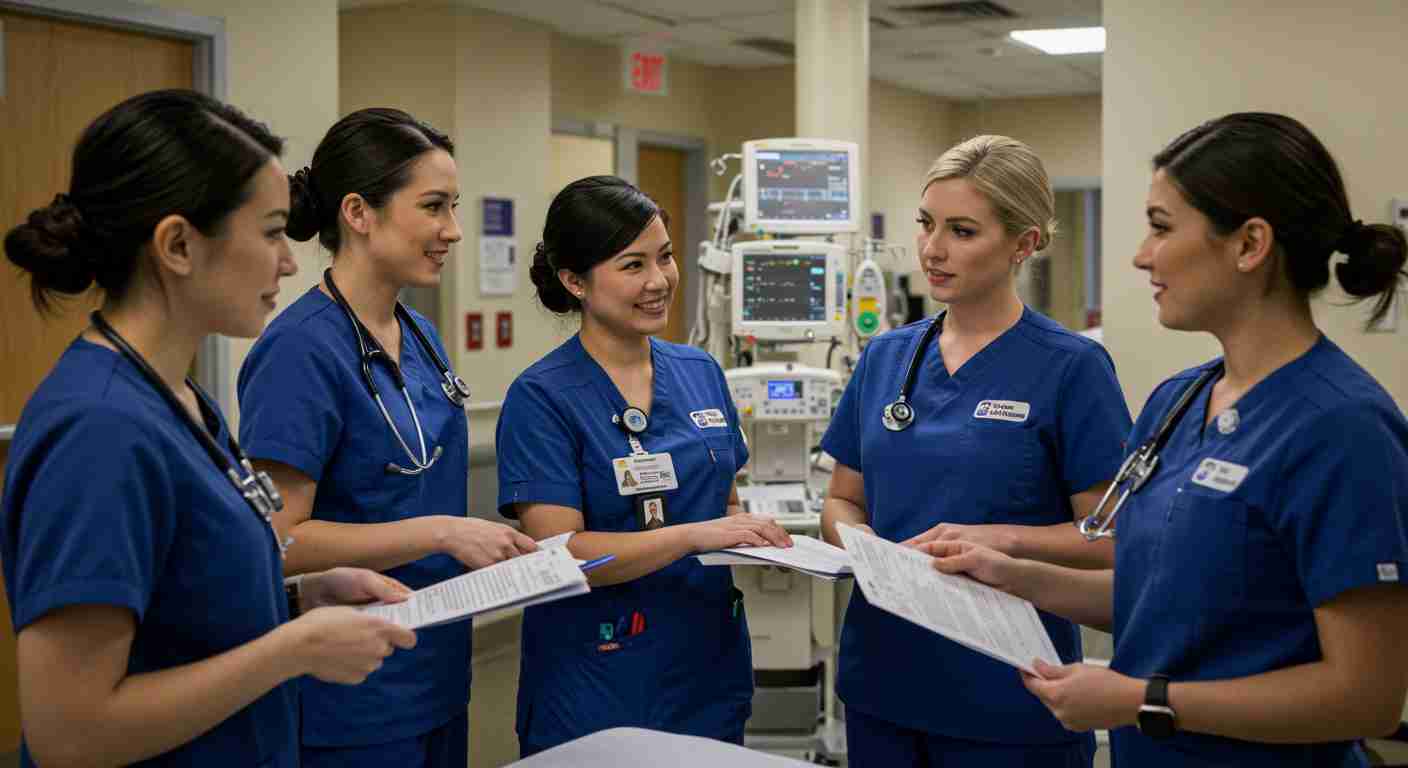
A big part of UF Health Jacksonville’s hiring record is its Academic Partnership Unit (APU), which UF says only one other U.S. hospital runs. Created by clinical faculty members Michael Aull and Patrick Nobles, the APU places each nursing student on one hospital unit for the whole clinical rotation. A staff nurse works one-on-one with the student while caring for patients and becomes, in Aull’s words, “a primary role model and mentor.” Eight units at UF Health Jacksonville took part as of 2022, and former APU students later return as mentors. Aull and Nobles reported in the Journal of Nursing Administration that nurses who had been through the APU had a 7% turnover rate after two years (UF College of Nursing, March 2, 2022). For nursing leaders, the program is also a way to assess and recruit students before they graduate.
How UF’s Accelerated BSN works
The ABSN is for people who already hold a bachelor’s degree or higher in a field other than nursing. According to the program page as of November 2026 (UF College of Nursing: Accelerated BSN):
- Format: four semesters of full-time coursework and clinical training. Classes start each May and finish in August of the following year, at either the Gainesville or the UF Health Jacksonville campus. Students may have to travel up to 100 miles to clinical sites.
- GPA: at least 3.0, calculated on the last 60 credits of the bachelor’s degree (or the cumulative GPA of a master’s or doctoral degree).
- Prerequisites (grade of C or better, completed by the end of the spring semester before the summer start): Anatomy and Physiology 1 and 2 with labs, Microbiology with lab, Statistics, Human Growth and Development (or Developmental Psychology), and Human Nutrition.
- Application: the UF post-baccalaureate application plus a NursingCAS application. The deadline for the summer 2027 cohort is February 1, 2027.
- Entrance exam: the HESI A2, taken once for UF in a single session through ProctorU. There is no minimum score; UF describes a cumulative score of 85 and a critical-thinking score of 800 or higher as competitive.
- Space is limited: UF says not all qualified applicants can be admitted.
Notes for international applicants
- Foreign degrees: transcripts not issued in English need certified, literal English translations, and applicants with foreign coursework must submit a course-by-course credential evaluation with a GPA calculation. Science prerequisites taken abroad will be judged through that evaluation, so check early whether yours will count.
- English: applicants whose first language is not English need a TOEFL score of at least 80 (internet-based), 213 (computer-based) or 550 (paper-based).
- Scholarships: the state-funded ABSN scholarships UF has offered since 2025 cover tuition and books but require a 36-month work commitment at UF Health, and UF Health said only Florida residents were eligible for the first round. International students should budget for full out-of-state tuition. See our report on UF’s record nursing class and LINE scholarships.
- Working after graduation: graduates must pass the NCLEX-RN and obtain a state RN license before practicing. Nursing is not on the Department of Homeland Security’s STEM-designated degree list, so F-1 graduates generally get 12 months of post-completion OPT, without the 24-month STEM extension.
Latest developments
UF’s nursing expansion continued after 2023. In March 2025 the college received $3 million, half from Florida’s Linking Industry to Nursing Education (LINE) program and half from UF Health, to fund 50 ABSN scholarships and lab upgrades at both campuses (UF Health, March 2025). In August 2025, 226 new BSN students started classes, including 85 newly created seats, bringing BSN enrollment across the traditional, accelerated and RN-to-BSN tracks to 722 (UF College of Nursing, August 20, 2025).
Demand for registered nurses remains strong: in May 2025 U.S. RNs earned a median of $97,550 a year (BLS Occupational Employment and Wage Statistics, May 2025). For a broader guide to how BSN programs work, see Studying Nursing in the U.S.: How a BSN Works.
References
- UF News: Accelerated nursing program at UF Health addresses nursing shortages in Jacksonville (November 7, 2023)
- UF College of Nursing: A solution to shortages: UF nursing program aids retention, recruitment (March 2, 2022)
- UF College of Nursing: Accelerated BSN program page
- UF Health: UF Nursing secures $3 million to expand Florida’s nurse workforce (March 2025)
- UF College of Nursing: Record number of students this fall (August 20, 2025)
- BLS: Registered Nurses, Occupational Employment and Wages (May 2025)
- University of Florida (Forward Pathway school page)