
This article was originally reported in September 2025.
On July 1, 2025, Brown University‘s Watson Institute for International and Public Affairs officially became the Thomas J. Watson Jr. School of International and Public Affairs. Economist John N. Friedman became its inaugural dean, and former institute director Edward Steinfeld, who developed the proposal for the new school, holds the honorary title of founding dean (Brown University, July 1, 2025). In September 2025, Brown announced a year of launch events, including a celebration on October 25 with retired Gen. Mark A. Milley (Brown University, September 30, 2025).
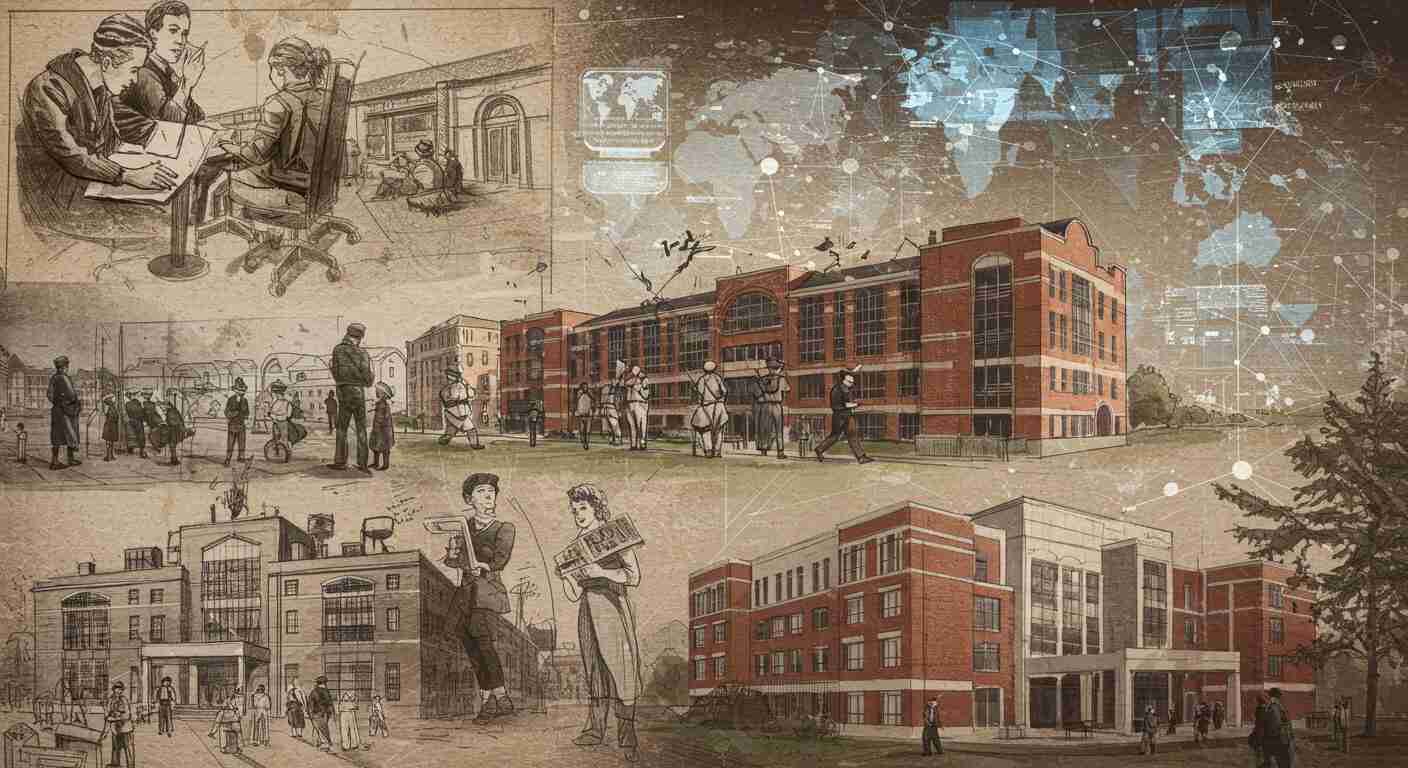
From council to school: a short history
Brown’s official history of the school traces it back several decades (Brown University):
- 1979: President Howard R. Swearer created a Council for International Studies.
- 1986: Swearer proposed an Institute for International Studies to bring related programs together.
- 1991: the institute was named for Thomas J. Watson Jr., a Brown alumnus, former IBM president and former U.S. ambassador to the Soviet Union.
- 2011: the Costs of War project was founded to measure the human and financial toll of U.S. wars after 9/11.
- 2014: the institute merged with the Taubman Center for Public Policy and American Institutions (founded 1984) and became the Watson Institute for International and Public Affairs. Brown launched its one-year Master of Public Affairs (MPA), which it describes as the only one-year residential MPA in the Ivy League.
- 2018: the institute moved into Stephen Robert ’62 Hall.
The inaugural dean
Brown named Friedman dean on April 21, 2025, as the Vascellaro Family Dean of International and Public Affairs, a position endowed by Mary and Jerome Vascellaro. Friedman studies social mobility, education and policymaking. He joined Brown’s faculty in 2015, chaired the Department of Economics from 2021 to 2024, and is a founding co-director of Opportunity Insights, the research lab known for its studies of economic mobility. He previously taught at the Harvard Kennedy School (2009–2014) and spent a year at the White House as special assistant to the president for economic policy on the National Economic Council (2013–2014). Friedman called the new school “a once-in-a-generation opportunity to build an interdisciplinary community of scholars, students and practitioners” (Brown University, April 21, 2025).
The launch-year program
Brown’s September 2025 announcement listed the inaugural year’s public events (Brown University):
- Dean’s Fireside Chats: James Kvaal, former U.S. under secretary of education, on “The Federal Government and Universities: What Went Wrong and How to Fix It” (September 30, 2025); Yvonne Aki-Sawyerr, mayor of Freetown, Sierra Leone (March 30, 2026); and Jay Clayton, U.S. attorney for the Southern District of New York (April 20, 2026).
- Three new research seminar series: Global Challenges, International Development, and Politics and Policies, with speakers from the World Bank, Princeton, Johns Hopkins, Boston University, Harvard, the University of Chicago and Yale.
- Launch celebration (October 25, 2025): a keynote on global security by Gen. Mark A. Milley, the 20th chairman of the Joint Chiefs of Staff (2019–2023), followed by a Q&A with Dean Friedman.
“No government holds separate policy meetings for each discipline,” Friedman said in explaining the school’s interdisciplinary approach (Brown University). At the October 25 event, held in the Salomon Center for Teaching, Milley also met with a small group of students, many of them veterans or active-duty members in the school’s Military Fellows Program (Brown University, October 25, 2025).
Latest update: growth plans and a new online MPP
In May 2026, at the end of its first year, the Watson School said it plans to double its faculty over the next five years, launch new research centers and expand its graduate programs under a new strategic plan (Watson School, May 29, 2026). Highlights:
- New faculty: economists Pablo Ottonello and Fabrizio Perri from the Federal Reserve Bank of Minneapolis are joining, among other hires.
- A redesigned MPA with at least ten new or redesigned courses and five specialization tracks: Global Security; International Finance and Economics; International Development; Climate, Energy and Environmental Policy; and Social and Economic Policy.
- An online Master of Public Policy (MPP): a 16-month, asynchronous program for working professionals, starting in January 2027.
- A $12 million gift from the Bravo Family Foundation, founded by alumnus Orlando Bravo, to fund two endowed professorships and economic and policy research.
- Later launch-year speakers included former secretaries of state Hillary Rodham Clinton and Condoleezza Rice at the Ogden Lecture.
How the programs rank
In U.S. News’ graduate public affairs rankings released in 2026, Brown is No. 55 in public affairs overall, No. 15 in international policy, No. 19 in social policy and No. 31 in public policy analysis. Brown University is No. 16 among national universities in the 2027 U.S. News ranking (Forward Pathway, schools and majors rankings; U.S. college rankings).
Applying to the Brown MPA as an international student
- Format: a one-year, full-time residential program that starts in early summer: two short summer sessions, then fall and spring semesters, for 10 course credits (Watson School, MPA Program Costs). Because it is residential, it works with an F-1 visa; the new online MPP does not.
- Deadline and materials: for entry in 2027, the application opens September 1, 2026 and closes January 15, 2027 (fee $100). Applicants submit transcripts, a resume, a personal statement and three recommendation letters. The GRE is optional but strongly encouraged; without it, applicants submit a quantitative resume. International applicants need TOEFL or IELTS scores (minimums are set by the Brown Graduate School), and admitted students with non-U.S. degrees need a course-by-course evaluation from ECE, WES or The Evaluation Company (Watson School, MPA Admissions Requirements).
- Cost: tuition is $8,740 per course credit in 2026–27, or about $87,400 for the 10-credit program before fees and living costs. All admitted MPA students receive some merit-based aid (Watson School, MPA Program Costs).
- Visa paperwork: admitted international students who need a visa must complete Brown’s financial certification before the I-20 can be issued (Watson School, MPA FAQ).
Undergraduates can also study these subjects at the Watson School through its international and public affairs concentration. For admissions statistics, costs and international enrollment, see our Brown University profile.
References
- Brown University: Watson School launch and history (July 1, 2025)
- Brown University: John N. Friedman named inaugural dean of the Watson School (April 21, 2025)
- Brown to mark Watson School’s inaugural year with robust events lineup, celebration in October (September 30, 2025)
- At Watson School launch event, Gen. Mark Milley stresses importance of upholding American values (October 25, 2025)
- Watson School experiences growth, plans for the future in inaugural year (May 29, 2026)
- Watson School: MPA Admissions Requirements
- Watson School: MPA Program Costs
- Watson School: MPA FAQ
- Forward Pathway: Schools and Majors Rankings