
This article was originally reported in July 2025. A November 2026 update on the 2026 cohort and the 2027 application is at the end.
In summer 2025, the Breakthrough Lab (B-Lab), the summer startup accelerator run by Brown University‘s Nelson Center for Entrepreneurship, brought together 23 student founders working on 13 ventures in health care, technology, food, wellness and social enterprise. It was B-Lab’s 11th consecutive summer. Over eight weeks, participants worked full time on their ventures with expert-led workshops, mentoring from experienced entrepreneurs, peer feedback and pitch events (Brown University News, July 24, 2025).
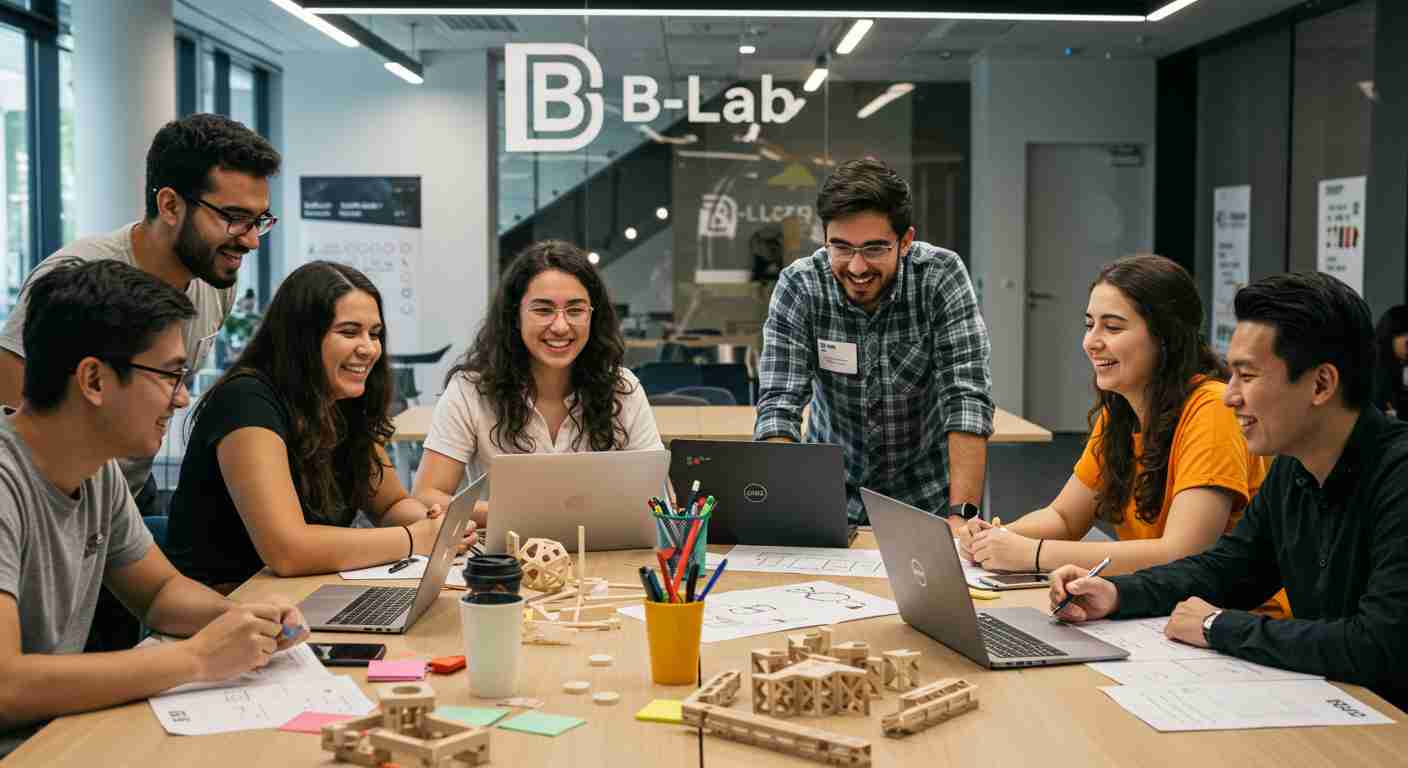
How B-Lab works
- Funding: each undergraduate participant receives a $4,000 scholarly award so that he or she can work on the venture full time instead of taking a summer job. “There are no distractions,” said B-Lab director Alexis Alston, a Brown alumna and venture capital professional.
- Who takes part: students from a wide range of concentrations, a handful of graduate students, recent Brown graduates and students from the Rhode Island School of Design (RISD). “B-Lab is really for anyone who is trying to solve big problems at scale,” Alston said.
- Support: workshops, one-on-one mentoring from a network of entrepreneurs, industry-specific advice, and peer support within the cohort. “Entrepreneurship outside of Brown can be a very lonely experience,” Alston said.
- Pitching: founders practice at Bears Lair, the Nelson Center’s “Shark Tank”-style event, giving five-minute pitches to alumni followed by questions, and end the summer with a pitch night and expo.
Source: Brown University News.
The 2025 ventures
The 2025 cohort included several teams of international graduate students. The 13 ventures were (Brown University News):
| Venture | Founders | What it does |
|---|---|---|
| 1nvestSense | Letian Yu, Sicheng Yang, Xiner Zhao (master’s in data science) | AI app using large language models to give retail investors real-time market insights |
| ChopChop | Junxi “Aaron” Shen, Shaoyuan “Ice” Yu, Zhou “Claude” Zou (master’s in innovation management and entrepreneurship) | Online marketplace for buying and selling homemade food |
| Daylily | Kartik Shrivastava (computer science, Class of 2028) | AI agent that handles real-time bargaining and direct sales for Shopify brands |
| EndoSwim | Milidu Jayaweera (biomedical engineering and entrepreneurship, Class of 2026) | Swallowable robotic capsule for non-invasive colonoscopy |
| Flosense | Noopur Kabra, Ruchi Ukhade, Sarah Fletcher (master’s in design engineering) | Pain-free external device that collects menstrual blood samples for lab testing |
| Melaa | Janya Kaur (Class of 2026), Jitpuwapat “Earth” Mokkamakkul (Class of 2025) | Platform for booking underused spaces such as cafés for gatherings |
| Nematex | Christopher Williams (geology-biology and computer science, Class of 2026) | Targeted biological solution to root-knot nematodes that damage crops |
| Nuru Bio | Christine Lujuo (master’s in biomedical engineering, 2025) | Marketplace connecting researchers with biological samples from African biobanks |
| RootedInLocal | Galit Ringach (environmental science, Class of 2025) | Farmer-first online marketplace for local food |
| Sensia | Parsa Lajmiri (Class of 2026), Benjamin Schornstein (Class of 2024) | Privacy-first system using smartwatch data to flag early signs of employee burnout and depression |
| TOMATO.FISH | Qinyi Fan (RISD interior architecture, Class of 2025) | Made-to-order traditional Chinese pastries sold online, at pop-ups and by local delivery |
| UAPPLY | Moise Gasana (Class of 2026), Maximilian Tippie (Class of 2027) | Single-profile platform for applying to multiple African universities |
| WYM | Sarah Comlan (Brown, Class of 2025), Vivian Uzibor (Wellesley, Class of 2024) | Water-sealed swim cap designed for textured and styled hair |
Applying to B-Lab
According to the Nelson Center’s program page (Brown Nelson Center: B-Lab Summer Accelerator), as of November 2026:
- Eligibility: currently enrolled full-time Brown or RISD undergraduate, graduate or medical students, including graduating seniors. Brown/RISD alumni and students from other schools can take part only as co-founders with a currently enrolled Brown or RISD student, and they do not receive the award.
- Teams: solo founders are not ruled out, but the program strongly prefers founding teams, ideally ones that have already worked together.
- Award: a $4,000 Scholarly Fellowship Award, plus Summer Earnings Waiver (SEW) support for eligible Brown students.
- Commitment: full time, in person in Providence for all eight weeks, starting with a two-week boot camp. B-Lab must be the participant’s main summer commitment; research assistantships (including UTRAs), summer courses and outside accelerators are not compatible.
- Timeline for summer 2027: applications open in December; the deadline is February 19, 2027, at 1:00 p.m. Eastern, and late applications are not considered. Finalists are notified in early March, interviewed in mid-March and told the final decision at the end of March.
For international students
- International students can apply. The Nelson Center asks them to visit Brown’s Office of International Student and Scholar Services (OISSS) early in the spring semester to complete the paperwork needed to stay in Providence over the summer, and notes that the award may be subject to tax withholding depending on tax-treaty benefits (Nelson Center).
- Working for your own startup is employment. Under Department of Homeland Security guidance, an F-1 student who runs a business must qualify for and obtain Optional Practical Training (OPT), and the business must relate to the student’s field of study; pre-completion OPT is limited to 20 hours a week while school is in session, and once OPT ends the student may not keep working for the business without another status that allows it (Study in the States: International Students and Entrepreneurship). Developing an idea in a program like B-Lab is different from being employed by your company, so confirm with OISSS what you may and may not do before incorporating, taking a salary or signing contracts.
- Undergraduate aid at Brown. Starting with first-year students entering in fall 2025, Brown is need-blind for international undergraduates and meets full demonstrated need for those admitted, provided they apply for aid when they apply for admission (Brown Undergraduate Financial Aid). Brown estimates the 2026–27 first-year cost of attendance at $99,994, including tuition of $74,568 (Brown Office of Financial Aid).
- Ranking. Brown is No. 16 among national universities in the 2027 U.S. News Best Colleges ranking (Forward Pathway: Brown University).
Latest update (November 2026)
B-Lab ran for its 12th consecutive summer in 2026 with nine ventures, including Naiad Technologies (a water-monitoring device that detects harmful algal blooms), Lindatoto (a digital health-records and telemedicine platform for low-resource settings), Goldvi and Subsix Nutrition (clean-label nutrition for older adults and athletes) and Tona (an AI dermatology tool aimed at better diagnosis for darker skin tones). Brown said B-Lab has supported 167 ventures since it launched in 2015, and more than 400 Brown alumni have served as mentors. “A great entrepreneur is obsessed with the problem they’re solving,” Alston said (Brown University News, July 23, 2026). Applications for summer 2027 are due February 19, 2027.
References
- Brown University News: B-Lab 2025: Student entrepreneurs develop solutions in health care, tech, wellness and more (July 24, 2025)
- Brown University News: Inside Brown’s Breakthrough Lab, where student entrepreneurs learn to tackle big problems (July 23, 2026)
- Brown University Nelson Center for Entrepreneurship: B-Lab Summer Accelerator
- DHS Study in the States: International Students and Entrepreneurship
- Brown Undergraduate Financial Aid: Need-blind admission
- Brown Office of Financial Aid: Cost of attendance
- Forward Pathway: Brown University