
(This article reports on news from May 2025.)
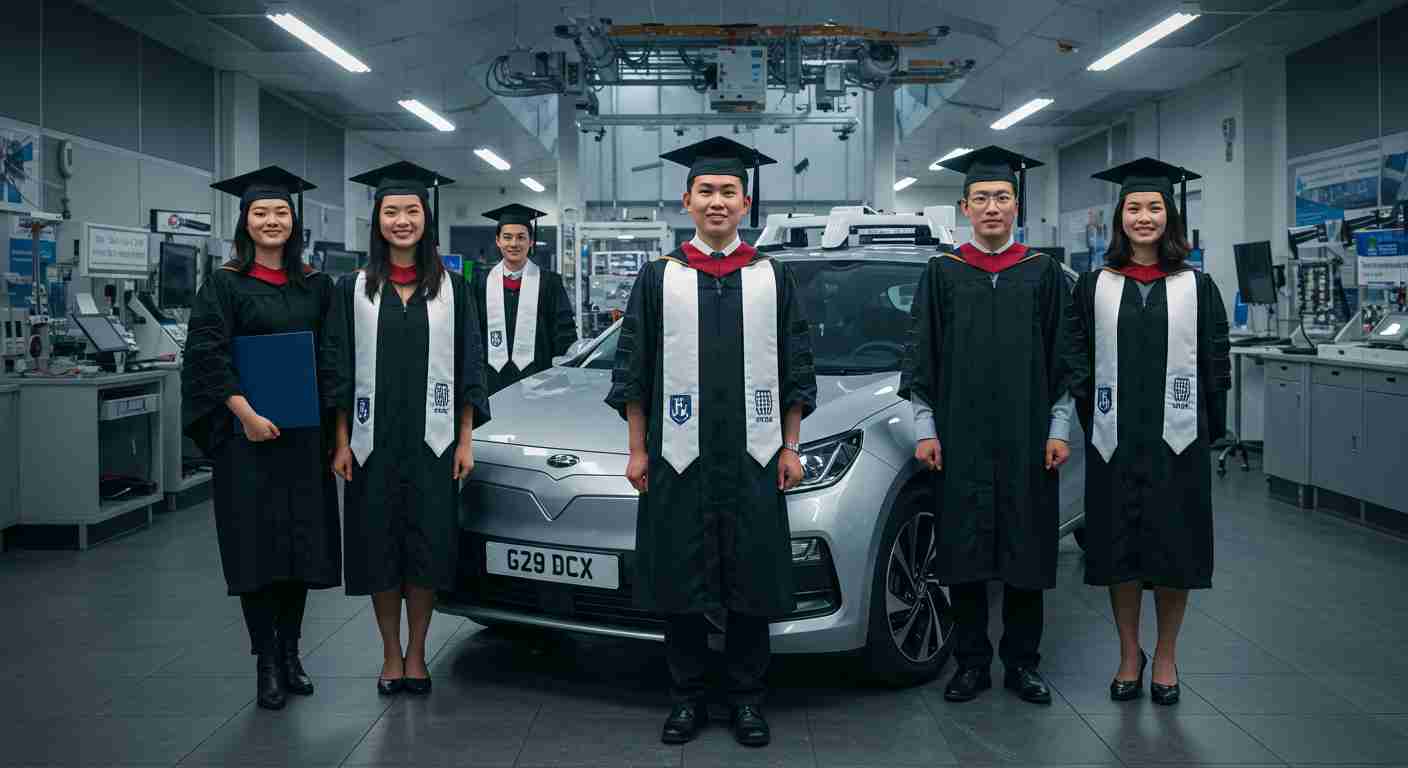
In May 2025 Clemson University awarded the first undergraduate degrees from its Bachelor of Science in Automotive Engineering, which the university describes as the first such bachelor’s program in the United States. Four students who finished early by applying earlier credits and taking senior-level courses ahead of schedule were honored that week with a brick-laying ceremony at the Clemson University International Center for Automotive Research (CU-ICAR) in Greenville, South Carolina, where their names were engraved in a brick pathway. Most of the first undergraduate class was expected to graduate later in 2025 or in early 2026 (Clemson News, May 9, 2025).
The first four graduates
| Graduate | Hometown | Next step |
|---|---|---|
| Garrison Bishop | Spartanburg, S.C. | Also earned a B.S. in mechanical engineering from Clemson; accepted a role at Imperial Die Casting |
| Matthew Flaim | Yorktown Heights, N.Y. | Graduate study in automotive engineering at CU-ICAR |
| Trevor Levine | Irmo, S.C. | Former CU-ICAR Makerspace staff member; accepted a position at Bertrandt US Inc. |
| Colin Luongo | Oxford, Ga. | Graduate study in automotive engineering at CU-ICAR |
“Looking back now, after almost 20 years, I see a vibrant graduate program that has really found its footing,” said Laine Mears, director of the School of Mechanical and Automotive Engineering and BMW SmartState Chair of Automotive Manufacturing. Anand Gramopadhye, dean of the College of Engineering, Computing and Applied Sciences, called the milestone “a testament to Clemson’s commitment to aligning education with the evolving needs of industry.” Clemson said more than 96% of the program’s graduates are employed in the mobility industry.
Two decades of automotive engineering at Clemson
| Year | Milestone |
|---|---|
| 2002 | Board of Trustees approves a graduate program in automotive engineering; BMW, Timken and Michelin endow professorships |
| 2006 | First graduate students enroll |
| 2009 | First master’s and Ph.D. degrees awarded |
| 2010 | Department of Automotive Engineering formed |
| 2022 | Board approves the undergraduate degree, developed with input from industry partners |
| 2023 | B.S. in Automotive Engineering launches with 35 students |
| 2025 | First B.S. degrees awarded; more than 1,110 graduate degrees conferred to date |
Source: Clemson News, May 9, 2025.
How the bachelor’s program works
- Entry through General Engineering. First-year applicants are admitted to Clemson as General Engineering students and take calculus, physics and other foundation courses. After the first year, students apply to the automotive engineering major in a competitive process (Clemson Automotive Engineering B.S.).
- Two campuses. Students spend their first two years on the main campus in Clemson and, from junior year, take classes at CU-ICAR in Greenville, about 45 minutes away by university bus, where the automotive faculty, graduate students and test facilities are based (Clemson News, February 16, 2023).
- Deep Orange capstone. Seniors work on Deep Orange, Clemson’s program in which students design and build a prototype vehicle, alongside master’s students.
- Combined B.S./M.S. Majors with a GPA of 3.4 or higher after their junior year can start an M.S. and count a limited number of graduate courses toward both degrees; the GRE is not required (Clemson B.S./M.S.).
When the program was announced in 2023, Clemson pointed to the concentration of automakers within 500 miles of the campus — including BMW, Volvo, Mercedes-Benz Vans, Honda, Tesla, Ford, General Motors, Toyota, Mazda, Nissan and Kia — and said it expected enrollment to grow to more than 200 students by fall 2027.
Graduate options for international students
Clemson’s graduate programs are the longest-established part of its automotive engineering offering. The department offers an in-person M.S. that requires an internship of at least six months in industry or with Deep Orange, an online M.S. (internship or thesis), a Ph.D. with five main research areas, and a graduate certificate. Research takes place at CU-ICAR (Clemson Automotive Engineering graduate programs). Engineering degrees generally carry STEM-designated CIP codes, which allow F-1 graduates to apply for the 24-month STEM OPT extension after 12 months of OPT if the employer uses E-Verify (USCIS); confirm the CIP code on your I-20 with Clemson’s international office. Note that only on-campus programs can sponsor an F-1 visa — online degrees do not.
Clemson at a glance
Clemson ranks No. 80 among National Universities in the 2027 U.S. News ranking, No. 57 for undergraduate engineering (2027) and No. 54 for graduate mechanical engineering (2026). For fall 2025 it received 61,517 first-year applications and admitted 23,586 (38.3%). It enrolled 29,077 students, including 1,695 international students — 1,483 of them graduate students. Out-of-state undergraduate tuition and required fees were $40,866 for 2025–26 (IPEDS). See our Clemson University school page and the schools and majors rankings.
References
- Clemson University celebrates nation’s first undergraduate degrees in automotive engineering (Clemson News, May 9, 2025)
- Clemson University to launch nation’s first Bachelor of Science program in automotive engineering (Clemson News, February 16, 2023)
- Automotive Engineering B.S., B.S./M.S. and graduate programs (Clemson Department of Automotive Engineering)
- Optional Practical Training for F-1 Students (USCIS)
- Clemson University (Forward Pathway school page; IPEDS admissions, enrollment and tuition data)