
(This article reports on news from April 2025.)
In April 2025, Clemson University marked the 20th year of Creative Inquiry, its program of team-based undergraduate research. Since its founding in 2005, Creative Inquiry has supported more than 72,000 undergraduate student experiences in more than 2,500 projects, and about 40% of Clemson’s living alumni took part in it as students (Clemson News, April 8, 2025).
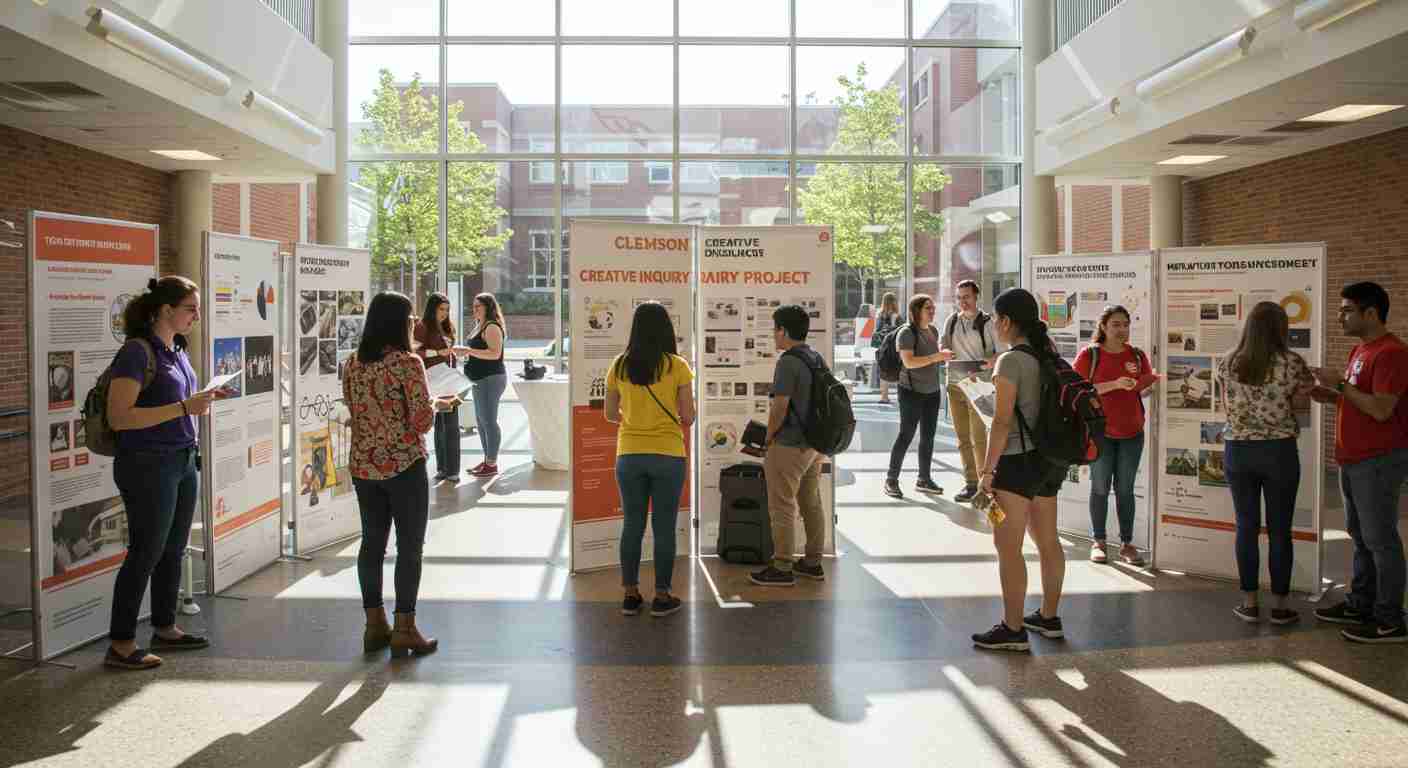
What Creative Inquiry is
Creative Inquiry + Undergraduate Research (CI + UR) is run from Clemson’s Watt Family Innovation Center. Each year about 4,500 undergraduates from all disciplines join roughly 400 long-term, team-based projects mentored by faculty, postdoctoral researchers and graduate students (Creative Inquiry + UR). Key features reported by Clemson:
- Open to every level and every major. First-year students can join, and projects exist in every academic department. The largest concentrations are in the colleges of Engineering, Computing and Applied Sciences; Science; Agriculture, Forestry and Life Sciences; and Behavioral, Social and Health Sciences.
- Teams rather than one-on-one lab work. Barbara Speziale, associate director of the Watt Center, who has led CI since 2008, said the program “broke through the traditional boundaries” that limited undergraduate research to one-on-one work and laboratory STEM fields.
- Real-world projects. Examples include public art outside McAlister dining hall, solar stations built and installed outside the Watt Center, the student-run Tiger Paw Classic golf tournament (which has raised more than $280,000 for nonprofits and scholarships), Tiger Pen Pals (education majors working with students on Eleuthera in the Bahamas on literacy practices) and field research in the Florida Keys on how waste affects invertebrates.
- Local impact. In the 2024–25 academic year, 139 projects directly benefited South Carolina through research, service learning and outreach.
- Tracked results. Since 2013 Clemson has kept a database of CI outcomes, with faculty reporting each year on publications and conference presentations. Speziale estimated that at a 2022 national symposium of about 20 universities, only four came close to Clemson’s program in size and scope.
Students present their work at the annual Focus on Creative Inquiry poster forum in the Watt Center (held April 9–11 in 2025), and Clemson also runs a student research forum and a summer undergraduate research symposium.
How to join a project
- Find a project. Use the CI project finder, which lists projects actively recruiting students from each major, and the list of current projects (CI + UR for undergraduate students).
- Email the mentor. Clemson advises sending the project mentor a professional email explaining your interest and asking how to join (CI student information).
- Register for credit. Most students take part through a course section for the project, with instructor approval. Registration steps differ by department: for example, General Engineering students submit their top three project choices through a form (General Engineering CI project list), while Biological Sciences requires instructor consent and a registration override (Biological Sciences courses).
- Plan to stay. Projects are long-term, and continued work can lead to citable accomplishments such as presentations at professional society conferences and co-authored publications.
Questions go to the CI + UR office at [email protected] or 864-656-9497.
Why it matters for international students
- Research experience early. At many large universities, undergraduate research depends on finding a professor willing to take you on. Creative Inquiry gives first- and second-year students a structured route, which helps when applying to graduate school or for internships.
- Credit versus pay. Most CI work is done for academic credit. If a project offers paid hours instead, that counts as on-campus employment for F-1 students, which is limited to 20 hours a week while classes are in session; check with Clemson’s international student office before accepting.
- Know the campus. Clemson is a public research university in a small town in northwestern South Carolina, ranked No. 80 among national universities in the 2027 U.S. News rankings (Forward Pathway rankings). Undergraduate enrollment, international student numbers and costs are on Forward Pathway’s Clemson school page.
References
- Clemson News: Starting with a question, ending with impact: 20 years of Creative Inquiry (April 8, 2025)
- Clemson University: Creative Inquiry + Undergraduate Research
- Clemson University: CI + UR for undergraduate students
- Clemson University: CI student information
- Clemson University (Forward Pathway school page)
- Forward Pathway: U.S. college rankings