
This article was originally reported in May 2025. Current program details for the 2026–27 academic year are at the end.
On May 27, 2025, Cornell University announced a new Semiconductor, Manufacturing, and Industrial (SEMI) Engineering pathway within its Master of Engineering (M.Eng.) in Systems Engineering. The pathway was open to both on-campus and distance-learning students. Cornell was then accepting applications for fall 2025 (until May 31, 2025) and spring 2026 (until December 1, 2025) (Cornell Chronicle, May 27, 2025).
What the SEMI pathway includes
- Core courses, shared with Cornell’s other systems engineering pathways: Model Based Systems Engineering or Foundation Systems Engineering; Systems Analysis Behavior and Optimization; and Project Management and Leadership for Complex Systems or Principles of Project Leadership.
- Electives chosen from the pathway’s course list. Students can concentrate in one of five areas: manufacturing; controls; big data and machine learning; manufacturing and semiconductor applications; or semiconductor design.
- An M.Eng. project worth 6 to 8 credits.
- Industry input: the chip and software design company Arm supported the development of the pathway’s cyber-physical systems courses in embedded systems, the Internet of Things and robotics.
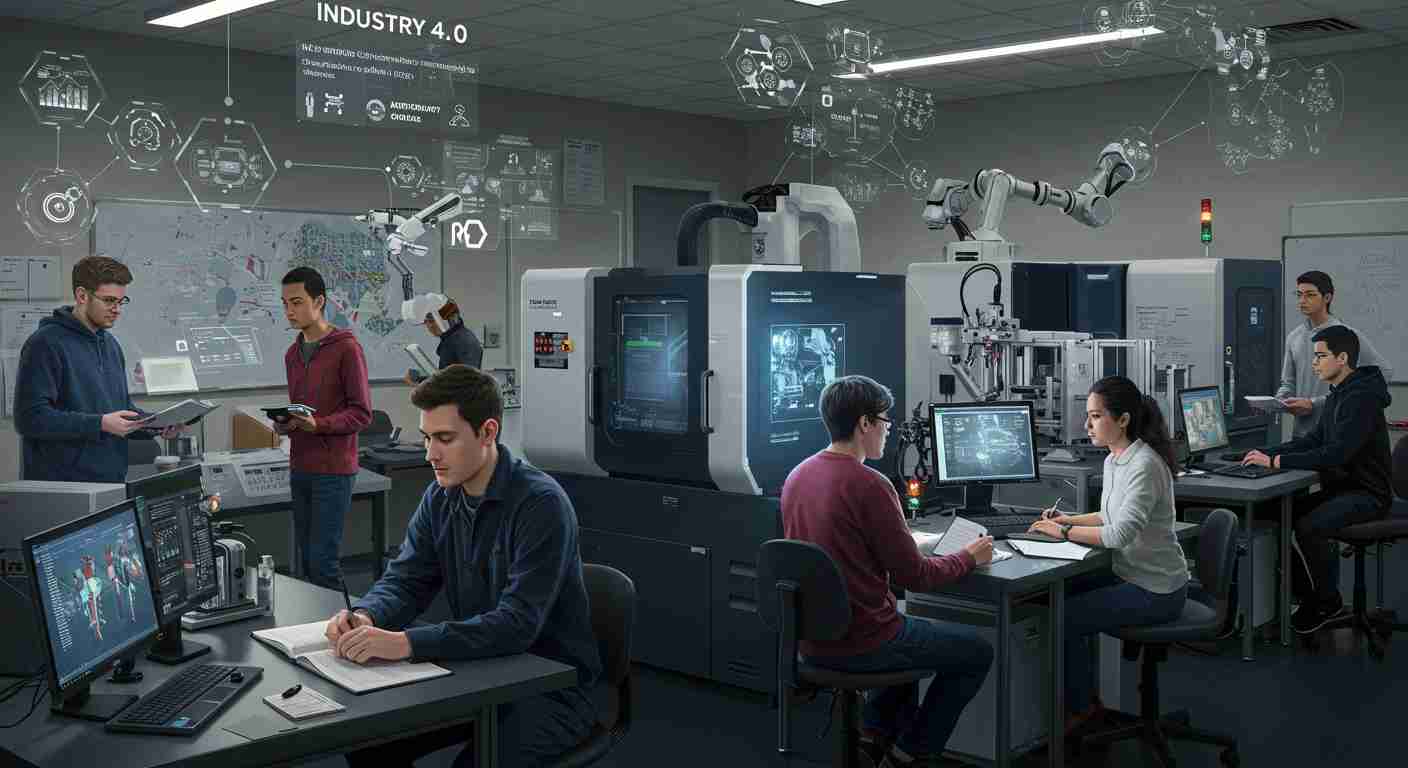
“This pathway will prepare students for a successful career with Industry 4.0 and 5.0 expertise,” said David Schneider, professor of practice in Systems Engineering. Industry 4.0 and 5.0 are shorthand for factories that combine automation, data and connected machines, with 5.0 putting more emphasis on people working alongside these systems.
How the Systems Engineering M.Eng. works
SEMI is one of several pathways in the same degree, alongside Energy Systems, Health Systems Engineering and a self-designed pathway. Pathways differ from the general degree only in which electives students take. Students can also add certificates, including Computational and Data Science, INCOSE, Six Sigma, Systems Engineering Design, Systems Engineering Specialist, and Sustainable Energy Systems Transition (Cornell Systems Engineering: M.Eng.).
| On campus (Ithaca) | Distance learning | |
|---|---|---|
| Credits | 30 | 30 |
| Pace | Full time, one year (fall and spring) | Part time, 1.5 to 2 years or more |
| On-campus time | Entire program | Two week-long core classes in Ithaca; lectures live or recorded |
| Tuition, 2026–27 | $36,973 per semester ($73,946 per year) | $2,465 per credit |
Tuition: Cornell Office of the Bursar. Living costs, health insurance and fees are extra.
The program is sizable and international. In the latest federal IPEDS completions data, Cornell awarded 202 master’s degrees in systems engineering, 121 of them to international students (Forward Pathway IPEDS database).
What international students should know
- Choose the on-campus format for a student visa. F-1 students must be enrolled full time, and only one online class per term (up to three credits) can count toward full-time study (8 CFR 214.2(f)(6)(i)(G)). The part-time distance-learning format therefore cannot be used to hold F-1 status in the United States.
- STEM OPT. Systems engineering (CIP 14.2701) is on the STEM Designated Degree Program List (SEVP STEM list). F-1 graduates of a STEM-coded degree can apply for 12 months of OPT plus a 24-month STEM extension (USCIS: STEM OPT). Confirm the CIP code on your I-20 with Cornell before you enroll.
- Funding is limited. Duffield Engineering’s M.Eng. Dean’s Fellowship covers full tuition for two semesters but gives preference to domestic applicants. Neither it nor the partial M.Eng. Committee Fellowship requires a separate application. Fall applicants who apply by February 1 are considered automatically for Duffield fellowships and scholarships, and spring applicants are considered as funding allows (Paying for your M.Eng.; M.Eng. admissions).
- Deadlines vary by program. Check the Systems Engineering admission pages for the Ithaca and distance-learning tracks for current dates and test requirements.
Cornell engineering at a glance
Cornell is No. 14 among national universities in the 2027 U.S. News Best Colleges ranking. In U.S. News’ 2026 graduate engineering rankings it is No. 11 overall, No. 8 in electrical engineering, and No. 10 in both industrial/manufacturing engineering and materials engineering. Industrial/manufacturing and materials engineering are the specialties closest to the SEMI pathway (rankings from Forward Pathway’s ranking database; see the Cornell University profile).
Update: the program in 2026–27
As of November 2026, Cornell Systems Engineering still lists SEMI among its M.Eng. pathways, with the same 30-credit structure and both formats. Tuition for 2026–27 is $73,946 a year on campus (Tier 1) and $2,465 per credit for distance learning, so 30 credits by distance cost about $73,950 in tuition (Cornell Bursar).
References
- Cornell Chronicle: New SEMI M.Eng. pathway trains systems engineers for careers in tech (May 27, 2025)
- Cornell Systems Engineering: Master of Engineering
- Cornell Duffield Engineering: Paying for Your M.Eng. Degree
- Cornell Duffield Engineering: M.Eng. Admissions
- Cornell Office of the Bursar: Tuition Rates and Fees
- 8 CFR 214.2 (F-1 full-time study and online courses)
- SEVP: STEM Designated Degree Program List
- Forward Pathway: Cornell University profile and rankings