
This article was originally reported in September 2025.
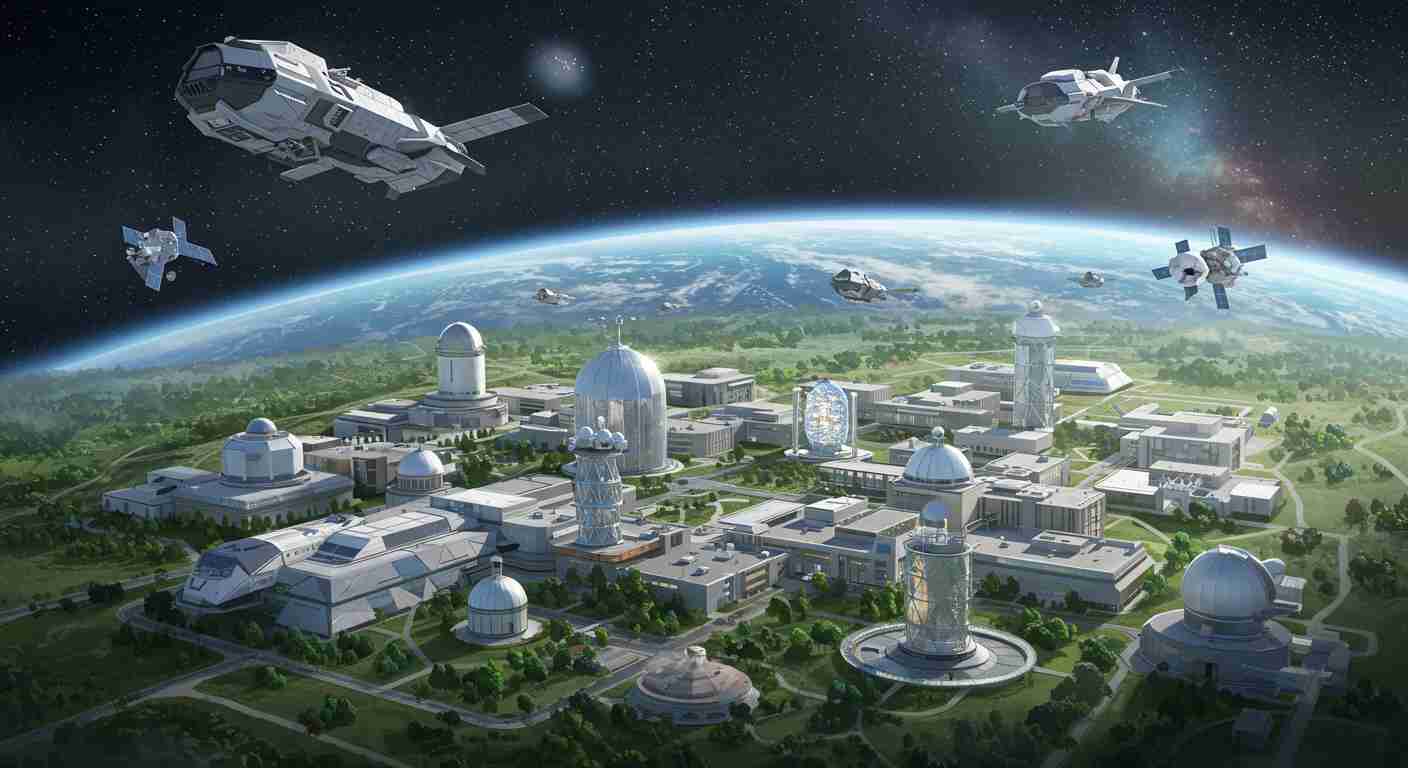
In late August 2025, Duke University‘s Trinity College of Arts & Sciences launched SPACE (Science & Policy to Advance Cosmic Exploration), a universitywide initiative to connect Duke’s research, teaching and policy work on space. It was started with an anonymous $2 million seed gift from a Duke alum (Duke Trinity College, August 27, 2025).
Who leads it and what it will do
SPACE is led by Michael Troxel and Daniel Scolnic, associate professors of physics in Duke’s cosmology group. Its board includes faculty from surgery, biology, electrical and computer engineering, history, physics, law and environmental policy, and economics, and participating units range from the Pratt School of Engineering and the Sanford School’s Space Diplomacy Lab to the Fuqua School of Business, the Law School, the Nicholas School of the Environment and the School of Medicine. The initiative’s stated goals are to:
- advance research on fundamental questions about the universe and on space technology and policy;
- hold workshops, a monthly seminar series, an annual Duke Space Symposium and talks by outside speakers;
- support multi-institution grant proposals to foundations and federal agencies;
- develop and manage at least one interdisciplinary master’s program in space science;
- act as a public hub for space events and build partnerships with universities and companies in North Carolina’s Research Triangle.
Duke noted that the space economy was valued at $630 billion in 2023 and is projected to reach $1.8 trillion by 2035. Dean Gary Bennett called the initiative “a recognition of the breadth and depth of work already underway across Trinity College and Duke University,” and Scolnic said, “This gift will create new opportunities for collaboration and learning” (Duke Trinity College).
The initiative held its public kickoff on September 8, 2025, at Penn Pavilion, with a keynote by Anna Menon, a Duke alumna, astronaut and former lead space operations engineer at SpaceX (Duke Biology).
Latest update
SPACE held the 2026 Duke Space Symposium, “Imagining Futures,” on March 19–20, 2026, hosted by the Sanford School of Public Policy. Sessions covered cosmology and the search for dark matter, science fiction and the cultural history of space, the risks of human settlement off Earth, the search for extraterrestrial life, the engineering challenges of the new space race, space debris and preventing armed conflict in space (Duke SPACE Initiative). As of November 2026, Duke had not announced admissions for the planned space science master’s program; check the SPACE Initiative website for updates.
What students interested in space should know
- Space is not only aerospace engineering. Duke’s initiative includes physics, biology, medicine, law, policy, history and business faculty. Students can approach space careers from many majors, for example astrophysics, electrical engineering, public policy or environmental science.
- Look for seminars and research groups. At universities with a space initiative, the seminar series and symposium are an easy way for undergraduates and graduate students to meet faculty working on space topics and find research opportunities.
- Check rules for space-related research. Some space and defense technology work is subject to U.S. export controls, which can limit the projects international students join. Ask the faculty member or research office before committing to a project.
- About Duke: Duke ranks No. 8 among national universities in the 2027 U.S. News Best Colleges rankings (No. 7 in the 2026 edition) (Forward Pathway rankings). See our Duke University school page for admissions, costs and international enrollment.