
This article was originally reported in October 2025.
Virginia Tech announced in October 2025 that more than half of its undergraduate majors now require a “bridge experience” (hands-on, career-related learning such as an internship, co-op, research or study abroad) to graduate. The university reached the goal of its Bridge Experience Program more than a year ahead of its spring 2027 target (Virginia Tech News, October 7, 2025).
What Virginia Tech announced
- Scale: as of fall 2025, 37 degree programs in 13 departments were part of the Bridge Experience Program, and the university estimated that about 4,000 students would take part in bridge experiences by the end of the following academic year.
- Origin: the program began in 2021 as Virginia Tech’s Quality Enhancement Plan, the university-wide initiative to improve student learning that is required as part of reaccreditation.
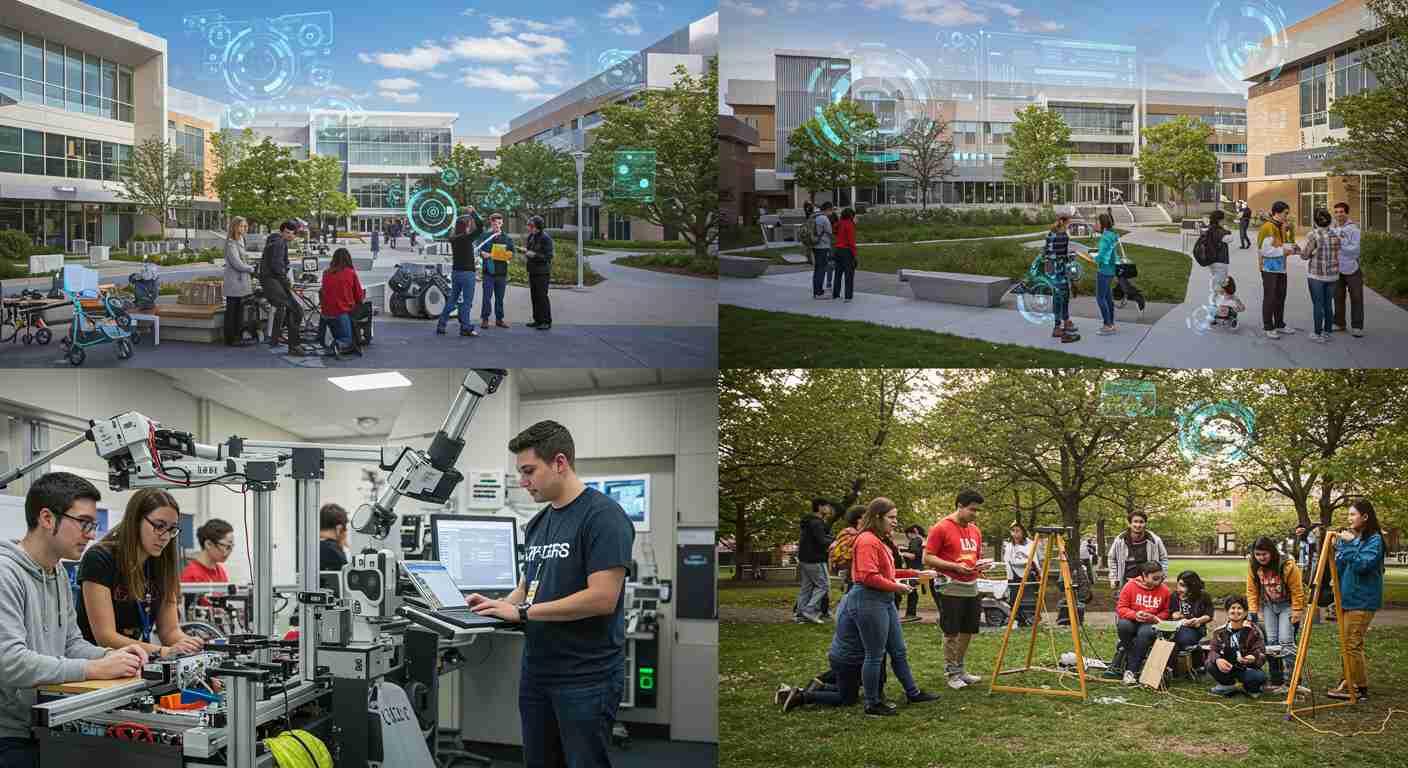
- What counts: faculty-mentored research in a campus lab, paid internships, co-ops with companies, study abroad, and service learning with local nonprofits.
- No extra cost or time: participating departments offer sections of a zero-credit, no-cost “3900” course built into the major, so the requirement fits into a four-year plan without adding tuition or delaying graduation.
“The purpose of a bridge experience is to connect our students’ experience in the classroom to their future career,” said Keri Swaby, assistant vice provost for experiential education. Jill Sible, vice provost for undergraduate academic affairs, called hands-on learning “a strong predictor for success after they leave the university” (Virginia Tech News).
Support for internships
Career and Professional Development, now part of the Office of Undergraduate Academic Affairs, supports qualifying internships. According to the announcement:
- the Cooperative Education and Internship Program partnered with 156 companies in the previous year;
- Campus internEXP is a hiring platform for paid internships on campus;
- the Ut Prosim Internship Support Fund gives grants of up to $5,000 for internships in Virginia that serve the public good, covering costs such as transportation, housing and required equipment, and provided about $80,000 in the spring and summer of 2025.
The program also supports Virginia Tech Advantage, the university’s commitment to expanding opportunities for Virginia undergraduates with financial need. A fifth cohort of faculty began working with the university’s Academy for Experiential Learning in fall 2025, and the long-term goal is for every degree program to include meaningful experiential learning.
Latest update
The program has kept growing in 2026. The Spring 2026 issue of the college’s magazine, Virginia Tech Engineer, says every College of Engineering undergraduate will be required to complete a bridge experience before graduating. Students begin planning in first-year engineering courses, and after securing an internship, co-op, research position or study abroad placement they enroll in ENGE 3900, a zero-credit online course in which they reflect on what they learned. Students profiled in the issue included a junior in construction engineering on a 12-week data-center construction internship and a senior in industrial and systems engineering on a spring 2026 co-op with Walt Disney Imagineering (Virginia Tech Engineer, Spring 2026). The program’s website listed 32 departments and degree programs in the program and invited applications for its next faculty cohort from January 14 to March 13, 2026 (Virginia Tech Experiential Learning: Bridge departments).
What international students should know
- Not every bridge experience needs work authorization. Undergraduate research on campus, study abroad and many service-learning projects can satisfy the requirement without off-campus employment. On-campus jobs do not require CPT for F-1 students.
- Off-campus internships and co-ops require Curricular Practical Training (CPT). After SEVP guidance issued on August 12 and August 24, 2026, which limits CPT to training that is a required part of the curriculum, Virginia Tech’s Cranwell International Center paused new CPT authorizations while it reviews which programs and courses meet the federal standard. Students already authorized for the current semester were not affected. Under Cranwell’s rules, F-1 students must be enrolled full-time for at least one academic year (two semesters) before CPT employment begins (Virginia Tech Cranwell International Center: CPT; SEVP Broadcast 2608-01).
- Plan early. If your major has a bridge requirement, ask your department’s bridge contact and Cranwell which options are open to F-1 students, and line up a research or study abroad alternative in case an off-campus internship cannot be authorized in time.
Virginia Tech ranks No. 52 among national universities in the 2027 U.S. News ranking. See our Virginia Tech page for admissions, cost and enrollment data, and our guide to Virginia Tech’s Campus internEXP on-campus internships.
References
- Virginia Tech News: Bridge Experience Program reaches key milestone (October 7, 2025)
- Virginia Tech Engineer: Bridge Experience Program (Spring 2026)
- Virginia Tech Experiential Learning: Bridge departments and programs
- Virginia Tech Cranwell International Center: Curricular Practical Training
- SEVP Broadcast Message 2608-01 (August 12, 2026)
- Forward Pathway: U.S. College Rankings