
Nursing is one of the most structured undergraduate majors in the United States: students take a fixed sequence of science and nursing courses, spend hundreds of hours in hospitals and clinics, and must pass a national licensing exam before they can work. This guide explains how a U.S. Bachelor of Science in Nursing (BSN) works as of November 2026, using the University of Connecticut’s nursing school and one 2025 graduate’s experience as an example, and sets out what international students should know before choosing nursing in the U.S.
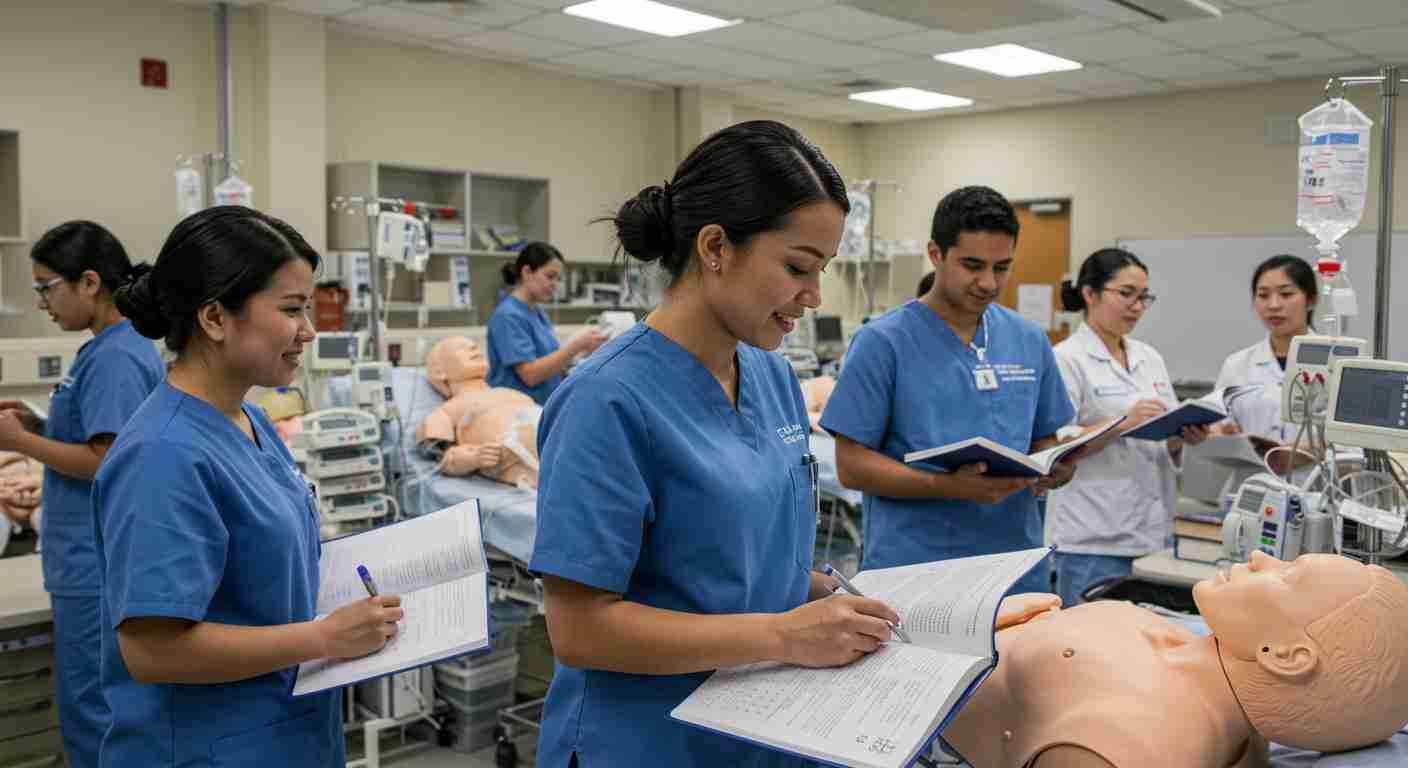
One graduate’s view: UConn, class of 2025
In a May 2025 Q&A with UConn Today, graduating nursing senior Samuel Geisler summed up his time at the University of Connecticut School of Nursing in three words: “Fun, collaborative, and short.” He said the professors were approachable and knowledgeable and wanted students to succeed, and that his fondest memory was his first days of clinical training, when he first applied what he had learned in his first two years to real patient care (UConn Today, May 2025).
Geisler competed on UConn’s track team throughout the program and had a job in his preferred specialty before graduating: he was starting in the emergency department at Connecticut Children’s hospital and hoped to return later for a master’s degree. His biggest takeaway came from a patient who had recently lost a spouse. He spent 30 minutes talking with the patient, who later thanked him for making them feel less alone. His advice to incoming students: “Enjoy the ride. Don’t take anything for granted.”
Geisler was one of 110 bachelor’s graduates at the school’s May 10, 2025 ceremony, alongside 85 master’s, 19 Doctor of Nursing Practice and 2 Ph.D. graduates (UConn Today, May 12, 2025).
How a U.S. BSN is structured
- Prerequisites and foundation years. The first part of a BSN usually covers general education plus sciences such as anatomy and physiology, microbiology, chemistry and statistics, along with introductory nursing courses. As Geisler’s account shows, at UConn the first two years build this foundation before clinical rotations begin.
- Clinical rotations. In the later years, students rotate through supervised placements in areas such as adult medical-surgical care, pediatrics, maternity, mental health and community health. Clinical schedules can include early mornings, evenings and weekends.
- Licensure exam. To work as a registered nurse (RN), graduates need a license from the state where they will work, which requires graduating from an approved nursing program and passing a licensing exam (BLS). That exam is the NCLEX-RN, administered for state boards of nursing by the National Council of State Boards of Nursing (NCSBN).
- Other routes. Besides the BSN, people can become RNs through an associate degree in nursing or, less commonly, a hospital diploma program. Many hospitals prefer BSN graduates, and accelerated second-degree BSN programs exist for people who already hold a bachelor’s degree in another field.
Careers and pay
Registered nursing is one of the largest occupations in the U.S. In May 2025, 3,379,720 RNs earned a median of $97,550 a year, with the middle half earning between $80,330 and $112,350 (BLS OEWS, May 2025). Nurse practitioners, who need a graduate degree, earned a median of $132,300 (BLS OEWS). The BLS projects RN employment to grow 6% from 2025 to 2035, faster than the average for all occupations, with about 180,800 openings a year (BLS Occupational Outlook Handbook).
Many RNs later earn a master’s or Doctor of Nursing Practice degree to become nurse practitioners, nurse anesthetists, nurse-midwives, nurse educators or managers, which is the path Geisler said he hoped to take.
What international students should know
- Admission is competitive and capacity-limited. Nursing programs are limited by the number of clinical placements they can arrange. At UConn, applications to the nursing school rose from almost 3,900 in 2024 to more than 4,700 in 2025 for about 225 first-year places (UConn Today, September 2025). Check whether a program admits students directly as first-years or only after prerequisite courses.
- Clinical requirements. Before clinical placements, students typically need immunization records, a background check and CPR certification. Ask each school how it handles these requirements for students whose records come from abroad.
- Work after graduation. Nursing is not on the DHS STEM list, so F-1 graduates generally have 12 months of OPT rather than 36. Longer-term employment is harder: U.S. immigration authorities have long held that most staff RN positions are not H-1B “specialty occupations” because they do not normally require a bachelor’s degree, although specialized roles and advanced practice nursing positions such as nurse practitioners and nurse anesthetists can qualify (Littler, summarizing USCIS policy). Many foreign-educated nurses instead come to the U.S. through employer-sponsored green cards. Discuss your long-term plans with an immigration attorney or your school’s international office before committing.
- Licensure outside the U.S. A U.S. BSN and RN license are not automatically recognized in other countries. If you may return home, check what your home country’s nursing regulator requires for internationally educated nurses.
UConn nursing at a glance
- Renamed school: In 2025 UConn alumna Elisabeth DeLuca, a 1969 nursing graduate, gave $50 million, the largest gift in UConn’s history, and the school was renamed the Elisabeth DeLuca School of Nursing. About $20 million of the gift goes to construction of a new nursing building scheduled to open in fall 2026, about $5 million to equipment, and about $25 million to scholarships and programs. The school enrolls about 900 students a year (UConn Today; The Daily Campus, October 2025).
- Rankings: UConn’s BSN program ranks No. 36 in the U.S. News 2027 undergraduate nursing ranking, and the university ranks No. 73 among national universities (Forward Pathway’s US Colleges Ranking).
- University data: For fall 2025, UConn admitted 29,065 of 55,479 first-year applicants (about 52%) university-wide and enrolled 1,487 international undergraduates. Out-of-state tuition for 2025–26 was $39,678 plus $4,034 in fees (IPEDS).
See Forward Pathway’s University of Connecticut profile for more admissions and cost data.
References
- School of Nursing Class of 2025 Reflects on Their Time as a Husky – UConn Today, May 2025
- UConn School of Nursing Celebrates Its 2025 Graduates – UConn Today, May 12, 2025
- UConn Planning to Rename Its School of Nursing in Honor of Alumna Elisabeth DeLuca – UConn Today, September 10, 2025
- UConn School of Nursing Renamed to Honor Alumna – The Daily Campus, October 7, 2025
- Registered Nurses – BLS Occupational Outlook Handbook
- Registered Nurses (29-1141) – BLS Occupational Employment and Wage Statistics, May 2025
- NCLEX – National Council of State Boards of Nursing
- USCIS Policy Memo Provides Guidance on Use of H-1B Petitions for Nursing Positions – Littler
- University of Connecticut – Forward Pathway school profile