
Money management is one of the first practical challenges of studying in the U.S. Many universities now run financial wellness programs that offer free coaching, workshops and tax help. This guide uses the University of Maryland’s Financial Wellness Center as an example of what a campus program can offer, then covers the money rules and habits that matter most for international students: budgeting against your school’s cost of attendance, work limits on an F-1 visa, taxes and scams.
Example: UMD’s Financial Wellness Center
The University of Maryland, College Park, launched a Financial Wellness Center at its Robert H. Smith School of Business in spring 2025, starting with workshops in April, National Financial Literacy Month. It is co-directed by Associate Clinical Professor Michael McMillan and Senior Lecturer Samuel Handwerger. McMillan said, “This is not just a business school project—this belongs to the whole university” (Maryland Today, April 3, 2025). Its main features are:
- Peer mentoring. Students trained through a financial peer mentoring course (open to all majors) meet one-on-one with other students about budgeting, investing, loans and financial planning. Mentors give guidance rather than specific financial advice.
- Workshops and events, including budgeting sessions, orientation tips for new students and a “Senior Send-off Week” for graduating students on tenant and landlord rights, student loan repayment and credit cards.
- TerpTax, a free student-run tax preparation program led by Handwerger. Its IRS-certified volunteers help low-income and international community members file their returns; volunteers who help international students need an additional certification. TerpTax prepared about 1,400 returns in 2024 (WTOP, February 28, 2025).
- Courses in personal and family finance in the School of Public Health, a stock investing class in the College of Behavioral and Social Sciences, and McMillan’s two campus-wide online personal finance courses.
Latest: in May 2026 the center opened a Financial Wellness Hub on the first floor of McKeldin Library, with a workshop area and a room for one-on-one sessions. Ten peer mentors staff it, each certified by the Institute of Financial Literacy, a national nonprofit. Partners include the Division of Student Affairs, University Libraries and Maryland’s State Employees Credit Union (SECU), and the hub works with Student Affairs’ Thrive Center for Essential Needs (Maryland Today, May 6, 2026).
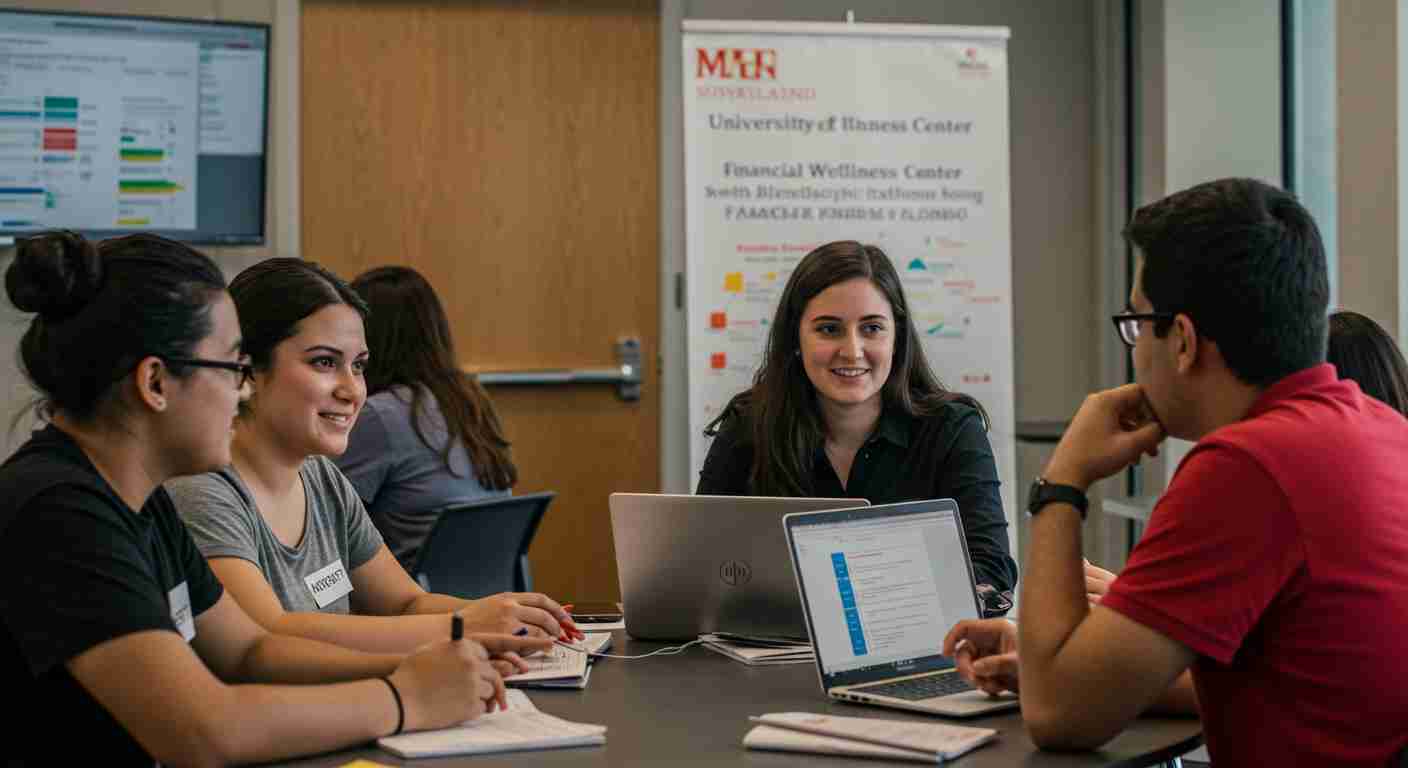
Most large universities have something similar, often under the financial aid office, student affairs or the business school. Search your school’s website for “financial wellness” or “financial literacy” and check whether it offers free coaching or tax help.
Money basics for international students
1. Budget against the full cost of attendance
Schools issue an I-20 only after you document funds for a year of tuition, fees and living costs (see, for example, Rutgers’ financial statement form), so start your budget from your school’s full cost of attendance, not just tuition. At UMD, for example, out-of-state tuition in 2025–26 was $39,464 plus $1,722 in required fees, and on-campus room and board was $15,958 (IPEDS). International students generally cannot get U.S. federal student aid (NYU Steinhardt FAQ), so plan for the full amount from family funds, scholarships or private loans, and expect tuition to rise each year.
A simple monthly budget for students covers:
- fixed costs: rent or housing payments, meal plan, phone and health insurance;
- variable costs: groceries, transportation, books and supplies;
- one-off costs: flights home, visa fees, deposits for off-campus housing;
- an emergency buffer, because transferring money from home can take days.
2. Know your work limits
On an F-1 visa, you may work on campus with approval from your designated school official, but “you may not work more than 20 hours per week when school is in session.” Off-campus work needs separate authorization, for example economic hardship authorization, which is available only after a full academic year and requires USCIS approval (Study in the States). Do not plan your budget around income you are not allowed to earn.
3. File your tax forms every year
- Most F-1 students are “exempt individuals” for the IRS substantial presence test during their first five calendar years in the U.S. and must file Form 8843 for each year, even with no U.S. income. If you also file a tax return, attach Form 8843 to it; if not, mail it on its own (IRS: Exempt Individual – Who Is a Student).
- There is no minimum income that triggers a filing requirement for a nonresident alien. You must file if you have, for example, wages, a taxable scholarship or fellowship, or income that is exempt under a tax treaty, because treaty-exempt income still has to be reported (IRS: Foreign Students and Scholars).
- Ask your international student office what tax help it offers; volunteer programs such as UMD’s TerpTax prepare returns for international students.
4. Protect yourself from scams
DHS warns that scammers call international students pretending to be DHS or other government officials. The calls can show real government numbers on caller ID, threaten arrest or deportation, and demand payment by wire transfer, gift card or cryptocurrency. DHS never asks for fees by phone or email. If you get such a call, do not share personal or bank information or send money; hang up, contact your designated school official and report it to the ICE Tip Line at 1-866-347-2423 (Study in the States, February 2026).
5. Use campus help early
If you run short of money, talk to your international student office and your school’s financial wellness or basic-needs office before you fall behind on rent or tuition. At UMD, a peer mentor helped one student find a way to avoid taking a semester off to work (Maryland Today).
University of Maryland at a glance
UMD ranks No. 49 among National Universities in the 2027 U.S. News ranking and No. 82 in the 2027 U.S. News Best Global Universities. For fall 2025 it admitted 26,902 of 60,056 first-year applicants (about 45%), and it enrolled 41,725 students, including 4,889 international students (IPEDS). See our University of Maryland-College Park school page for admissions and cost data.
References
- Building Financial Literacy, One Terp at a Time (Maryland Today, April 3, 2025)
- Financial Wellness Center Hub Opens in McKeldin Library (Maryland Today, May 6, 2026)
- Certified TerpTax volunteers help students file returns (WTOP, February 28, 2025)
- Working in the United States (DHS Study in the States)
- Exempt Individual – Who Is a Student (IRS)
- Foreign Students, Scholars, Teachers, Researchers and Exchange Visitors (IRS)
- Beware of DHS Imposters: Protecting Foreign Students from Scams (DHS Study in the States, February 2026)
- University of Maryland-College Park (Forward Pathway school page; IPEDS admissions, enrollment and cost data)