
Electric scooters, e-bikes and ordinary bikes are among the easiest things to steal on a U.S. campus: they are valuable, light, easy to resell and often left outside residence halls and classroom buildings. Losing one can cost hundreds or thousands of dollars, and for international students without a car it can also mean losing your main way of getting around. This guide covers how often these thefts happen, what campus police recommend, the battery and housing rules many universities now enforce, and what to do if your ride is stolen.
How common is it?
- Los Angeles and USC. LAPD data analyzed by Crosstown showed 1,046 reports of stolen e-scooters and other motorized devices, including e-bikes, in Los Angeles in 2024, up 22.3% from 2023 and more than four times the 2021 count. University Park, the neighborhood around the University of Southern California, had the most reports of any neighborhood, 206, up 22.6%, with jumps at the start of the fall and spring semesters. The real number is likely higher because not every theft is reported and LAPD was moving to a new records system in 2024 (Crosstown, February 27, 2025).
- California State University, Long Beach. E-bikes and e-scooters accounted for 25 of the 35 motor vehicle thefts reported on campus in 2024 and 44% of on-campus incidents, the largest share of any crime. 2024 was the first year these devices were counted as motor vehicles (Long Beach Current, November 21, 2025).
- Virginia Tech. In April 2025, Virginia Tech police issued a crime alert after four electric scooters were stolen around residence halls on the Blacksburg campus in a single evening (Virginia Tech News, April 25, 2025).
USC Department of Public Safety Assistant Chief David Carlisle told Crosstown that “thieves will typically look for the scooters that are unlocked” and that popular electric scooters “are easy to sell to unscrupulous buyers.”
How to protect your scooter or bike
- Use a U-lock, not a cable lock. Virginia Tech police say most U-locks resist hacksaws and bolt cutters, and CSULB Police Chief John Brockie said “most of the locks that are defeated are cable locks.” A property manager quoted by Crosstown also recommended case-hardened chains or ceramic-coated U-locks.
- Lock it to a bike rack, every time. Lock the frame to a fixed rack so the scooter cannot be ridden or carried away. Brockie advises locking up even for short stops, because many thefts are crimes of opportunity.
- Register it with campus police. USC DPS encourages owners to register their devices, and CSULB’s Bike U-Lock Program lets students register bikes and e-bikes with University Police and get a free U-lock. Write down the serial number and keep photos and the receipt.
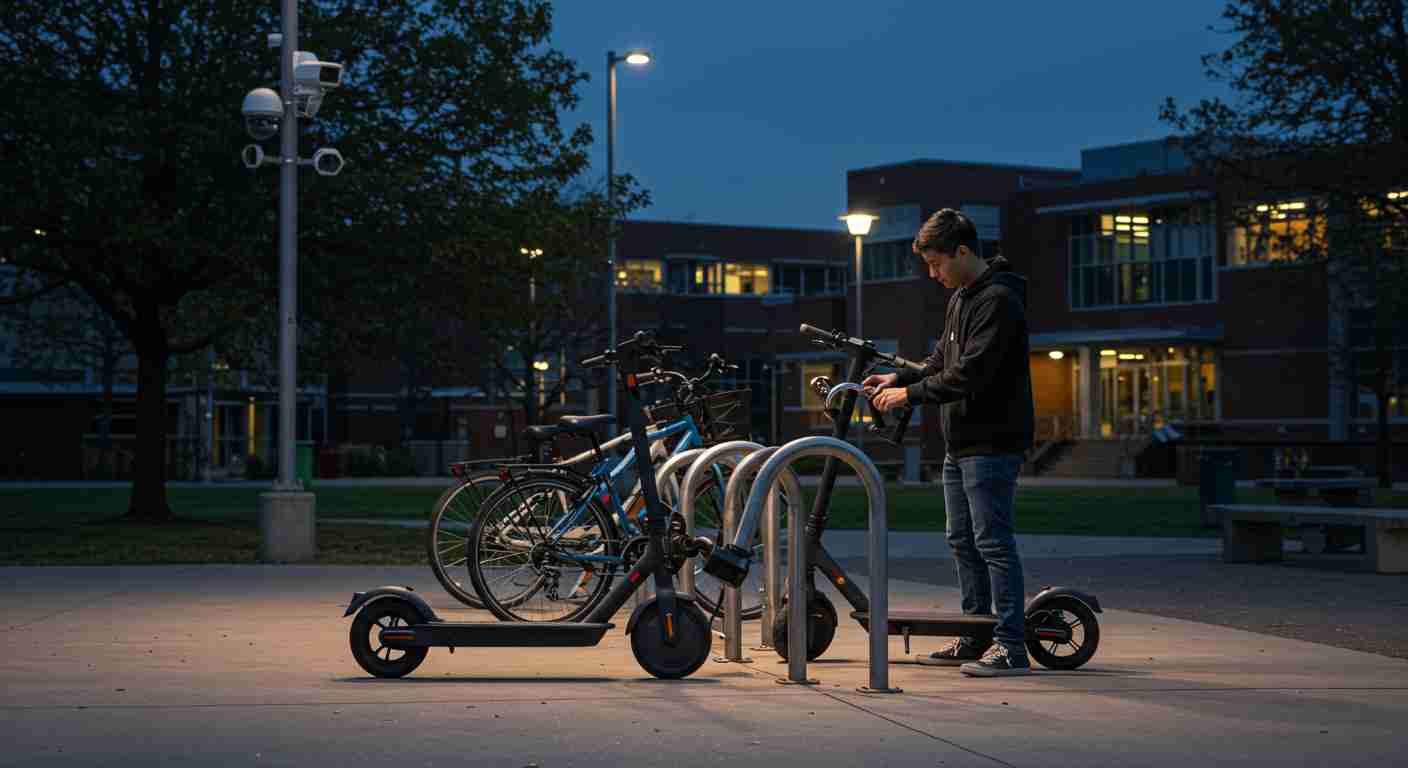
- Park where people and cameras are. Use busy, well-lit racks near building entrances rather than isolated corners, and bring removable batteries or displays inside where your housing rules allow it.
- Consider a hidden tracker. A small Bluetooth or GPS tracker hidden on the frame can help police find a stolen device, although a thief may find and remove it.
Check your campus rules before you buy
Because lithium-ion batteries can overheat or catch fire if damaged, badly made or charged improperly, many universities now limit where e-scooters and e-bikes can be parked, stored and charged. Rules differ a lot between schools, so check yours before you buy or ship a device:
- University of Pittsburgh: from August 1, 2026, e-scooters may not be parked, stored or ridden on university property, with fines of $100 and then $200 and possible impoundment. E-bikes may use outdoor racks and a charging area in one garage but are not allowed inside any university building, including residence halls (University of Pittsburgh).
- William & Mary: under a policy approved in September 2026, devices may not be brought into or stored in residence halls without permission, charging must happen off campus, and every device must carry a certification mark from a nationally recognized testing laboratory, such as UL 2849 for e-bikes or UL 2272 for e-scooters (William & Mary).
Mobility devices used for a disability are usually handled through the school’s disability services office. The U.S. Consumer Product Safety Commission has also urged manufacturers and sellers to make sure e-bikes and e-scooters are certified to UL 2849 or UL 2272 (CPSC, December 2022). A certified device is safer and is more likely to meet campus rules.
If your scooter or bike is stolen
- Report it to campus police right away, or to city police if it was taken off campus. Give the serial number, photos, lock type and the time and place you last saw it. Virginia Tech, for example, asks people to call its police line or 911 and also accepts anonymous tips online.
- Keep the report number. You will need it for an insurance claim, and it helps police match a recovered device to you.
- Check tracker apps and resale sites, but let police handle recovery rather than confronting anyone yourself.
- Read your school’s crime alerts. Campus police post timely warnings when there is a pattern of thefts, which tells you which racks or buildings to avoid.
Tips for international students
- Check local law as well as campus rules. Pittsburgh, for example, cites state law and the fact that the city does not currently authorize e-scooters on its streets as reasons for its campus ban.
- Find out whether your renters or personal property insurance covers a stolen bike or scooter, and what the deductible is, before you need to file a claim.
- Buy from a seller who can show the device’s safety certification, and avoid uncertified batteries or chargers.
For more on student life and safety at specific schools, see our school pages, such as the University of Southern California page.
References
- Electric scooter thefts skyrocket across Los Angeles (Crosstown, February 27, 2025)
- Lock it or lose it: E-bike, e-scooter thefts increase on campus (Long Beach Current, November 21, 2025)
- Crime alert: Theft (Virginia Tech News, April 25, 2025)
- E-Scooters & E-Bikes (University of Pittsburgh)
- Micromobility/Personal Mobility Device Policy (William & Mary)
- Important Safety Information Concerning Micromobility Devices (U.S. Consumer Product Safety Commission, December 2022)