
This article was originally reported in September 2025.
The University of California San Diego received a three-year grant of nearly $1 million from the National Science Foundation (NSF) to launch ExSTENT, a summer training program that brings community college students into a university cleanroom to learn semiconductor fabrication, the university announced on September 25, 2025 (UC San Diego Today, September 25, 2025).
What ExSTENT is
ExSTENT stands for Experiential Semiconductor Training in Emerging Nano-Technologies. It is funded by NSF’s Experiential Learning for Emerging and Novel Technologies (ExLENT) program for 2026 through 2028, and it was UC San Diego’s second NSF semiconductor workforce grant of 2025, after a $300,000 award for its SEMI University program. The principal investigator is Riley Need, a research specialist at the Qualcomm Institute (QI), and the co-principal investigator is Oscar Vazquez Mena, a professor in the Department of Chemical and Nano Engineering (UC San Diego Today).
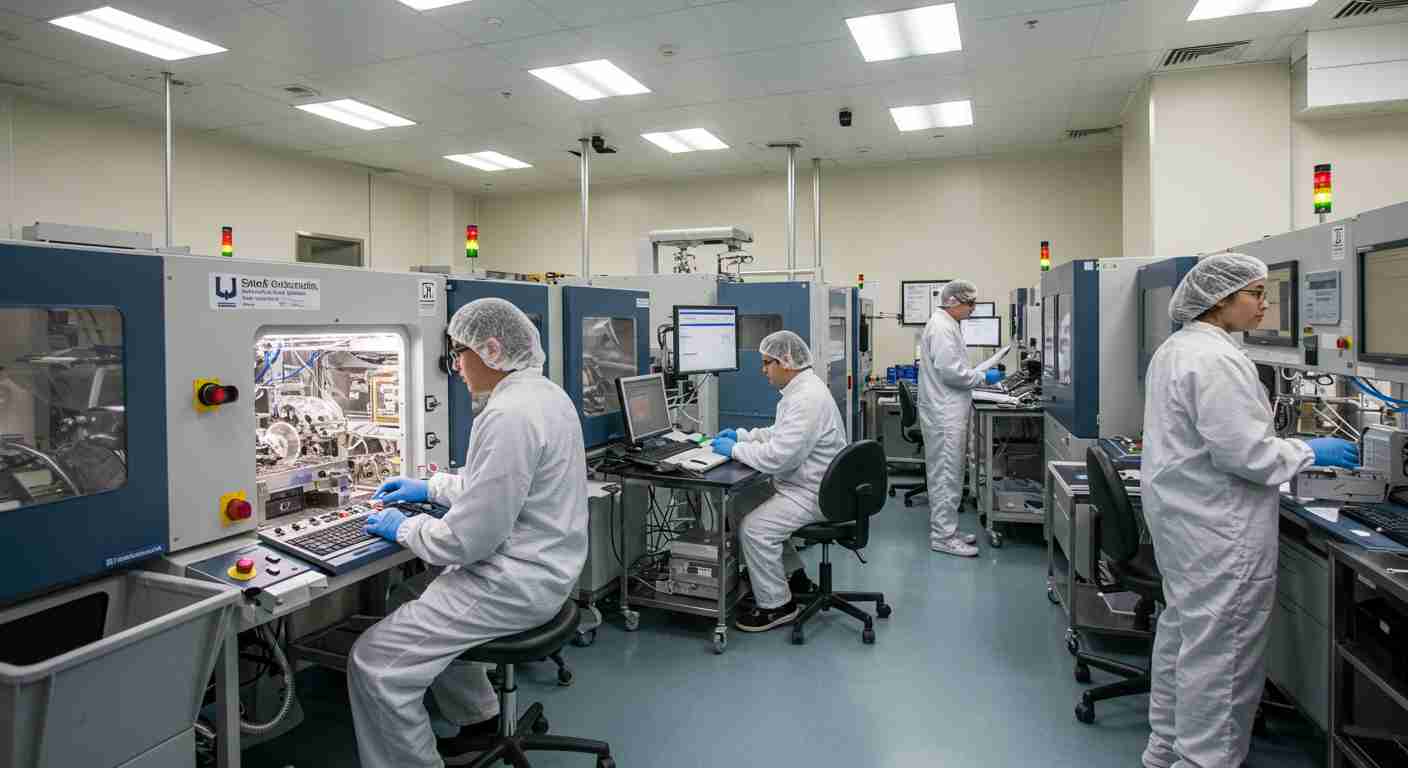
- Who: 20 to 30 community college students each summer, a group that often lacks access to advanced labs and cleanrooms.
- Format: a nine-week summer intensive with stipends and travel support, beginning with a first cohort in summer 2026.
- Where: QI’s Nano3 cleanroom and the campus Makerspace, using research-grade tools under expert supervision.
- What students learn: core fabrication steps, including lithography, film deposition and etching, plus electrical characterization of devices, applied to biosensors, solar cells and quantum devices, with exposure to sectors such as biotechnology, solar energy and quantum circuits.
- Industry links: students work with local companies through cross-sector partnerships.
In later years, the team plans to bring in community college teachers to develop hands-on semiconductor modules for classrooms across Southern California. To keep the program going after the grant, it may transfer its modules and curriculum to interested community colleges or publish an open-source toolkit.
Why it matters
Need cited a projected demand for 115,000 new U.S. semiconductor workers by 2030, about 60% of them in technician and entry-level engineering roles, and estimated that about 67,000 of those jobs could go unfilled without targeted training (UC San Diego Today). Programs like ExSTENT aim to give community college students, who make up much of the technician pipeline, hands-on cleanroom experience before they enter the workforce or transfer to a four-year degree.
Semiconductor study options for international students
- Check eligibility first. ExSTENT is designed for community college students; UC San Diego’s announcement does not describe citizenship requirements, so international community college students should ask the program directly. Paid summer programs can also count as employment, so F-1 students should check with their designated school official before accepting a stipend.
- Four-year and graduate routes. UC San Diego ranks No. 29 among national universities in the U.S. News 2027 edition (Forward Pathway’s US Colleges Ranking), and its Nano3 cleanroom serves research in nanoengineering and related fields. Other universities are building semiconductor-focused graduate options; see our report on Cornell’s semiconductor pathway in its Systems Engineering M.Eng. and Purdue’s NSF chip design hub.
References
- UC San Diego Today: UC San Diego Awarded Nearly $1M NSF Grant to Launch Semiconductor Workforce Training Program (September 25, 2025)
- Forward Pathway: Cornell Adds a Semiconductor and Manufacturing Pathway to Its Systems Engineering M.Eng.
- Forward Pathway: Purdue’s Chipshub Named NSF Chip Design Hub with $7 Million Award