
This article was originally reported in March 2025.
MIT’s Department of Aeronautics and Astronautics (AeroAstro, or Course 16) has added a hands-on laboratory class in which undergraduates design, build and test a rocket engine component. The course, 16.811 Advanced Manufacturing for Aerospace Engineers, was first offered in fall 2024 and was described by MIT News in March 2025 (MIT News, March 28, 2025).
What students do in 16.811
16.811 is a 13-week, communication-intensive lab course for juniors and seniors who have completed Unified Engineering, the department’s foundational sequence. Demand in the first year was high enough that places were allocated by lottery. Working in teams of two or three, students design, build and test a laboratory-scale electric turbopump, the kind of pump used in liquid-fueled rockets to deliver fuel and oxidizer to the combustion chamber at high pressure. Teams manage the whole production process themselves, including budgeting, documentation and testing, and use advanced tools such as metal 3D printing (MIT News).
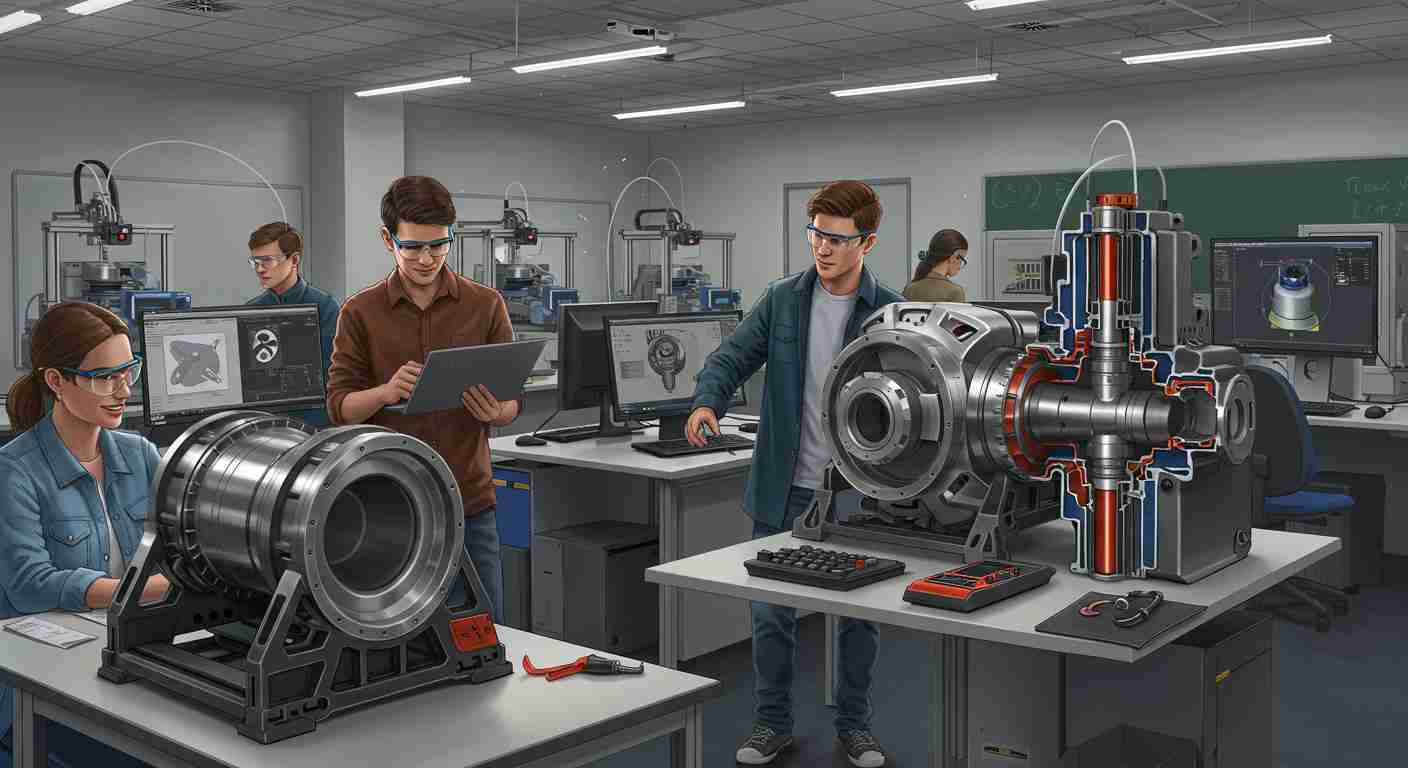
The course is organized into three labs:
- Impellers: the rotating bladed disk that pressurizes the fluid.
- Rotor system: the assembly that supports the impeller.
- Integration and testing: combining the rotor with the casing and testing the finished pump.
Students learn machine shop tools in the Arthur and Linda Gelb Laboratory; their impellers were printed at MIT’s SHED (Safety, Health, Environmental Discovery) lab; Desktop Metal is an industry collaborator; and teams use Concepts NREC’s Agile Engineering Design System and Advanced Rotating Machine Dynamics software for machinery analysis. Teams also work with outside vendors to produce parts. Work is assessed through written lab reports, regular progress presentations and a final presentation to MIT instructors and industry representatives.
Why MIT created the course
The course was developed and is co-taught by Zachary Cordero, the Esther and Harold E. Edgerton Associate Professor, and Zoltán Spakovszky, the T. Wilson Professor in Aeronautics, with lecturer Jessie Stickgold-Sarah teaching professional communication. It was built over two years of Independent Activities Period (IAP) workshops and grew out of feedback at an annual summer workshop Cordero organizes on materials challenges in reusable rocket engines, where attendees from industry, government and academia said future engineers need familiarity with advanced design tools and processes such as additive manufacturing on top of strong fundamentals. The course uses concurrent engineering to connect fundamentals, functional requirements, design, materials and manufacturing (MIT News).
- “They don’t just learn how to solve a problem set — they learn how to be an engineer,” Cordero said, adding: “In the real world, things are leaking.”
- “The key differentiator here is that there is no solution,” Spakovszky said. “They are pushed to learn how to learn on their own.”
- Junior Danishell Destefano said, “I learned a lot about how to read technical literature and compare design trade-offs to make my own decisions,” and named time and project management as the biggest skill she gained.
Studying aerospace engineering at MIT
- Rankings: MIT is No. 1 in U.S. News’s undergraduate aerospace engineering ranking (2027) and No. 1 in the graduate aerospace engineering ranking (2026 edition). It is also No. 1 among national universities in the 2027 U.S. News rankings and No. 1 in QS World University Rankings 2027 (Forward Pathway ranking database).
- Admissions: for fall 2024, MIT received 26,904 first-year applications and admitted 4.7% (IPEDS).
- International students: in fall 2025 MIT enrolled 11,886 students, including 3,455 international students; 529 of the 4,535 undergraduates were international (IPEDS).
- Cost and aid: 2025–26 tuition and fees were $62,396, plus about $20,280 for room and board (IPEDS). MIT says it is one of very few U.S. institutions that are need-blind and meet full demonstrated need for all undergraduates, domestic and international; from 2025–26, students from families earning under $200,000 a year typically pay no tuition (MIT Student Financial Services).
See our Massachusetts Institute of Technology page for more admissions and cost data.